Ardha Chandrasana: An Open Heart

11 Aug

I’m not shy about my love for Ardha Chandrasana, or, Half Moon Pose.  To my heart, it is the embodiment of grace and peaceful power. And there are variations to serve students of all levels that still allow each to receive the bliss of this expansive, radiant posture.

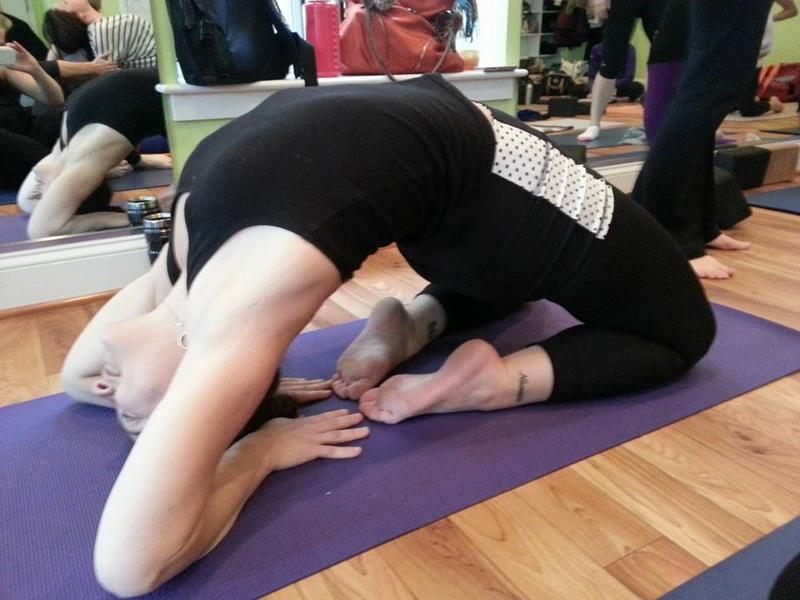
On a physical level, the benefits of this posture are numerous and rich: The muscles of the standing leg are strengthened as that leg acts as the main point of structural stability in the balance. The practitioner grounds through the whole foot, engages the quadriceps to allow the hamstrings to lengthen, and engages the muscles around the calf to stabilize the ankle. The muscles of the raised leg are also engaged. The foot flexes strongly so that all five toes point back evenly and the muscles of the calf lengthen. Again, the quadriceps muscle in the front of the thigh is engaged to allow the hamstring to lengthen and the leg to eventually become straight. The upper body is working and stretching also in this posture. The spine is long; if the spine collapses or curves when the bottom hand is brought to the ground, place a block underneath that hand to lift the torso and encourage length from the heel of the raised leg all the way through the crown of the head.

One way to approach this is from Parivrtta Parsvakonasana / Extended Side-Angle Pose. From Extended Side-Angle, reach the lower arm about 6-12 in. beyond the front foot and press the fingertips into the floor. Bring the overhead arm to the top hip. Begin to shift weight into, and ground through all four corners of the front foot (big toe, little toe, inner heel, outer heel). On an inhale, slowly begin to straighten the front leg while simultaneously raising the back leg and extending it until it is parallel (or slightly above parallel) to the floor. Engage the quadriceps of the standing leg to lift the kneecap and allow the hamstring to release and stretch, while continuing to engage the calf muscles and ground through the foot of the standing leg. The more firmly you press the foot of the standing leg into the floor, the more lift and stability you will feel.

Flex the foot of the raised leg as if you were standing on a wall behind you. By flexing the foot, the leg muscles awaken and make this posture feel more stable.

Half moon with hand on hip


Inhale and begin to rotate the top hip back, and open the chest toward the sky. If you feel steady, take the top arm away from the hip and raise it straight overhead. Your drishti, or eye-gaze can look either at the toes of the standing leg or up at the top hand. Do whatever brings the most ease and comfort to your neck.

If you have trouble with balancing in this posture or simply want to invite greater length into the spine, try bringing a block under the grounded hand. This will encourage lift and length in the spine while simultaneously offering more stability. A block is especially useful if you find rounding or curving happening in your back as you bring the hand down toward the floor.

Half moon with block

You might also practice this posture against a wall. Even if you have strong balance, I often encourage students to try Ardha Chandrasana against a wall to really understand what it feels like to stack the hips and shoulders evenly. The foot of the standing leg remains pointed directly toward the front of the mat while the rest of the body opens toward the long side of the mat. Think about pressing both shoulder blades, the back of the hips, and the raised leg into the wall firmly in order to open the chest and heart more toward the sky.

Half moon at the wall

Breathe deeply in this pose, reaching and lengthening through all of the limbs and the crown of the head. You can even make this into a little flow, lengthening the crown of the head and flexing to reach strongly through the back heel on the ihales, and stretching the arms apart in opposite directions on the exhales. Feel the energy all the way through the fingertips and toes, and expand as if you were trying to radiate across as much space as possible. Open your heart to a feeling of bliss as this energy flows out from you. Take 3-5 breaths and then slowly bend the front knee and bring the back leg down with control. Repeat the asana on the other side.

Once you feel comfortable and steady in Ardha Chandrasana, there are a few ways to challenge yourself if you wish.

For a deep stretch along the psoas and hip, on an inhale, bend the raised leg and reach back with the top arm to receive the foot. Exhale, relax the shoulder, and kick the foot into the hand. You should feel deep opening in the shoulder and a stretch through the hip flexors, psoas muscle, and quadriceps of the raised leg.

Full moon

If you’re interested in playing with your balance, try bringing the fingertips up off of the ground. I like to rest mine gently on my shin.

Half moon balance

Full moon balance

One wonderful way to explore your body’s center of gravity and challenge your balance is to create a vinyasa (breath linked with movement) between holding the foot in this posture, and Natarajasana / Dancer’s Pose.

Inhale and kick into the hand strongly, using the breath and the traction created between this kick and extension of the front arm to rise up, coming into Natarajasana. Take one full breath in the posture and reach wide. Kick the foot away from you as you reach the chest and fingertips up and forward. Inhale deeply, and then exhale and reach through the front fingertips as you lengthen the spine and fold back down, bringing the hand either all the way to the mat or back to the shin. Think of moving your body like a seesaw with the hips serving as the axis. And again, always feel free to try these variations with your standing leg against a wall so that you can explore with support. Build a solid foundation and the balance will come.

I hope you enjoy exploring movement freely in Ardha Chandrasana. Remember to listen to your breath always, as it will guide your asana practice. Allow it to be calm and even through the nose. If it gets ragged or choppy, or you find yourself holding your breath, try a variation of the posture with more support. Be open and listen to the messages of the body, so that you can experience your practice in the most complete way possible.

Finding Yoga

18 Jul

mermaid

My first experience with yoga was a one-credit course I took during my freshman year of college. Like many first-year students, I really struggled with the challenge of balancing rigorous courses and living independently for the first time. I’d only heard of yoga in a peripheral sense, and imagined that the classes would be full of lithe, flexible bodies that could easily fold into beautiful shapes, and sit comfortably on the floor for seated meditation.

Stressed out and battling obesity, I was certain that my clumsy, unfocused, anxious self would stick out like a sore thumb. I’d felt that way about every athletic activity I’d ever done: I always needed that costume just a little bit bigger than the other girls in dance class, and had stood red-faced in front of a high school swimming coach who frowned at the size I ordered for the team suit: “I told you to size down for racing suits. These need to be like a second skin.”

“That is one size down,” I’d responded, simultaneously thinking, and it’s also already digging into my shoulders and squeezing my ribs like a vice.

But yoga, I was told, wasn’t about the poses. It was about meditation, and I frankly thought that a forced hour of calm in my week was probably a very good thing. So I signed up. The Svaroopa-style class focused on deep, supported postures to facilitate release in the spinal muscles. Props were used liberally, and while I was embarrassed that I needed twice as many bolsters as the other students to support my knees when we sat in cross-legged, when I was all set up and able to find my breath, it was something special. I didn’t understand much of the reasoning behind it, but I liked how I felt after class.

The following summer, I made the decision to have gastric bypass surgery, and experienced a significant weight loss. But the real challenges appeared several years later. Once faced with maintaining a healthy weight, I had difficulty finding ease or balance. In search of cheap exercise, I fell into running and found it sort of okay. It was something I could easily get out of the way before work, and there were always fun little races like the Color Run or Warrior Dash to offer a goal. But old disordered habits reared their heads. One month I’d be running miles, exercising to extremes, and counting every gram of sugar going into my mouth, and the next I’d be binge-eating (and consequently getting sick), skipping the morning runs, and deciding that I didn’t have the energy to care about weight. As a result I developed some nutritional deficiencies, and often found myself running through injuries in order to “make up” for what I considered to be poor dietary choices.

When running finally became more like a chore and often caused lingering joint pain, I wondered if there was really any form of fitness out there that suited me. Had the years of obesity wrecked my joints and connective tissue so much? Throughout life, everything I’d turned to for exercise had eventually left me feeling bored, or turned off by the competitive aspect. But I remembered how good my back and shoulders felt after those simple college yoga classes, and wondered if yoga might provide joint relief, some exercise, and relaxation. Still, the thought of attending a class was intimidating, so I bought a few yoga flow mp3 albums and practiced at home in my little office for a few months. It felt amazing, and slowly small changes started happening. I stood up straighter, and felt more able to cope with stress. But in truth, I knew something was still missing. At a point, my practice stagnated, so I swallowed my anxiety about not fitting in, and went to a real yoga class at a studio on Old Town Alexandria.

And that time it clicked. From the first “om,” I was hooked. Suddenly, I was scouring studio schedules for classes near my office on Capitol Hill. I told my boss I’d work late on Wednesdays in order to take a longer lunch break and attend a midday class near the office. There were so many styles and types of yoga to explore, but I fell in love with Vinyasa Flow, Bikram yoga, and Hot Hatha classes. A tiny voice in the back of my head remained skeptical, reminding me constantly that this “exercise” wouldn’t be different.  Then one day during class I was struggling, attempting a posture I wasn’t yet ready for, and an instructor said, “It’s okay to be where you are today. Take your ego out of the equation and honor your own practice.”

To be given permission to not push everything so hard, to not always having to be better or accomplish more…that was different. To have permission to simply be present with breath and an intention felt so peaceful. The deeper I dove into the practice and philosophy, the more there was to learn. I felt able to let go of some of the compulsive habits that didn’t serve me. Yoga became a mindfulness practice that fed me spiritually, brought better focus, and allowed me to challenge my physical body in a compassionate way. To realize that there would always be more to learn and explore was a beautiful gift that brought a sense of calm. “You can always try a little bit more tomorrow,” one of my current teachers often says.

Yoga felt like home.

I decided to take my practice deeper, and completed a 200-hour interdisciplinary yoga teacher training at Mind the Mat in Alexandria, VA. The curriculum included a study of yoga history and philosophy, yogic lifestyle and ethics, anatomy and physiology, teaching and practice of asanas, meditations, pranayamas, chants, and mantras, yoga business, and a basic understanding of therapeutic yoga and prenatal yoga principles.

My practice and teachings are strongly rooted in a respect and love for the aspects of yoga practice on a physical, emotional, and spiritual level. As a teacher, I strive to create yoga experiences that allow students to discover sattva, or balance both on the mat and in their daily lives. I teach workshops and classes in the Washington, DC metro area, and delight in sharing the mindfulness practices that have brought positive focus, peace, and a deeper connection with others into my own life.

Down with Disease! An Art Auction for Sara’s Family

5 Mar

Eight Julys ago, I met an incredible woman while studying abroad in England. Sara is the kind of person whose presence just makes you feel better when you walk into a room–instantly friendly and welcoming. She emits positive, joyful energy from her very core. We knew each other for barely a week before I knew I’d met a true friend. With our friend Beth, we spent a weekend in London seeing shows in the West End, visiting the Tower of London, British Museum, Buckingham Palace, the Salvador Dali museum, the Globe Theatre, and Westminster Abbey. We even found a hole in the wall called The Laughing Halibut to get our first fix of real fish n’ chips.

Back on campus in Cambridge, we admired a good-looking Hamlet over glasses of wine at an outdoor production, played countless rounds of trivial pursuit in the college pub, made friendship rings out of gummy candy, and generally just LAUGHED. I don’t think I stopped smiling the whole summer.

She even flew across the country later that year to visit me in Boston.

sara

On top of all of that, Sara is a WARRIOR. A few years after we studied abroad together, Sara was diagnosed with Hodgkins Lymphoma. She beat it. It came back. She beat it again.

Now Sara is battling Hodgkins Lymphoma for the 3rd time, and is pretty much so awesome that we all know she’s going to take it down. BUT! She needs a bone marrow transplant and treatment in Kansas City. (Fortunately, her sister is a donor match, which means a much lower risk of rejection.)

A silent art auction has been organized to raise funds to provide her husband, Brandon and son, Jazz with a place to stay in Kansas City and to provide them with some basic living expenses while Sara is away from work, so that she can have the family support she needs the most during her 100 days of treatment away from home. Please take a few minutes to browse through and consider bidding on one of the beautiful pieces found here. You have until March 21st:

http://ebbflowarts.com/sara/

The website includes instructions for out-of-state bidders. Even if you can’t make a bid yourself, please share this link and spread the word. It would mean a great deal to me, and I know that your positive vibrations will lift Sara up and give her strength.

Visit Sara’s blog at http://whatabeautifulbuzz.blogspot.com/ to learn more about her journey.
UPDATE 3/17: Here is a link to donate directly:Click here to lend your support to: Down With Disease!  Funding for the Johnson Family. and make a donation at pledgie.com !
Shanti om,
Neen

Satisfy My Soul: Sweet Potato, Chickpea, and Collard Greens Stew

14 Jan

Long-time readers of this blog will no doubt remember the “Mystery Food” series. For a couple of summers, I participated in Community Supported Agriculture programs in the NoVA area. Basically, it’s like buying stock…only more delicious. You pay a lump sum to a local farm at the beginning of the growing season, and once a week receive a box full of whatever has been harvested that week.

What I miss the most about it is that it forced me out of my comfort zone. I had to plan meals around whatever appeared in that box—and during some times of the year that meant figuring out what to do with massive quantities of squash, apples, or greens. Kale must grow really well around here, because boy-howdy did I eat a lot of kale those summers.

So when my friend Heather tipped me off to a special deal on Relay Foods, a grocery delivery service that sources from local stores, restaurants, and farms, I was excited to find they had their own version of this CSA-type share called a Bounty Box. Cha-ching! Time for vegetable roulette. I ordered one and anxiously anticipated what might appear on the porch.

There were some glorious pink lady apples, a jug of fresh apple cider, a nice fat little tomato, some white potatoes, watercress, curly kale, an enormous pile of collard greens, and several very hefty sweet potatoes. I was definitely pleased with the haul, but a little thrown for a loop. Confession time: I never buy sweet potatoes or collards. I have nothing against them, but I just never buy them or cook with them.

20140106_170432

Nothing like a mystery box to let your mouth know what it’s been missing! Seasonal food is awesome, because it’s exactly what the earth has to offer at that moment—and wherever you are, it’s probably exactly what your body is asking for too. Think about it: Collards packed with vitamin c, k, and soluble fiber (not to mention factors that regulate immune function) and sweet potatoes full of fiber, beta carotene, vitamin c, vitamin b-6, and potassium. Yep, mother earth definitely knows you need some protection against flu season. And nothing says yummy winter food like a stew…

Sweet Potato, Chickpea, and Collard Greens Stew

  • 1 tbsp. olive oil
  • 1 onion, diced
  • 2 cloves garlic, minced
  • 1 tsp. smoked paprika
  • ½ tsp. coriander seeds
  • ½ tsp. cayenne pepper
  • ½ tsp. cumin
  • 3-4 cups collard greens, large ribs removed, roughly chopped
  • 1 15.4 oz. can of no salted added chickpeas, drained, or 2 cups of dried chickpeas soaked overnight
  • 2 large sweet potatoes (approximately 1 lb.), peeled and diced
  • 2-3 cups vegetable or chicken stock
  • Salt and pepper to taste

Begin by heating the olive oil, paprika, cumin, cayenne pepper, and coriander seeds  in a large pot over medium heat. Heat for about one minute, and then add the chickpeas and stir to combine. Cook the chickpeas until lightly browned, about 5-7 minutes. Remove, and set aside.
20140109_171922Add the onions to the pot and cook until soft and somewhat translucent, about 5-7 minutes. Add the garlic and cook one minute more, stirring frequently so that the spices don’t burn.

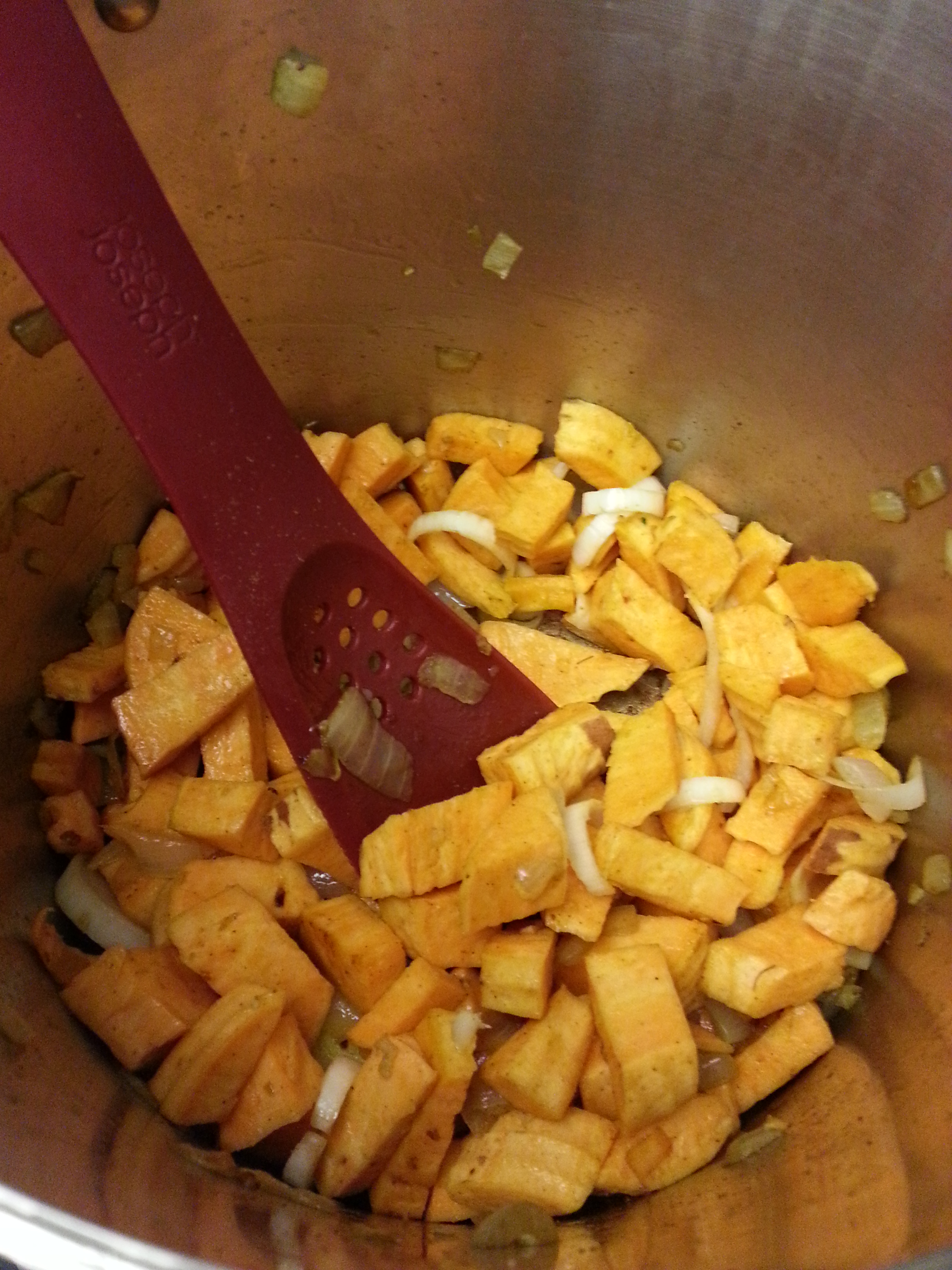
Add the diced sweet potatoes to the pot and cook for 10 minutes.
20140109_173252Once the sweet potatoes have softened slightly, add enough vegetable or chicken stock to the pot to just cover them. Bring the mixture to a boil, then reduce and simmer for 15 minutes or until the sweet potatoes are very tender.
20140109_174255
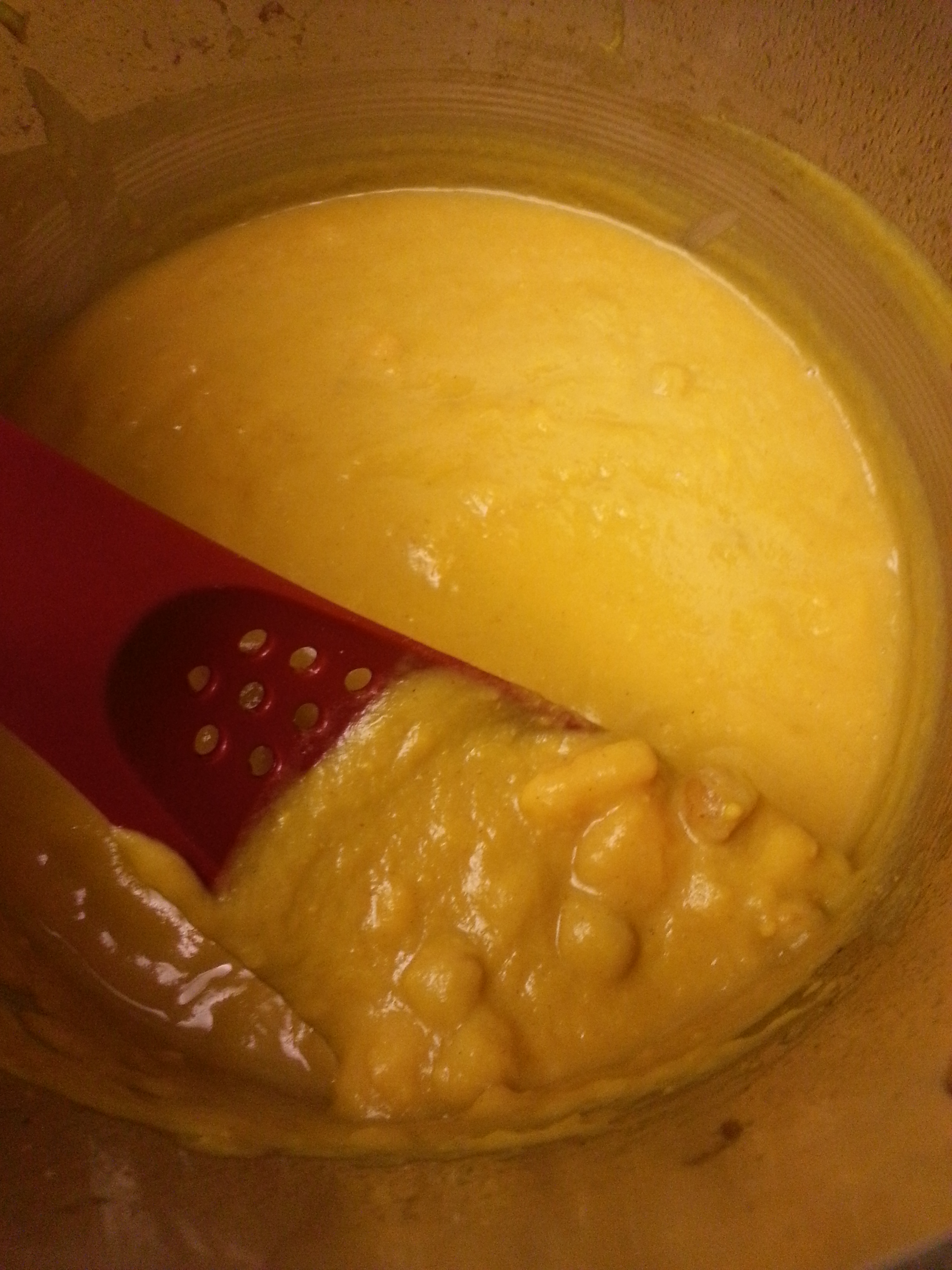
Remove the pot from the heat and blend or mash the soup until you like the consistency. I like to leave some chunks of sweet potato, rather than making this smooth like bisque.
20140109_180547
Return the pot to the stove over medium heat and add the collard greens and chickpeas. Simmer the soup for 10-15 minutes or until the greens are tender.
20140109_191507Serve hot, garnished with some roasted chickpeas, pumpkin seeds, or sunflower seeds for some crunch.
20140109_191523
Nothing like a bowl of something hearty to warm your body and soul on a cold January evening. And a reminder that sometimes being thrown out of your regular routine leads to a whole new experience of comfort, ease, and culinary satisfaction.

Ciao for now,

Neen

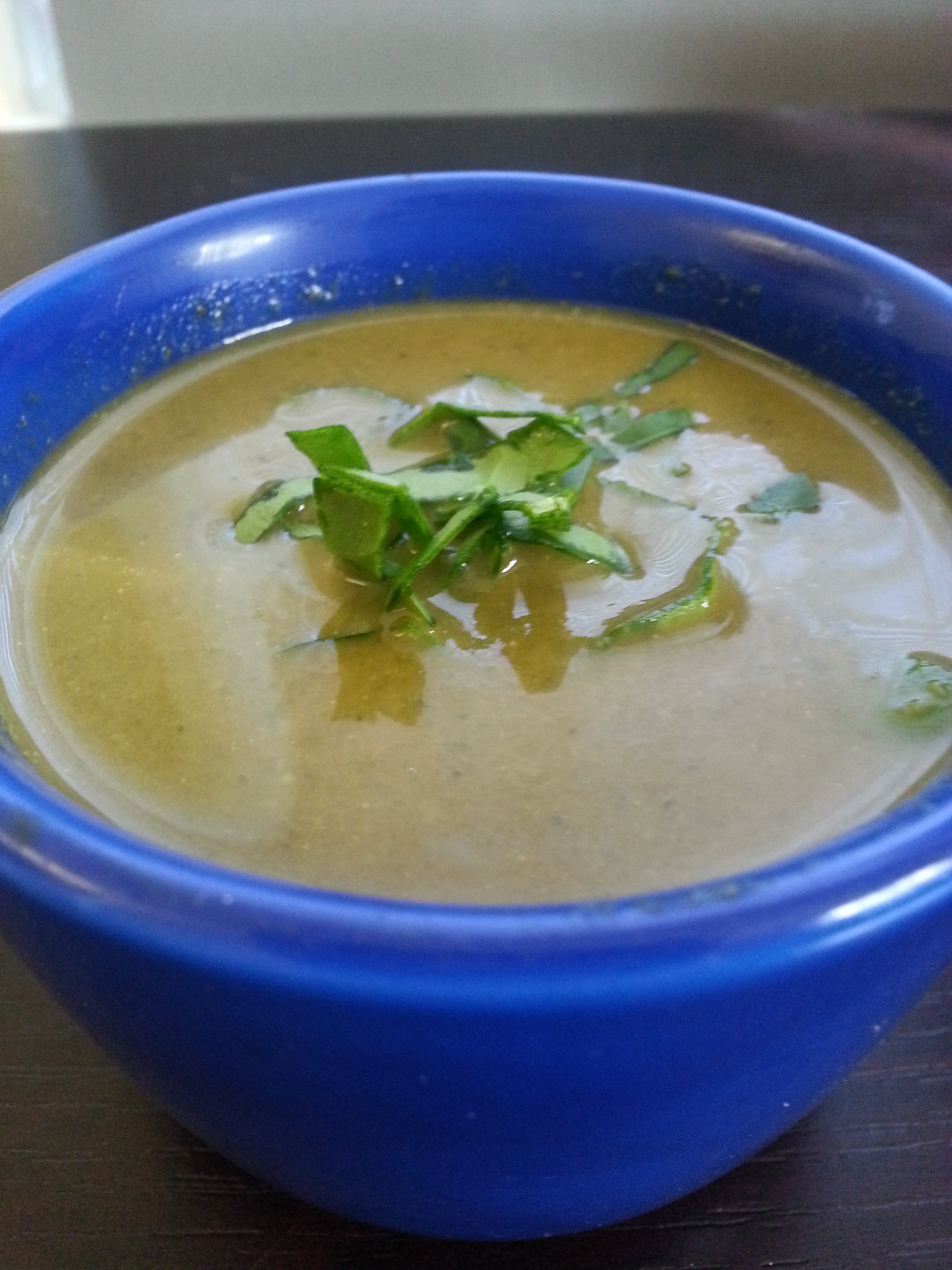
Dreamy Creamy Greens: Vegan Broccoli and Spinach Bisque

12 Jan

Happy New Year, dear readers! I am so grateful to all of you who visit and spend some of your time perusing the blog. I can’t believe that Neen’s Notes celebrates its SIXTH birthday this year. Here’s to another year of sharing and cooking wonderful things together.

Like many, I find myself reflecting at the start of a new year on the goals I did or didn’t accomplish, what brought joy or sadness, and even how I changed on a physical and spiritual level. 2013 forced me to re-evaluate myself in the deepest, most raw way. Losing the “definition” of who I was when I lost my job forced me to acknowledge that I was defining me by an occupation that could change at any moment. Gently, I let it tug me toward finally making the leap to start yoga teacher training, let myself go deeper and find a better sense of self and how I connect and interact with everything and everyone else. And I guess it’s pretty obvious that it has been a powerful and eye-opening experience thus far.
I enter 2014 stronger, more flexible (in mind and body), and eager to learn.

Though I don’t make new year’s resolutions, a general mantra of adding more good to life and causing less harm overall has been at the forefront of my mind. And for me, part of causing less harm and adding more good to my culinary life means less meat and more plants. Even as a conscious omnivore who sources animal proteins from local, sustainable sources as best she can, I can’t deny that eating animal protein is an indulgent choice. It has a greater impact on the environment, is less economical than producing plant protein, and is cruelty toward a sentient being. So rather than beat myself up for not going full vegetarian or vegan, I’m simply focused on adding more good to life, learning more plant-based recipes and techniques, and eating more plant-based meals. Taking and wasting less overall is something that would make me feel like a better citizen of the planet.

And of course, anything worth cooking is worth making delicious. This week, I’m sharing a soup that hits all the right notes: It’s creamy, comforting, rich, and earthy, is loaded with health benefits and cleansing ingredients, and is free of most common allergens (gluten, nuts, and dairy). It might not cure whatever influenza plague seems to cling to most cities in the winter months, but I’d call this the best tasting preventative medicine I’ve ever had.

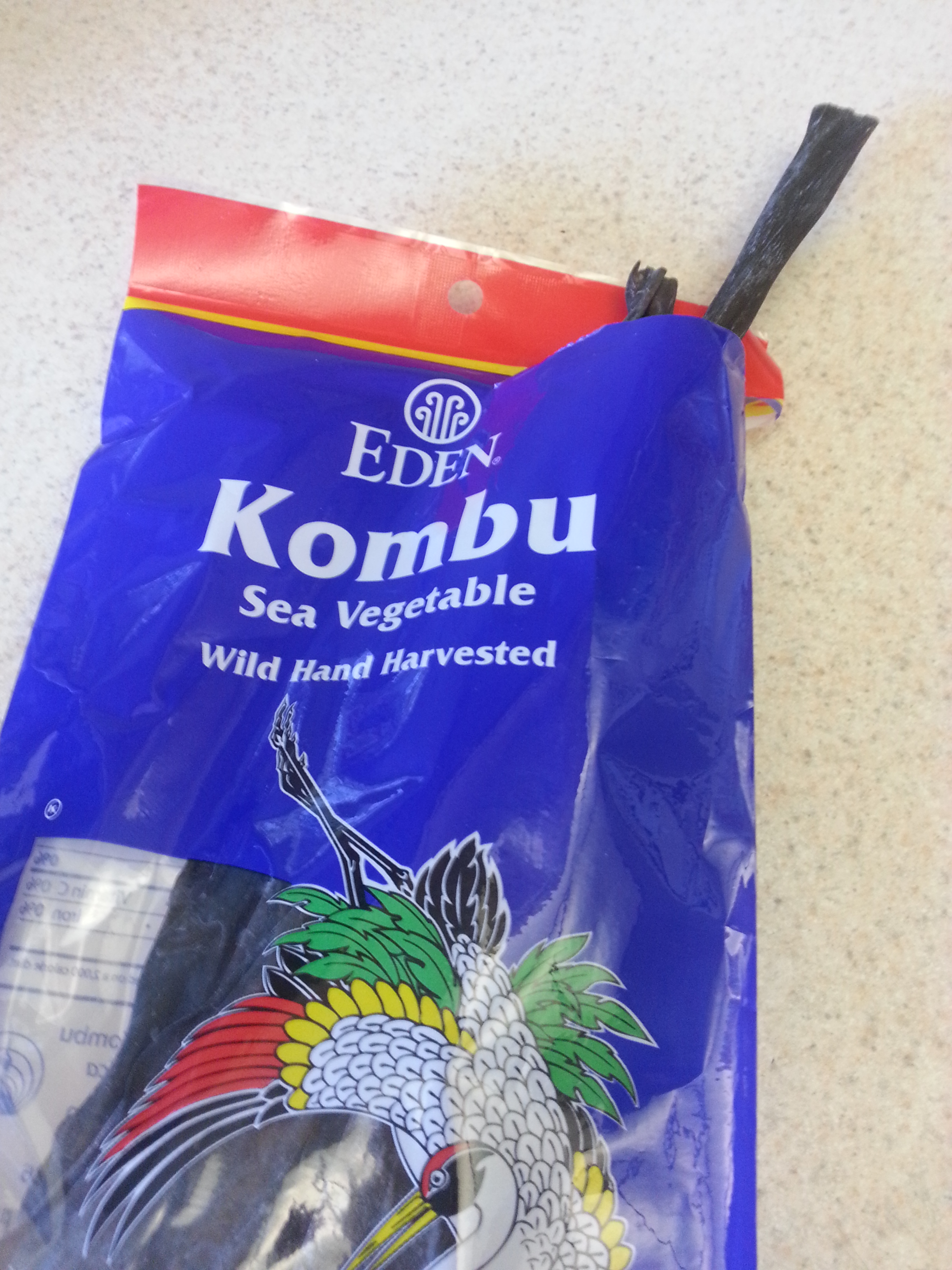
I loved cream of broccoli soup growing up, but always bogged down with milk and cheese. Nothing quite like a rich, salty, cheesy bisque surrounding little florets of broccoli. And while there’s nothing wrong with fat in your diet, I thought “we can do better!” Let’s give the body a break–digesting dairy is difficult. In fact, a whole lot of people lack the lactase enzyme almost entirely. Instead, our friend light coconut milk comes in here and brings the creaminess to the party, while simultaneously raising HDL levels and helping improve the blood cholesterol profile. Broccoli helps to modulate the body’s immune response because it’s loaded with vitamin c and and iron, and the addition of spinach brings even more iron, vitamin a, folate, b vitamins, calcium, potassium, and omega-3 fatty acids (talk about a super-food). Ginger adds a special spiciness to the blend, and can also soothe an upset stomach and act as a mild anticoagulant and improve blood circulation. Finally, the soup is simmered with a piece of kombu, an edible sea vegetable that contains a large amount of glutamic acid, which brings that savory, umami taste to the pot. Kombu is a great way to achieve an earthy flavor and body in soups without adding animal protein. It’s also rich in iodine that helps regulate the thyroid, which in turn, helps you stay hormonally balanced and healthy. Why aren’t you eating this yet??

Oh…my bad. Here’s how to get it:

Creamy Broccoli and Spinach Bisque

1 tbsp. olive oil
1/2 onion, chopped
2 cloves garlic, minced
1 leek, scrubbed and cut into 1/2 in. coins (discard dark green parts for use in stocks or broths)
1 in. piece of ginger, chopped
3 cups broccoli, rough chopped
3 cups spinach, rough chopped
3 cups unsalted vegetable stock (or water)
1 piece kombu
1 cup light coconut milk
1/2 tsp. cumin
1/2 tsp. smoked paprika
1/2 tsp. cayenne pepper
Salt and pepper to taste

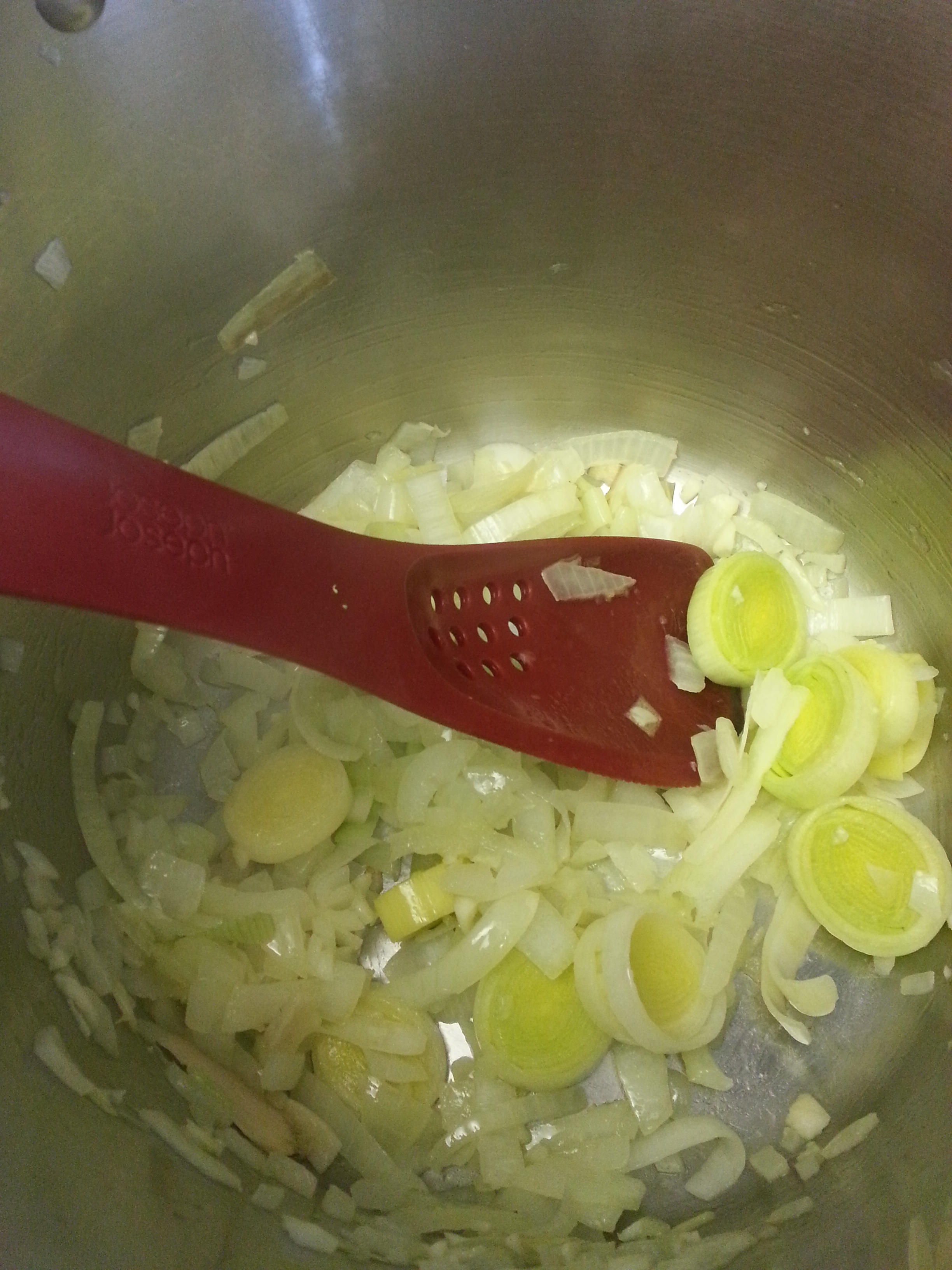
Heat the olive oil in a large pot over medium heat. Add the chopped onion and leek to the pan and cook until mostly translucent, but not browned, 5-7 minutes. Add the ginger and garlic and cook one minute more.
20140112_101930Add the spinach and broccoli to the pot and mix well.
20140112_102337
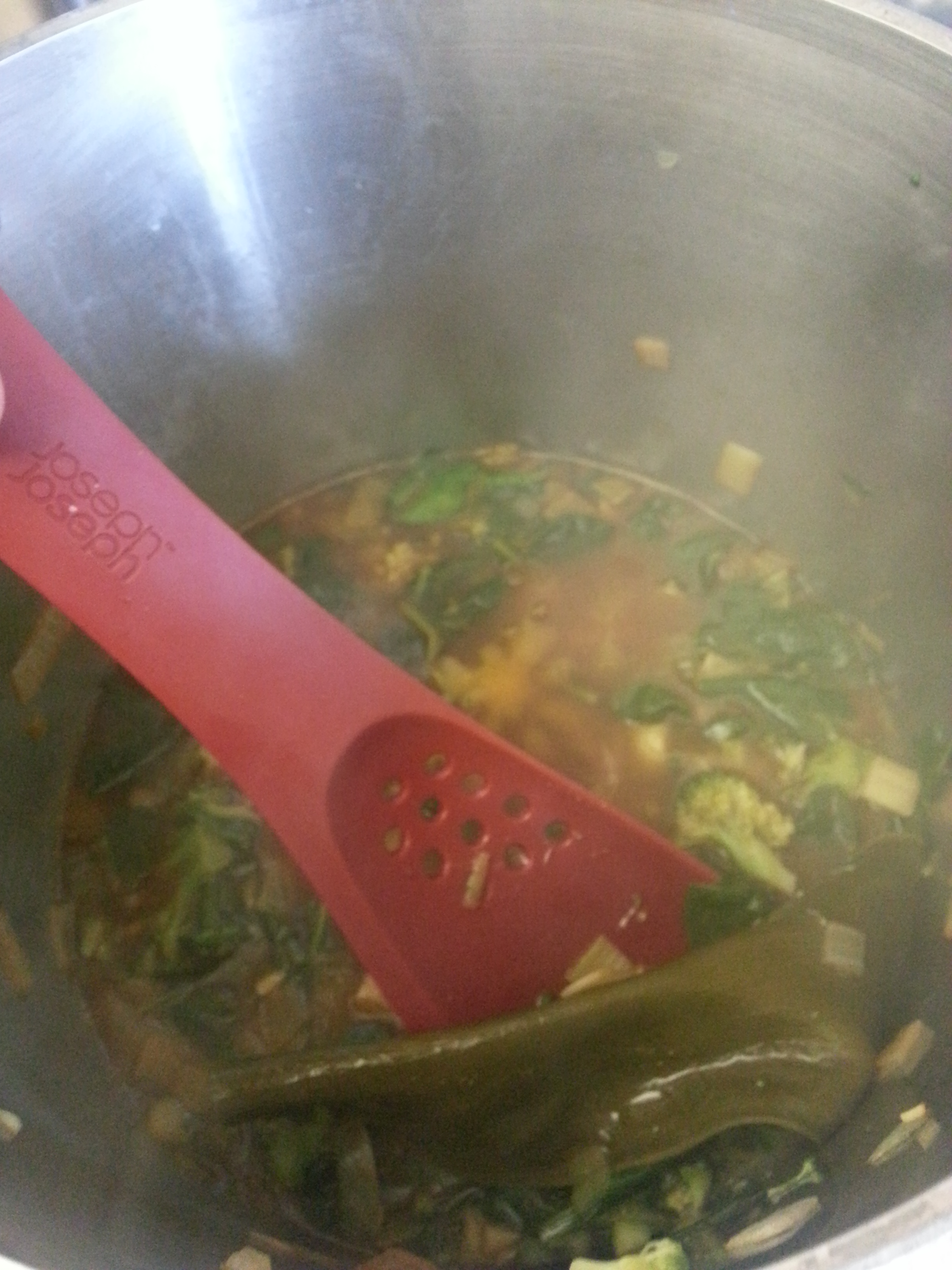
Add the broth and spices, raise the heat to high and allow the soup to come to a boil. Once it is boiling, reduce the heat to a simmer.
20140112_103524
Add the kombu to the pot and simmer until the broccoli is tender, about 10-15 minutes.

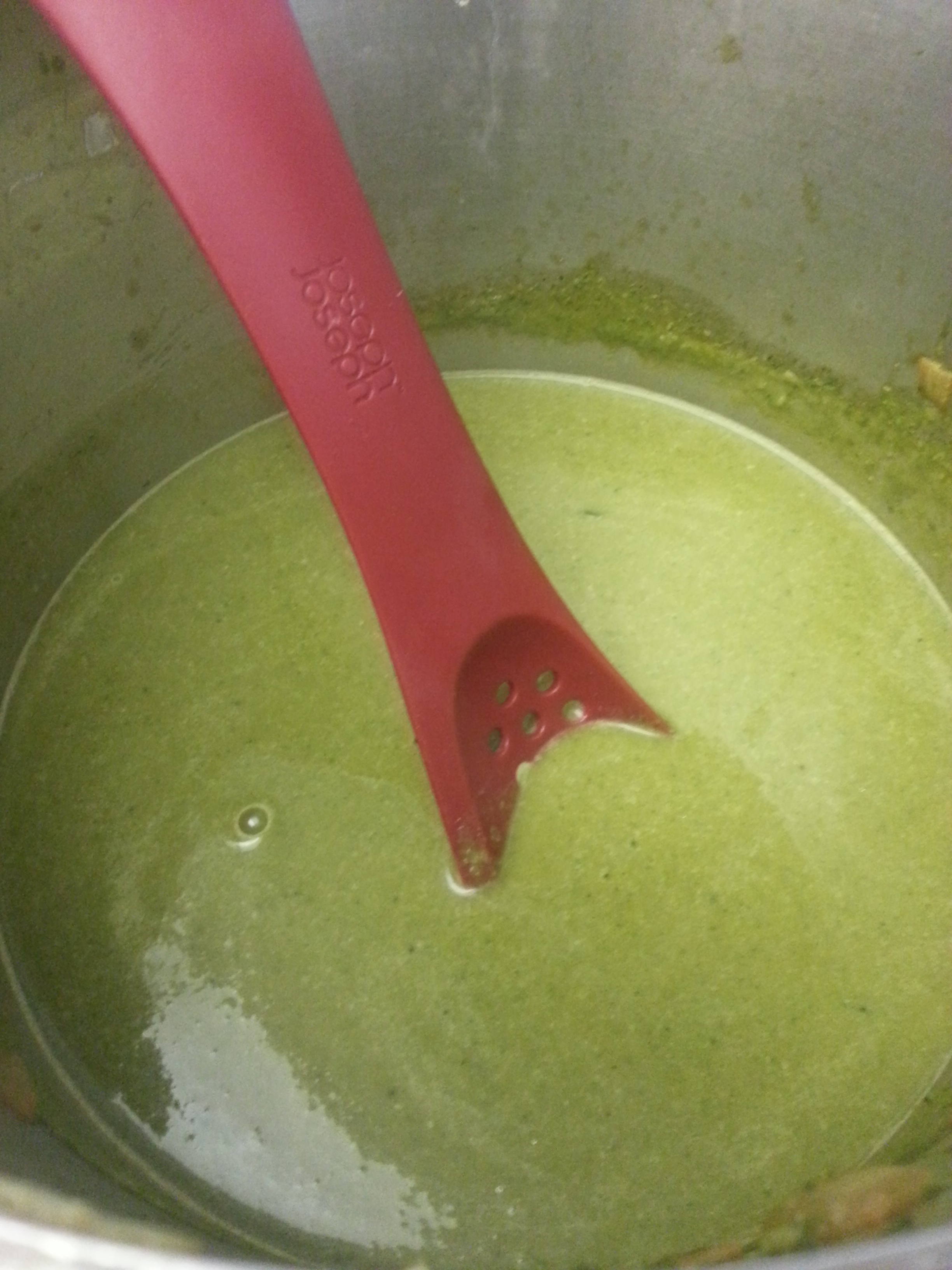
20140112_102729Remove the pot from the heat, discard the stick of kombu, and puree the soup in a blender (working in batches to avoid splatters), or using an immersion blender. Add the coconut milk and return the soup to the stove over low heat. Season with salt and pepper to taste.
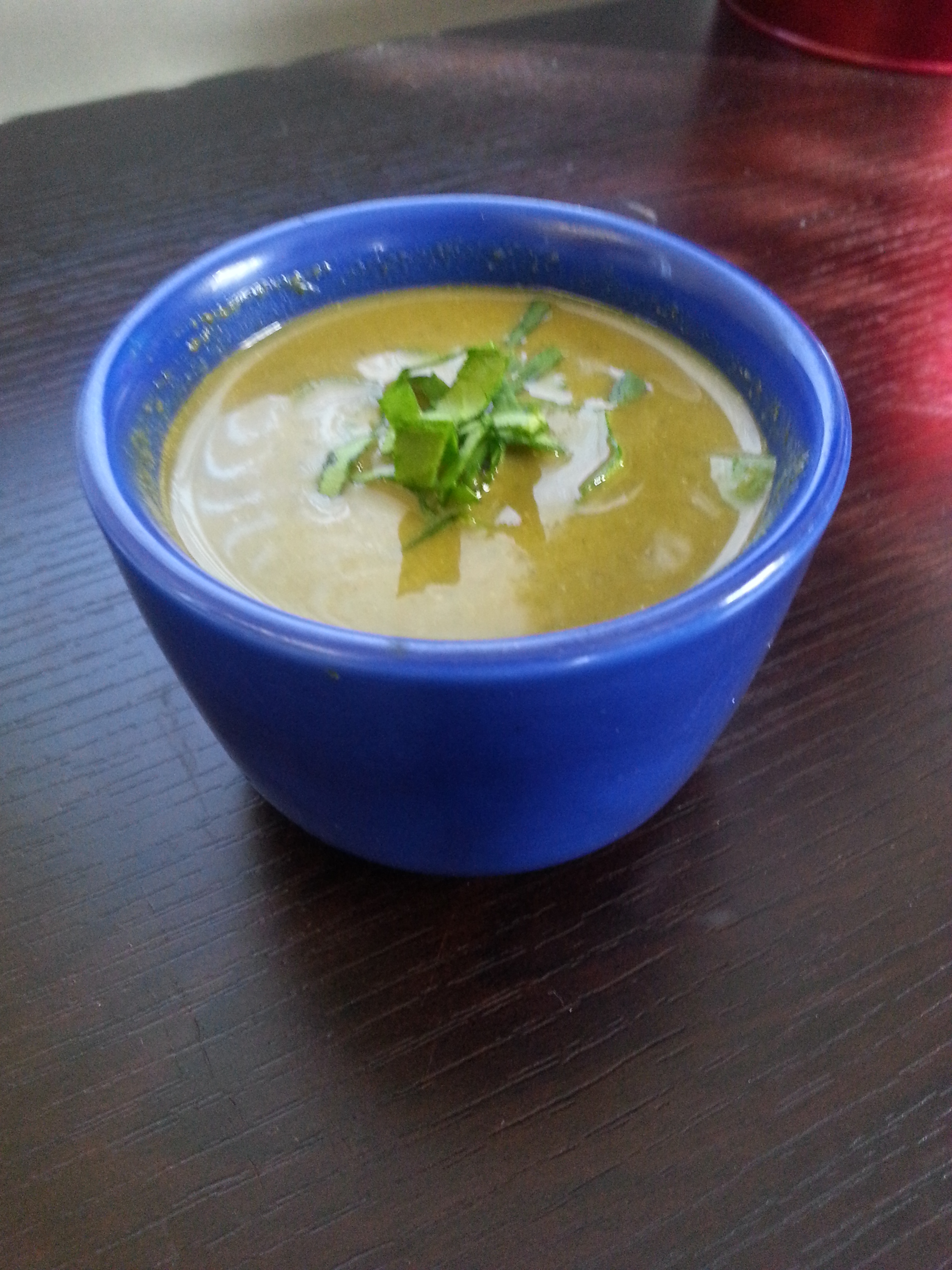
20140112_104033Serve hot, garnished with fresh herbs.

20140112_12094520140112_121018Treating yourself to this soup is a gift in so many ways. Not only does it taste rich and velvety, it feels like it was meant for comfort on a cold winter day, and all those health benefits are a present for your body. And because it’s free of animal products, gluten, and nuts, it’s something you can share with a great majority of folks. And you know, I think food almost always tastes better when shared.
Ciao for now,
Neen

The Trance Dance

13 Dec

Initially, I saw the words “trance dance” on the syllabus for yoga teacher training and felt an anxious curiosity rise up through my stomach. The self-conscious person does not easily become uninhibited, especially one who is hyper-aware of her body within space. Even nearly a decade removed from being obese, I am still constantly aware of how much space I am taking up when I am in crowds of people.

And it’s not exactly an easy thing to define, because like most things in yoga, how it’s defined and what it is depends on the lineage being studied, the perspective of the practitioner, the geographic region, the group of people….and so on and so forth. The best description I found online was this one from Kiara Boch Yoga:

We are creative, rhythmic, fluid beings. It’s in our cells. We are made mostly of water, which is always flowing, moving and changing. When rivers in nature are contaminated, it prohibits life from flourishing and it becomes stagnant, dis-eased, even toxic. The physical, mental and emotional rivers of our body act the same way. When people are fearful, repressed, they freeze and hold still, rejecting the life force from moving through the self. Yoga Trance Dance is all about taking back your power and reclaiming your natural harmonized state of being. It’s about exploring the eternal flow of natural spontaneous movement through yoga and ecstatic free-form movement. When the rivers are flowing and circulating, grace appears, Joy and embodied freedom ignite liberate us to move, to breathe, and to be alive!

Three weeks ago, I walked into the studio and was surrounded by the scent of sage. The yogi leading our dance explained that sage is an herb often used in purifying rituals, and since our theme for the weekend was purification, cleansing, and discipline, burning it was a way to purify the students and the space. We had a brief lecture to discuss the physical cleanse we’d be taking part in (which took place this past weekend), and then moved our blankets and notebooks aside, coming to sit in a circle. I noticed that bolsters and blankets were lining the walls.

That’s odd.

And then I saw the basket of blindfolds.  The anxious curiosity in my stomach turned sour. Not okay, not okay, not okay, a thousand times not okay. My teacher went on to explain that we would hear music from all over the world, that she and one other teacher would remain un-blindfolded in order to guide us away from any danger or help anyone who really needed to get out. But she encouraged us to stay in it, stay with the present moment, and challenged us to breathe through whatever feelings or thoughts came up. For the entire duration, we would practice a specific kind of breath—two short inhales through the nose, followed by an exhale through the mouth. No matter what changed throughout the experience, one could return to the breath at any time. It comforted me slightly. If you panic, just come back to the breath. Deep down, you know that no one in this room would ever hurt you.

And frankly, I was the one holding the blindfold. I had to choose to put it on. Years ago I had therapist named Karen. I asked her many times how I was supposed to just deal with panic. How I was supposed to just work through anger, rage, mistrust, and deep, deep darkness. Now someone was asking me to return to the darkness and it occurred to me…

You cannot purify or detoxify that which you cannot face.

And so I faced the darkness. I began the breathing pattern: In, in…ouuuut. In, in…ouuuut. Something like a dijeridoo or vuvuzela came blaring through the speakers.

I can’t do this. Please let me out.

I remembered the split-second of standing in the doorway of an airplane before I leapt forward with arms spread wide to fly toward earth. That moment that happened in less than a second—not even enough time to think—where every cell in my body resisted moving forward. Only now, my body was resisting even being within the space.

Let go.

I can’t.

You can.

I remembered the first time that I performed a synchronized swimming routine in the 12 ft. deep section of the pool. The spotlight was so bright against the black evening sky that seeing was next to impossible. The music was almost all vibration underwater, with the occasional lyric somehow finding a clear path through rows of moving bodies. “Waterproof” make-up and Knox gelatin smeared across my face, and blurred what little vision I had. In those moments, there was only trust. We could only count, breathe, and depend on our co-swimmers to reel us back toward the fold whenever one of us pin-wheeled out of control. We lived the darkness and consumed the sound, letting it fly out through limbs with no ground beneath them.

My body remembered the cold night air against my skin as we took our bows alongside the pool, and I let out an audible shudder in the studio. The dijeridoo got louder and the music unfolded into the room, spilling itself across the floor and grabbing my ankles.

Move.

At first the motion was small, only a minor sway side-to-side. I thought of the woman who led the belly-dancing class I went to in high school with my friend Audrey. She rippled her arms like a snake, making a fluid, ever-changing sideways “S” shapes. It never looked smooth when I stood doing it, judging my jiggling, floppy arms in the mirror. But, having resigned myself to doing something, I figured it was worth trying. I went by feel, seeing if I could turn my arms to liquid. You have no bones! I felt the shape and let it ripple over and over again, occasionally feeling another student brush against me or squeeze my hand in solidarity.

The wariness crept back in frequently and each time I returned to the breathing pattern. Every so often, whatever movement I was making stopped feeling right and I would stand, just swaying. My hands came to the blindfold, and each time came the temptation to tear it away and see what was happening. Maybe just a little peek to see where I was in the room.  I couldn’t understand why I just wanted to know so badly, but I did. Still, I resisted the impulse and stayed in a sea of ink and occasional sputters of kaleidoscope-colors behind my eyelids.

Every time the music changed, my body changed too. At times it felt deeply sad, slouching toward the floor and moving as though weighed down by wet, heavy clay. During some moments it was wild, like a jungle animal—I distinctly recall crouching down near the floor and imagining myself as some sleek, wild panther lurking through the darkness. Still at other moments there was a profound sense of release—at one point my mouth opened and instead of the exhale of breath came a pure, single sung note. ( I watched The Little Mermaid way too many times as a kid—it reminded me of this: http://www.youtube.com/watch?v=h6V5HefJn0w) And yes, at some moments there was nothing but that impulse to escape.

The sound of “oommmmmmmmmmmmmmmmmmmm” came over the speakers, cueing our class to lay down and take a resting pose. Finally silence offered itself to the room and we removed the blindfolds, blinking eyes full of incredulous confusion and gratefulness. Slowly, we arranged ourselves back into the giant circle where we’d started.

I didn’t expect what happened next: I cried and couldn’t stop.

Here you are.

A whole lifetime happened in an hour and forty-five minutes. My body remembered itself throughout its history, and as I faced the darkness, I saw both all that I was unwilling to look at, and everything I wanted to see, but had somehow forgotten over a lifetime of “I should be” and “I should do.” My body had made strange shapes on the outside, but my mind felt color, breathed vibration, and warped like a funhouse mirror.

All I could do was try to thank my classmates for allowing me the safe space to have such an experience. I felt a depth of gratefulness that almost turned to guilt when I wondered how I could ever repay them for the journey. Through my tears I tried to explain that simply being there and feeling their vibrations around me made it possible to resist the panic, to not react to the fear, and to say YES to life, YES to experience, YES to being present right there just as I was.

To say YES to myself.

That night I wrung myself out more than any twisting posture has ever done. And suddenly there was space for more in my heart. This morning, my teacher said during class that the wonderful thing about yoga is that you develop the ability to have space for yourself anywhere, even on a crowded metro train. You create space within yourself for peace, and no one can steal that away. What a beautiful thing to learn.

You have peace within you, and it is yours to keep. Even in the chaos.

Ciao for now,

Neen