Archive | Recipes RSS feed for this section

My Cheesy Valentine: Part Deux

15 Feb

Shortly after meeting my best friend in the world, I discovered his disdain for most things vegetable-related. I’ve since learned that while he doesn’t necessarily enjoy a veggie as the star of the show on a plate, he doesn’t mind their flavors in a dish. And to his credit, he’s become much more adventurous in our six-ish years together. Still, I was a little bit shocked the first time I made these little crostini that he found them just as delightful as I did. It’s a great appetizer for a crowd, or just for you and your sweetie.

Spinach, Artichoke and Caramelized Onion Crostini

  • 1/3 cup low-fat plain yogurt or Greek yogurt
  • 1/3 cup low-fat sour cream
  • 3 oz. Neufchatel cheese or cream cheese
  • 1 can of artichoke hearts, drained
  • 10 oz. fresh spinach
  • 1 onion, diced
  • 1 clove garlic, minced
  • 1 tsp. dried thyme
  • 1 tbsp. Dijon mustard
  • ½ tsp. dried cayenne pepper
  • Salt and pepper to taste
  • 1 french baguette

Cut the baguette into ½ in. slices on a diagonal and lightly brush them with olive oil. Toast until golden brown and set aside.

In a wide pan, sweat the diced onions in olive oil until soft, translucent and sweet. Add the garlic and cook for another minute. Add the spinach and cook just until it has wilted. Set the pan aside.

In the bowl of a food processor, combine the yogurt, cheese, sour cream, artichoke hearts, thyme, mustard, pepper, and a few pinches of salt. Pulse to combine. Add the spinach, onion and garlic to the food processor and pulse until it has a spreadable consistency.

Top each toasted baguette slice with the spread and serve at room temperature. We had ours with some thin-sliced hot soppressata on the side. In the summer, I serve it as a chilled dip alongside raw carrot slices for a cool appetizer.
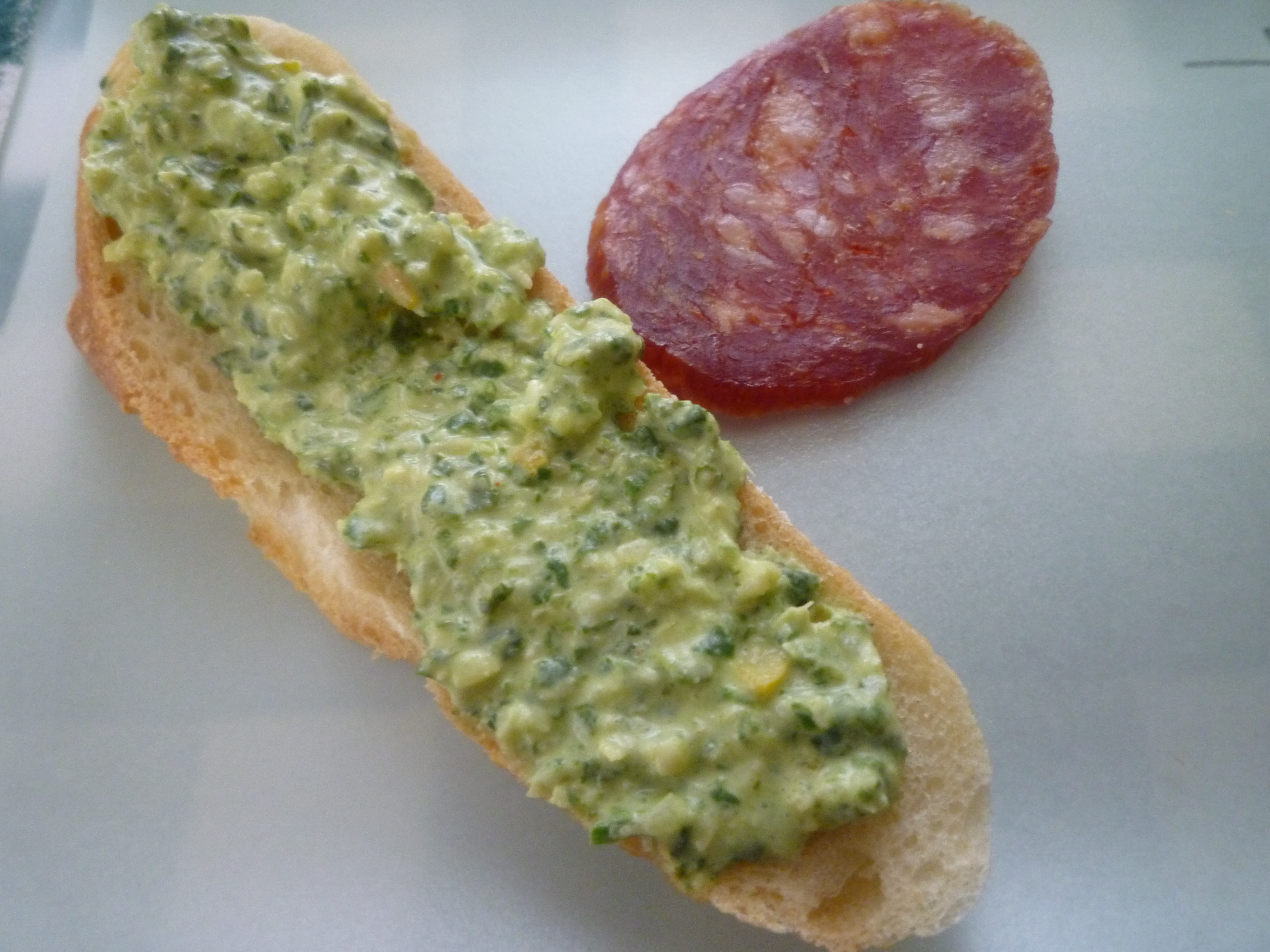
So that was our Valentine’s day appetizer, and you heard about the entrée in part 1, but I know what you’re really here for: Dessert.

I made this pound cake, which baked up beautifully. It’s an easy one-bowl recipe. It took a little bit longer to cook in my oven, but not by much. Maybe 1 hour and 30 minutes instead of the indicated 1 hour and 20 minutes.

The cream was whipped with some vanilla bean paste and a few teaspoons of sugar. I kept the it fairly neutral, because the cake was plenty sweet on its own.

The coulis was my favorite part (and apparently was Joe’s as well, because I caught him eating it out of the container with a spoon, haha). If your Valentine, like mine, does not love chocolate, try this!

Mash a pint of blueberries with a few teaspoons of sugar, a few drops of vanilla extract or vanilla bean paste, and the juice of one lime. You can also add a little bit of the zest for a stronger lime flavor. Simmer gently until thickened and a little bit syrupy, then let it cool to room temperature.

To put it all together, spoon a few generous swirls of the coulis on a plate, and then top with a cake slice and a dollop of whipped cream. The sauce has just enough tartness to balance out the cake’s sweetness and the cream brings the whole dish together. Oh, and the cake has the most wonderful, crackly crust. Delicious.

I hope that you are all having a lovely week! Enjoy the new goodies.

Ciao for now,

Neen

My Cheesy Valentine

14 Feb

A few weeks ago, I decided to try my hand at cheese making. It’s something I’ve always wanted to give a go, but wanted to do a little bit of research before trying. (With graduate school out of the way, I’m now working through the backlog of cookbooks and recipes I neglected.) For someone who loves cheese as much as I do, the prospect of making my own was very exciting. Since I’d planned to make Joe a special meal for Valentine’s day, I saw it as an opportunity to get something extra-special on our plates.

I started with ricotta, the easiest cheese to make. If you have milk (whole and 2% yield the best consistency), buttermilk, and some cheesecloth, you can make ricotta in under a half-hour. Line a colander with a few layers of cheesecloth and set aside. Combine a half-gallon of milk with 2 cups of buttermilk in a large pot over medium high heat. Stir every so often to keep the mixture from scorching, but once it is hot and steaming, stop stirring. When the mixture reaches about 175 degrees F, the curds will separate from the whey. Gently ladle the curds into the cheesecloth, tie up the corners, and hang the cheese to drain for about 20 minutes. Voila! You’ve made ricotta. Store in an airtight container in the refrigerator for up to a week.

Next up was another favorite: Mozzarella. This required a bit more special equipment, but I was able to order anything I needed from New England Cheese making Supply Co. I must recommend Ricki Carroll’s book, Home Cheese Making if you’re interested in learning all about the history and science behind cheese.

So here’s what you’ll need for mozzarella:

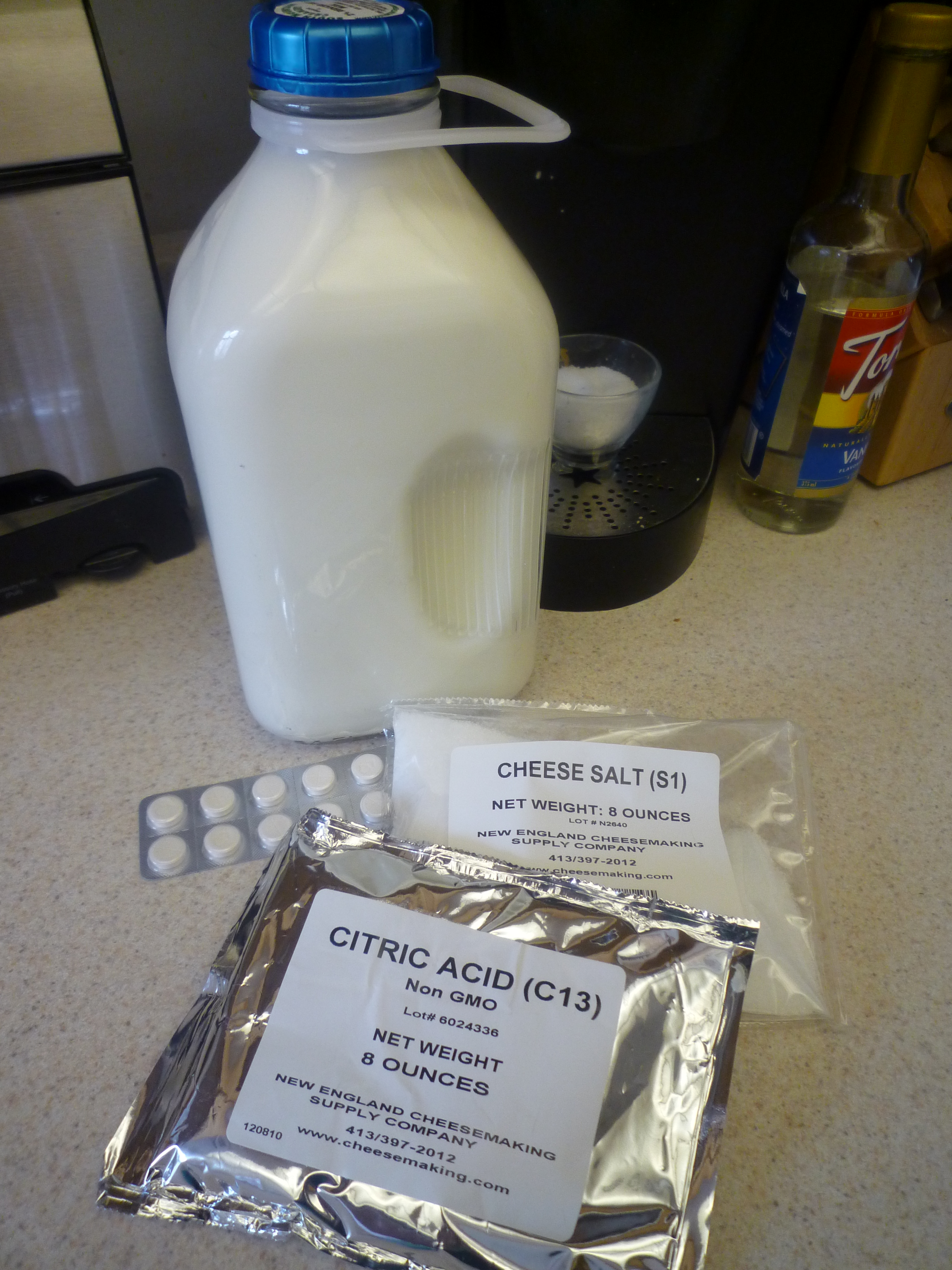
Ingredients

  • One gallon of milk*
  • 1 ½ tsp. citric acid dissolved in one cup of cold water
  • ¼ rennet tablet diluted in ¼ cup of cold water
  • 1/4 cup of cheese salt

*Note: Do not use milk that is labeled “ultra-pasteurized.” Pasteurized / homogenized milk will work just fine, but UP milk has been treated at such high temperatures that it is not suitable for most cheese making. (It will work for ricotta.)

Hardware

  • A large pot
  • A small colander that can fit inside the pot and a pair of tongs (or a spider if you have one)
  • A thermometer that will clip onto the pot
  • A board for kneading
  • Heat resistant gloves (I used these—I bought them for when I use my mandoline because the hand guard on it is flimsy.)

Okay, here we go!

Combine the milk and citric acid/water mixture in a pot over medium-high heat while stirring vigorously, then stir gently while the milk heats to 90 degrees F.

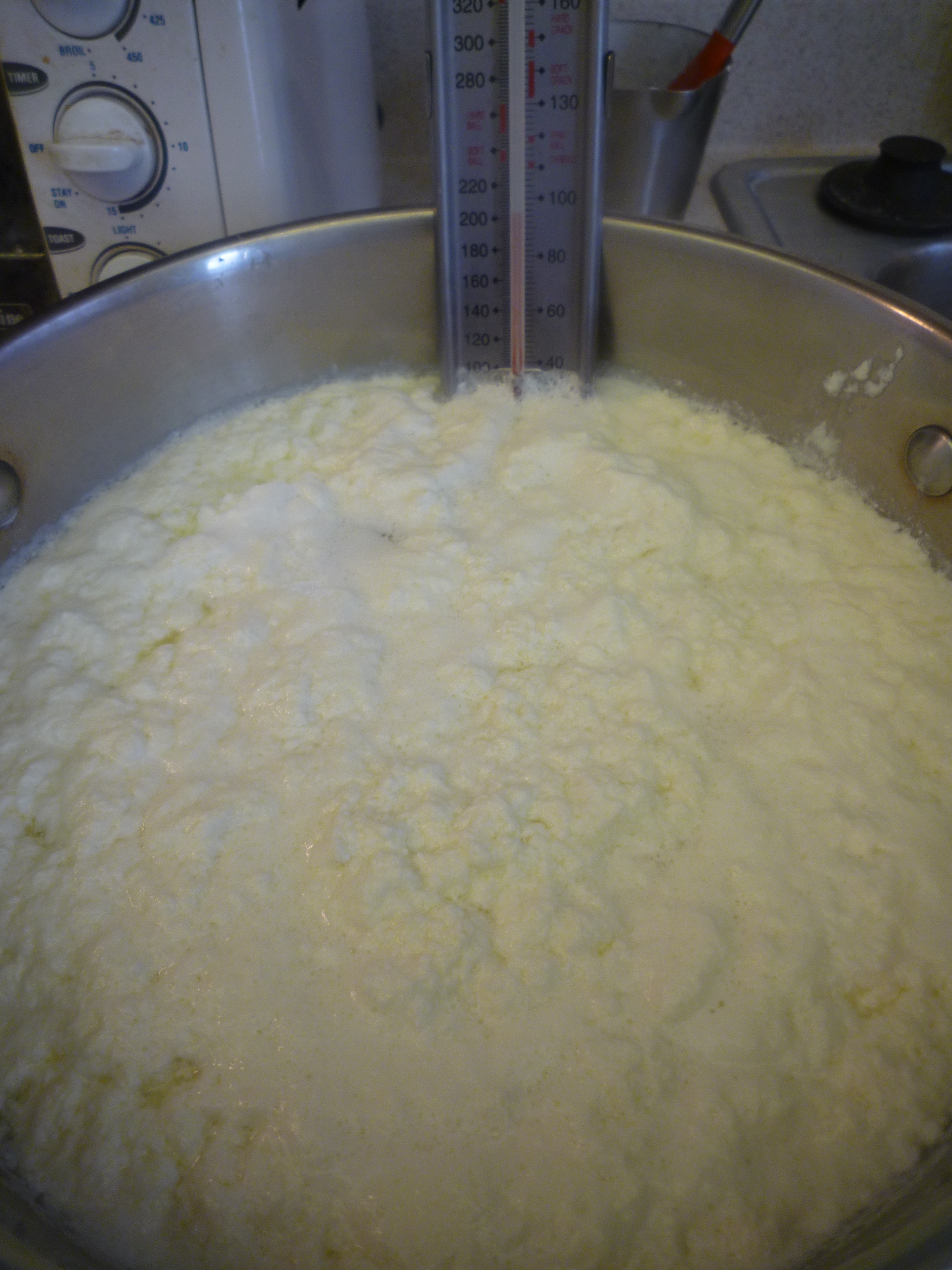
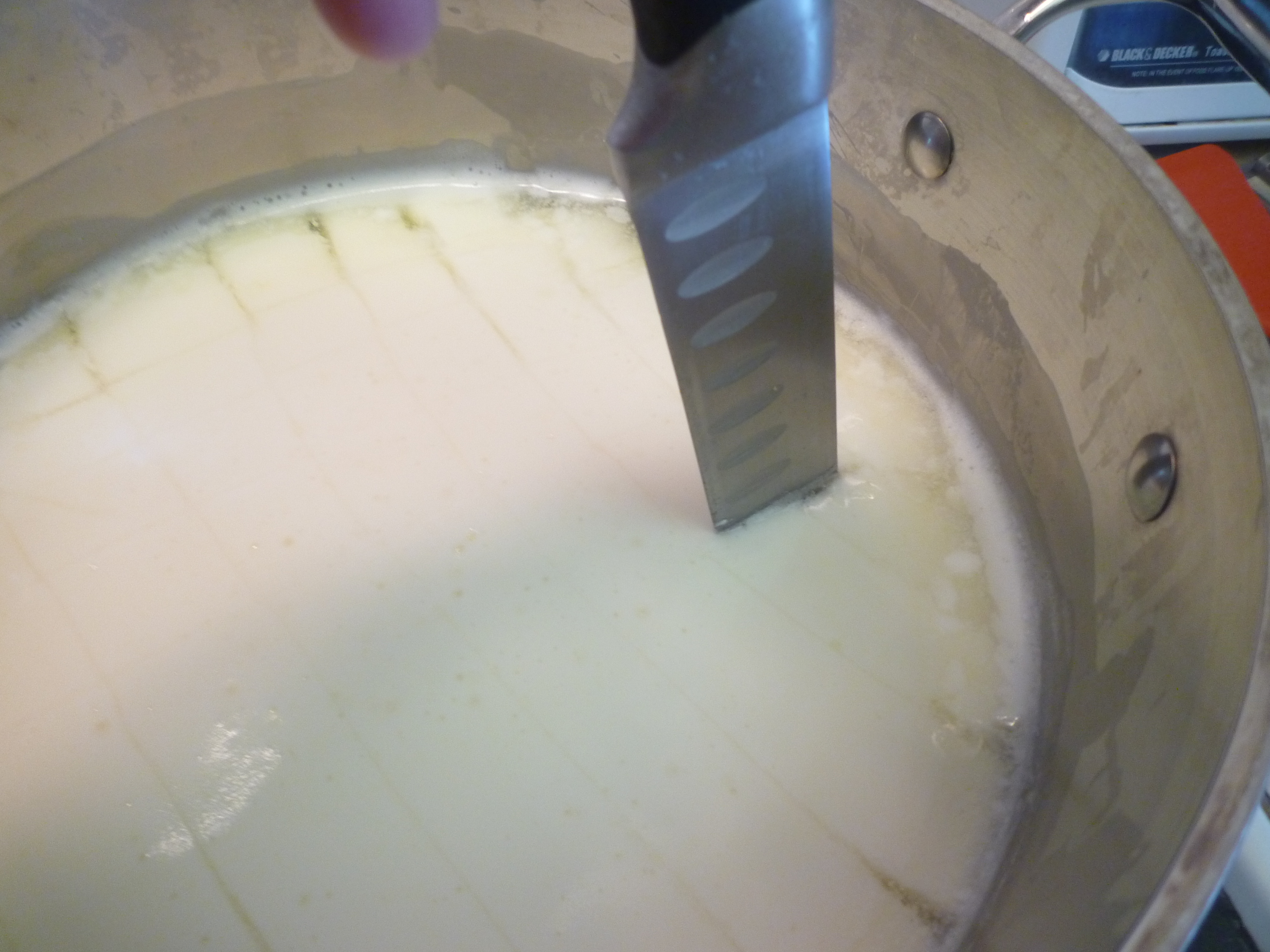
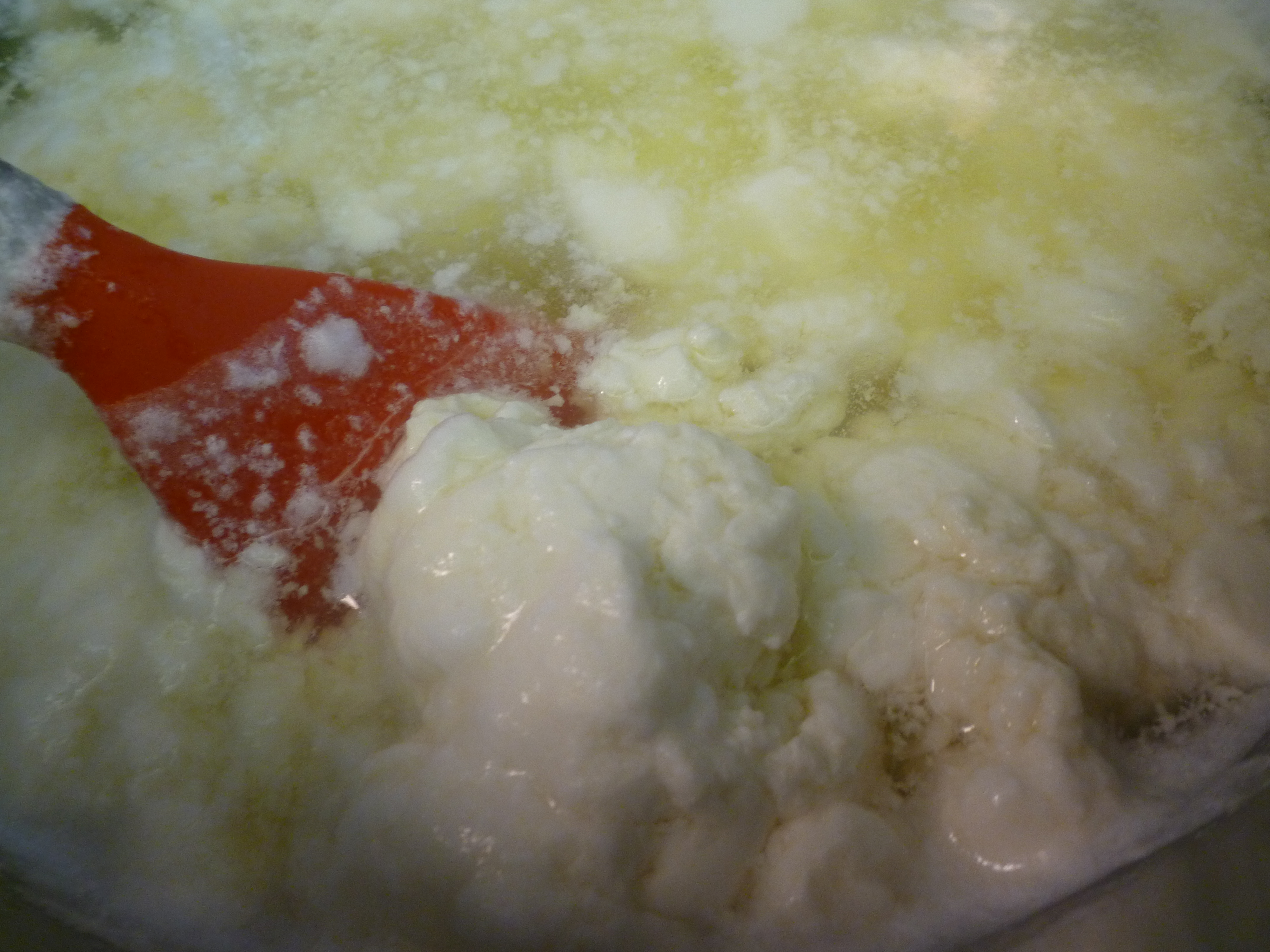
Take the pot off of the heat and add the rennet, mixing in a gentle up and down motion for 30 seconds. Put a lid on the pot and leave it undisturbed for 5 minutes. When you remove the lid, the curd should look like custard and should show a clear separation between the curd and whey. Test by putting two fingers between the curd and the side of the pot. If you see a clean break, the curd is ready to cut. If it is too soft, wait another five minutes and test again. It took a total of 15 minutes in my kitchen.

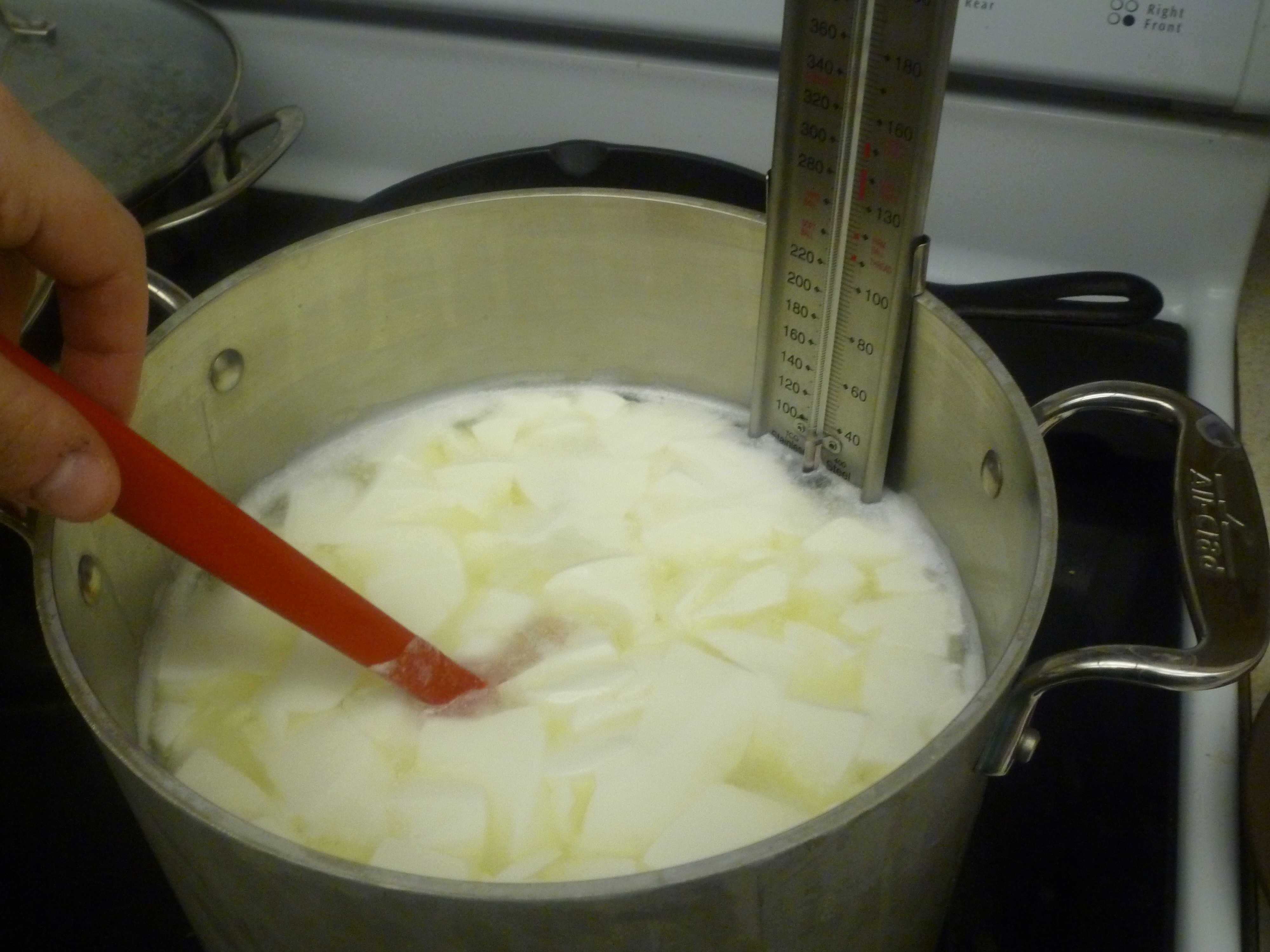
Cut the curds into a checkerboard pattern and put the pot back over medium-high heat. Cook, stirring the curds gently until they reach 110 degrees F. Take the pot off of the heat and continue stirring gently for 3-4 minutes.

Gently ladle the curds into the colander over a bowl so that you can reserve the whey that drains off of them. Press them gently to remove as much whey as possible and so that they begin to form a cohesive unit.

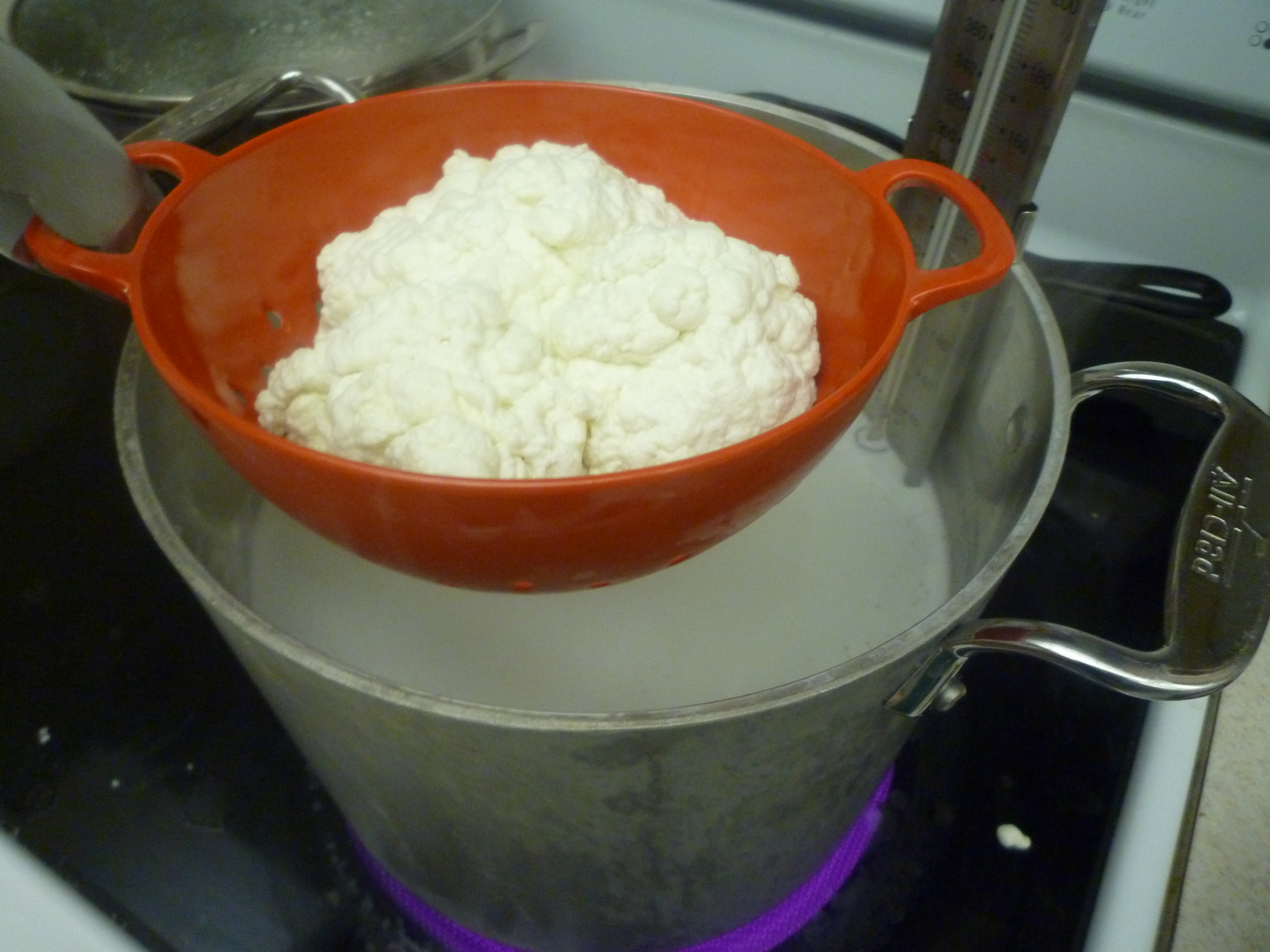
Pour the whey that has collected in the bowl back into the pot, add the ¼ cup of salt, and allow it to heat to at least 175 degrees. (Put on your gloves!)

Dip the curds in the colander into the hot whey for several seconds.

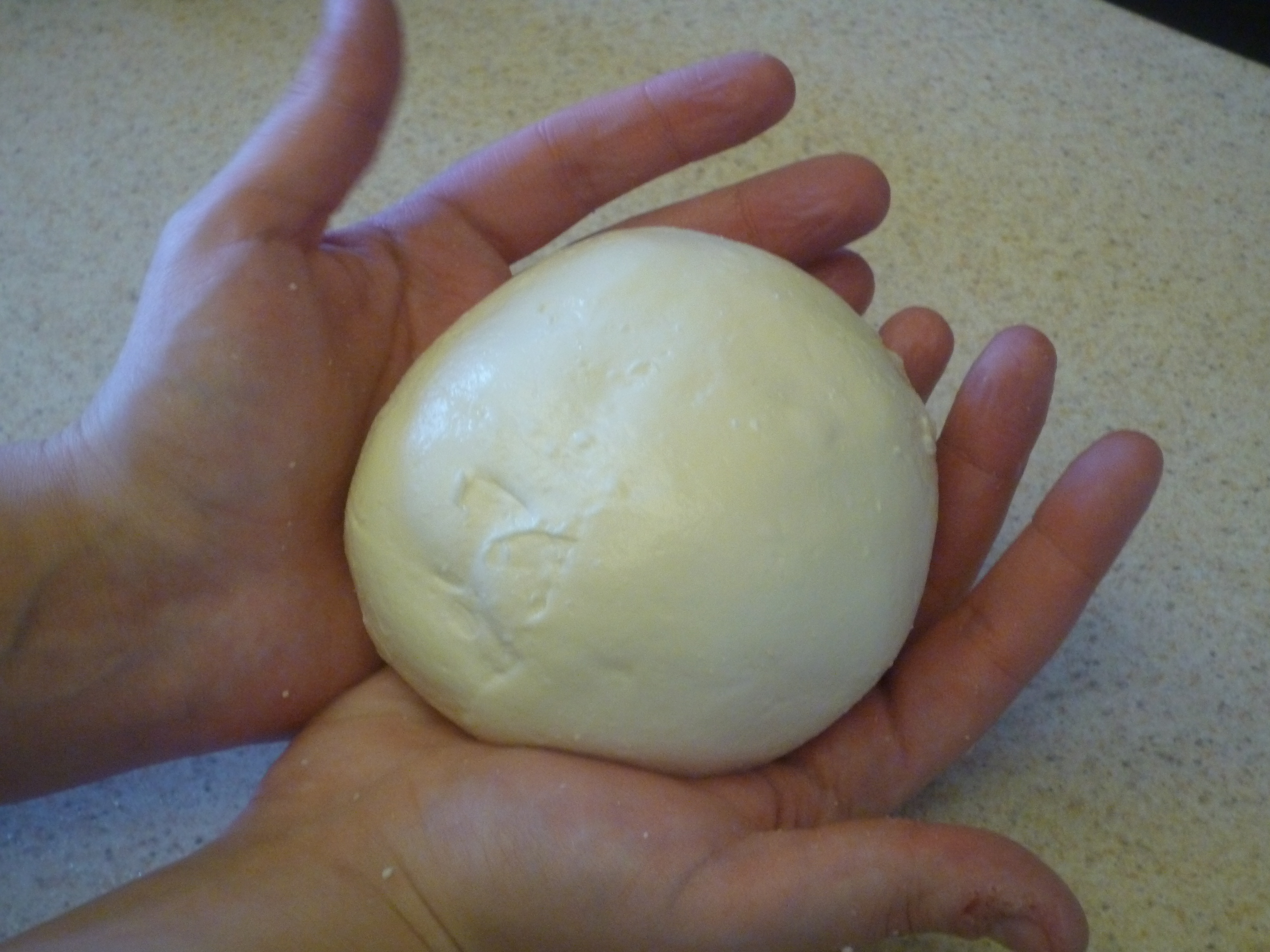
Remove, and then knead the curds like bread dough. Repeat this process several times until the cheese is cohesive and stretchable. The cheese is ready when it is shiny and has a consistency similar to pulled taffy. Roll into a ball and place immediately in a bowl of cold water for ½ hour. This will improve the texture of the cheese.

From there you can slice, grate, or melt it however you like.

So what did I make for my Valentine?

I made a batch of homemade pasta (hail Lidia Bastianich’s recipe) and filled ravioli full of fresh cheese and spices. Topped it all off with a touch of tomato & sweet pepper sauce and sprinkled on a little extra ricotta for good measure. Simple, but with ingredients so lovely I wanted to let them speak.

We also had some spinach, artichoke and caramelized onion crostini with hot sopressata, and finished the meal with a decadent little pound cake with vanilla bean whipped cream and blueberry-lime coulis for dessert. Don’t worry, recipes for the apps and dessert are forthcoming!

For now, have a happy (and cheesy) Valentine’s day. Share it with the ones you love and remind them just how special they are to you.

Ciao for now,

Neen

Black and Goldies: Super Blondies

1 Feb

Two entirely different things inspired this post. First, there was the February 2011 issue of Bon Appetit. If you haven’t seen the cover of said magazine, it was a siren calling, “Look at these delicious cocoa-walnut brownies, don’t you want them right now?” To use a Bourdain-ism: Total food porn.

Then there was January 23rd. It was the day that my beloved Pittsburgh Steelers valiantly defeated the New York Jets to secure their spot in Super Bowl XLV. I can’t wait for the big game this weekend vs. Green Bay. It has potential to be one of the best ever: Two teams so well-matched that it’s the lowest Super Bowl point spread in 27 years.

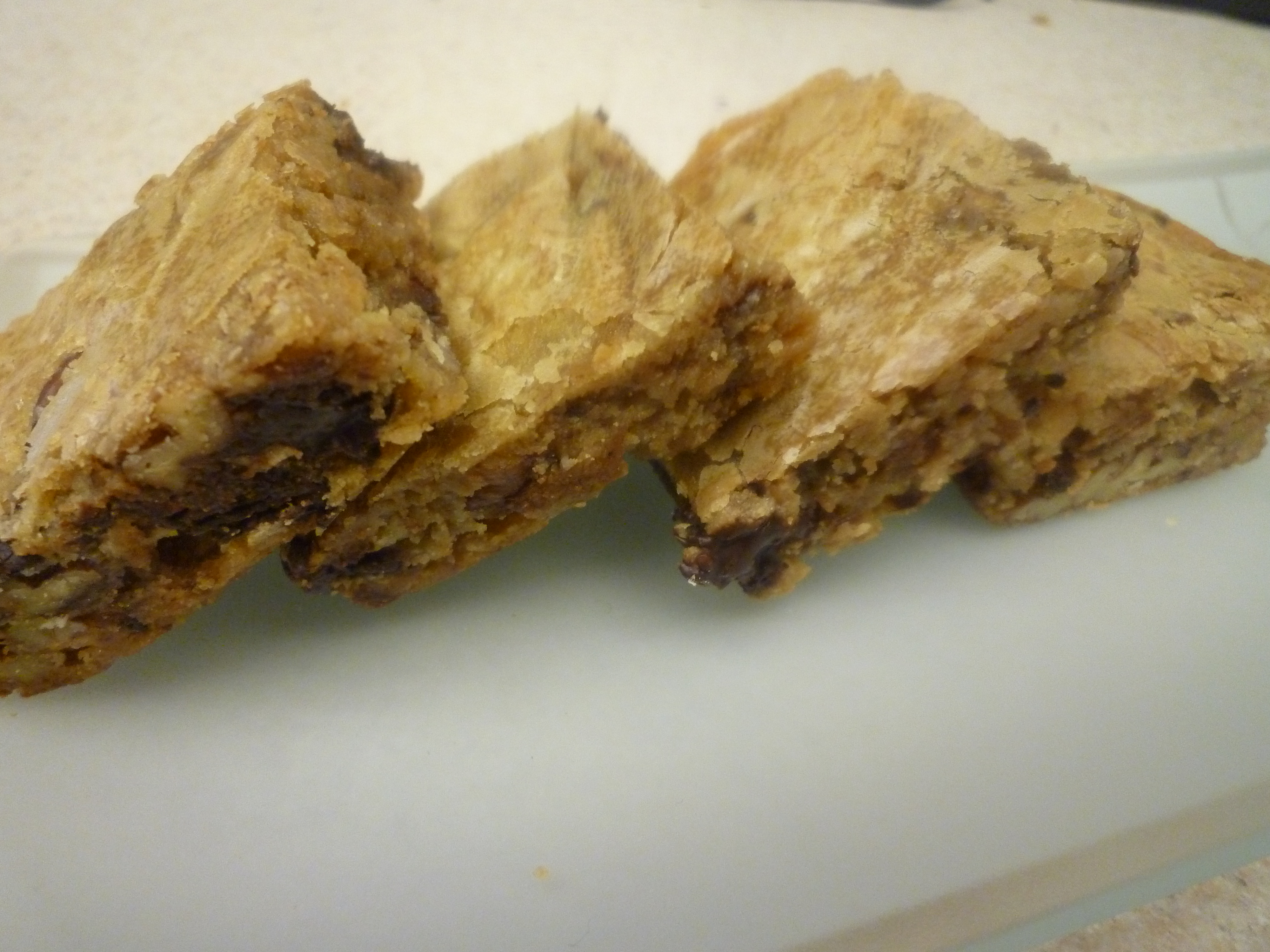
Having already made and devoured Bon Appetit’s dark and decadent goodies last week, I decided to switch it up this week and go for the gold. This one’s for you, Steelers.  Good luck in the big game!

Black and Gold Blondies

Black and Goldies

These are a one pot wonder, so make sure that your saucepan is big enough to accommodate all of the ingredients. I used a 4qt. to account for whisking space.

Ingredients
1 cup all-purpose flour
1 cup light or golden brown sugar, packed
8 tablespoons (4 oz.) unsalted butter
1 egg
½ tsp. vanilla extract
1 tsp. coconut flavoring (optional, but soooo good)
¼ tsp. salt
2 oz. dark chocolate, roughly chopped
1 cup pecans, toasted and chopped

Method
Pre-heat the oven to 350 degrees F.

Line an 8×8 in. pan with parchment or buttered foil.

To toast the pecans, spread them out on a sheet pan and bake for about 8-10 minutes or until lightly fragrant.

Cut the butter into 1 in. pieces and melt in a saucepan over medium heat. Stirring gently, allow it to cook for about 5 minutes or until the foaming subsides and the butter browns just lightly.

Take the pan off of the heat and beat in the brown sugar until the mixture is smooth and shiny.

Beat in the egg and extracts until thoroughly combined.

Slowly beat in the flour and salt until no dry spots remain and then add the pecans and dark chocolate pieces.

Spread the batter in the prepared pan and bake for 25 minutes or until a toothpick poked into the center comes out mostly clean (a crumb or two is fine). The top of the blondies should look shiny and set. This may take up to ten minutes longer depending on your oven, but start checking for doneness at 25 minutes.

Here’s the hard part: Wait. Let them cool in the pan on a wire rack for an hour and a half and then gently lift the whole slab out of the pan (this is where your foil/parchment is so handy). Let them cool out of the pan for an hour more and then cut into squares. Yield: 16 blondies.

Cook’s note: There is no leavening agent in this recipe, so these will be more fudgy and less cakey than some brownie/blondie recipes. The edges (especially if you use buttered foil) are lightly crispy. Personally, I love a gooey cookie so I have no complaints.

Enjoy the treats and GO STEELERS!

Troy Polamalu and Ryan Clark after the AFC Championship

Ciao for now,

Neen

Back to Basics: Béchamel

21 Jan

In The Making of a Chef , Michael Ruhlman recalls that nearly everyone in his Skills One class at the Culinary Institute of America scorched the first béchamel sauce that they attempted. He vividly describes the mountain of pots lined with scorched flour/butter/milk piled in the sink. Upon reading this, I smiled to myself:

“Oh, I remember that.”

I cannot count the number of times during college that I stood (highly annoyed) scrubbing stuck-on roux off of the bottom of my only saucepan. Irritated, I’d grab On Cooking off of my bookshelf and wonder, “What did I do wrong this time?” The number of things that could go wrong with such a simple sauce astounded me: Wrong pan. Pan too hot. Milk too cold. Milk too hot. Flour and butter not cooked enough. Gritty consistency. Raw floury taste. Burnt taste.

I hope to help my dear readers avoid that angst. This is how I make my white sauce and, inspired by the passage from Ruhlman’s book, I thought it was worth sharing.

Carl Sagan once wrote that “if you want to make an apple pie from scratch, you must first create the universe.” I say that if you want to make the perfect macaroni and cheese, you must first create the béchamel.

Unlike other mother sauces that begin with long-cooking stock, the beauty of béchamel is in its simplicity and relatively short cooking time. It is a post-work weeknight sauce.

Begin by pouring one cup of milk—in my opinion, 2% yields the best consistency and mouth feel—into a small saucepan. Add a bay leaf, bring the milk to a boil and then remove the pan from the heat and cover it.

In a medium saucepan, combine 1 oz. of butter and 1 oz. of flour over very low heat to make a roux. The roux will act as the thickener in this sauce. Using a pan with sloped sides is very important. You don’t want your roux getting stuck in the corners of a straight-sided pan and scorching. Not only will that undoubtedly ruin the flavor of your sauce, but lost roux means a watery, runny consistency.

As the butter melts, mix it with the flour to form a paste. There are various stages of cooking a roux. For béchamel sauce, cook on low heat only until it is just golden. The more a roux is cooked, the more flavor it develops, but the trade-off is that it loses its thickening ability. Darker roux are frequently used for brown sauces, gumbos and stews.

Now it is time to add the milk to the roux. Patience is the key here. Think about making an emulsion. If you’ve ever made mayonnaise you know that if you add the oil to the egg yolks too fast, the mixture will break and you will be left with a messy oil slick instead of a creamy mayonnaise. In this case, if you add the milk too quickly (or use cold milk) the sauce will be lumpy and/or grainy. How sad. So begin whisking the roux before any milk even touches the pan and add the scalded milk in a thin, steady stream.

Whisk, whisk, whisk. Turn the heat up to medium and do not stop whisking. Within a few minutes, the sauce will thicken and begin to bubble. At this point, add a few pinches of salt and taste the sauce. It will probably still have a little bit of raw, starchy taste. Cook, stirring continuously for 5-6 more minutes until the sauce is velvety and coats the back of a spoon. Add a few pinches of freshly grated nutmeg, stir, and taste again. If you like how it tastes, stop there.

Think, I mean really think, about how your sauce tastes. Yes, béchamel is often just a base, but it’s like building house: If you don’t have a good foundation, the rest is just going to crumble. So take time to make your base well and the final product will reward your taste buds. Taste, season, and taste again. Remove the bay leaf before serving.

Now you have your béchamel, or white sauce, and you can get creative. Add a handful of your favorite cheese and stir until it melts—that goes great over pasta and vegetables (I LOVE it on broccoli), use it unadulterated as lasagna or moussaka filling, or add a small onion that has been very finely diced and sweated in butter to make sauce soubise—which is excellent with grilled meat.

So there you have it: Delicious white sauce that takes less than 20 minutes to make. Experiment and enjoy.

Ciao for now,
Neen
Ms. MLIS and the 114 Dozen Treats

6 Jan

Happy New Year from Neen’s Notes!

I took a hiatus from blogging in December for a multitude of reasons. The first was to focus on completing my final projects for graduate school. You may recall such posts where I defeated the Great Perl Dragon and other beasts along the way, but this was (to put it in super-nerd terms) the true Boss Battle. And yes, I won the game of graduate school. I’m now a bonafide library and information scientist.

And then came the baking and candy making. Once the final papers were off to my instructors, I suddenly had…time. It’s not as though I never had free time while I was in school, but I always had a lingering, “I really should be working on (blank)” feeling whenever I tried to take some down time. Last December, when I was only a little more than half-way through school I made 65 dozen cookies for friends and family. I did not anticipate ever coming close to breaking that record. After all, I only have two cookie sheets and two 9×13 in. pans.

Armed with my favorite recipes from last year and a brand new confectionery book, I warned my family not to bake and that I’d bring more than enough home for Christmas. I’m not sure they anticipated quite how excited I was to be back in the kitchen.

Here’s the final tally:

7 dozen peanut butter cups
3 dozen Nutella cups
6 dozen orange chocolate truffles
6 dozen gingersnaps
4 dozen thumbprints
6 dozen peanut butter blossoms
3 dozen chocolate almond coconut biscotti
4 dozen chocolate cherry walnut biscotti
4 dozen cranberry orange pecan biscotti
8 dozen Russian tea cakes
10 dozen coconut joys
17 dozen walnut caramels
7 dozen torrone
10 dozen chocolate marshmallows (for Folger party)
12 dozen vanilla-almond spritz cookies
3 dozen walnut-coconut patties
4 cups sweet and spicy pecans
4 cups sweet and spicy peanuts

Total? Not counting the candied nuts, 114 dozen. I should go into business! If you have a request for any of the recipes above, let me know. There may be photo-tutorials for some of them in the coming weeks. Candy is so temperamental that it can be hard to get pictures of the process, but I’m getting better at setting the timer/one-handed photography.

My final reason for a blogging hiatus? Pittsburgh, of course! I can’t believe that I somehow didn’t write about the fact that (back in October) Joe got us tickets to the Steelers’ last home game of the season as an anniversary gift. The game was 2 days before Christmas and so we decided to spend the first week of our holiday up in PA.

Joe has taken me to a few Steelers games when they’ve played down here at Fedex Field, but I had never been to a home game at Heinz Field. In fact, the only home game I had ever gone to was a game at Three Rivers Stadium when I was…12ish? Needless to say, my anticipation was building for a very long time.

Thursday, December 23, 2010 I watched the Pittsburgh Steelers beat the Carolina Panthers 27-3 from Section 223, Row K, and it was incredible. My favorite part of the stadium was the Great Hall, where memorabilia (including all of the Lombardi trophies!) from Steelers and Pitt Panther stand-outs are on display for all fans to see. A live band, members dressed in black and gold and donning Polamalu wigs, blasted rock music to get the crowd milling around excited and ready to go. Fans wore jerseys from every era emblazoned with names like Lambert, Greene, Harris, Bettis, Stallworth, Bleier, and Swann. Of course, current players were heavily represented as well, and even some…interesting throwbacks like Kordell Stewart. I did not, however, witness any Neil O’Donnell jerseys and do not believe I ever will. 

And everyone, I mean everyone carried a Terrible Towel. Even before the announcer could start naming the players who ran onto the field, the crowd looked like a sea of Vegas-gold waves. The experience of being in a place where 60,000 people are excited and proud of the same thing was unbelievable. The players on the sidelines too, waved their Terrible Towels to liven up the crowd during crucial moments. (The glorious noise forced 2 Carolina time outs and contributed to 3 false starts. Hope we helped, boys!)

I don’t think I stopped smiling the entire evening. Thank you again, Joe, for making yet another one of my dreams come true!

Yet, that was only the very beginning of our vacation. You’d think it couldn’t get any better but it did. We spent the next 4 days celebrating with family we don’t see nearly enough. There are few things that make me happier than just having time to spend with my parents, brother and sister-in-law, and Joe. We had some wonderful meals together, wandered the Strip District, and just caught up on life over wine and board games. Cigars, too. Oh, and cookies…days and days of cookies. I feel like we should install a fire-extinguisher type case in each family member’s house that contains a tray of cookies: “Break glass in case of celebration.”

I hope your holiday held wonderful memories as well. My hope for this year is that I may continue learning how to have more compassion for both others and myself, to remove the ego and respect what my body and mind can do on each day that I am alive, and to live with a sense of respect for all that this amazing planet provides each day.

Happy 2011—Ciao for now!

-Neen

Truffle Shuffle

23 Nov

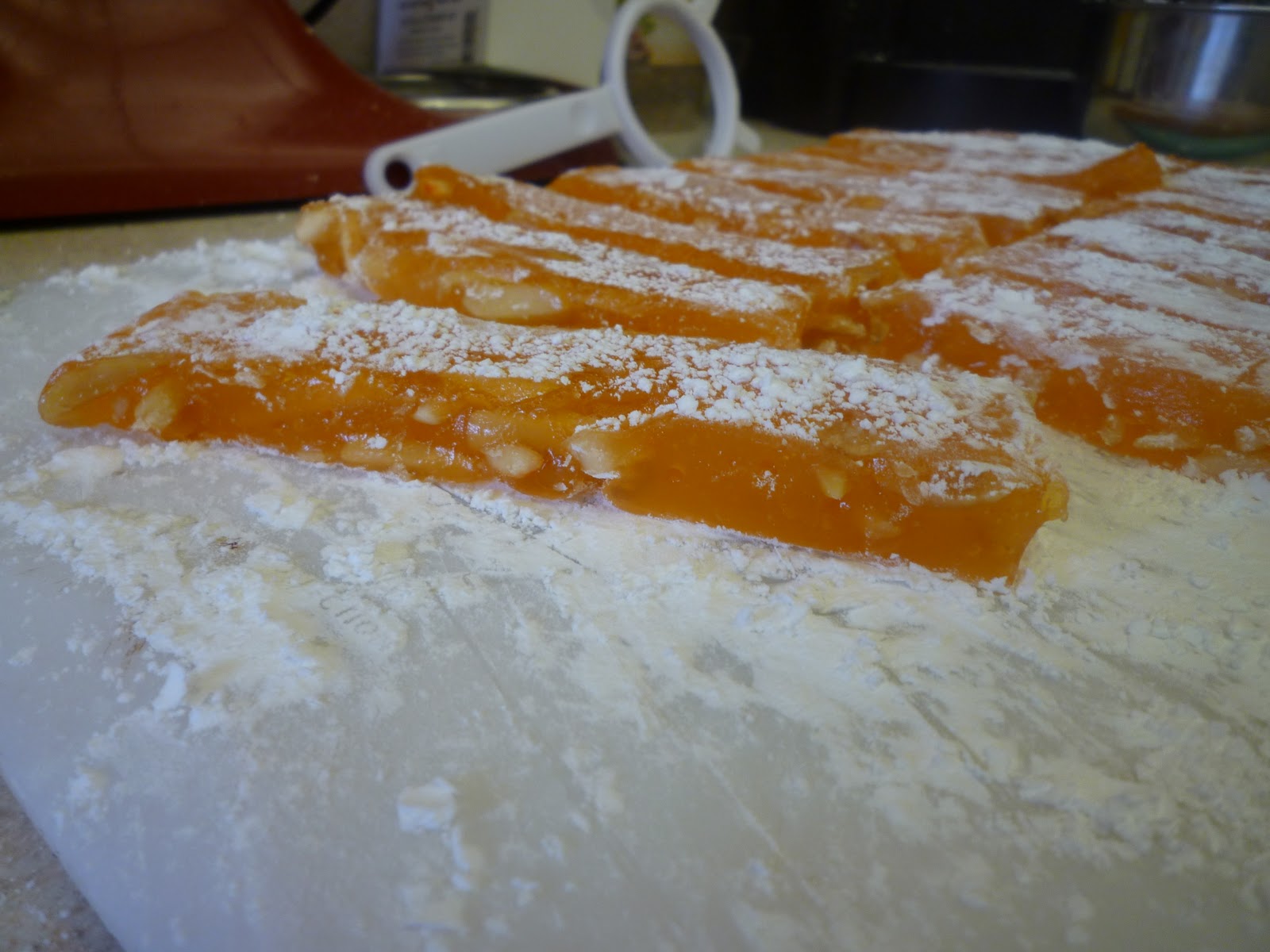
I recently gifted myself Chocolates and Confections at Home with the Culinary Institute of America written by Peter Greweling, an instructor at the CIA. I’ve been in the kitchen nearly every free moment since receiving it. Each chapter begins with a discussion of the theory and techniques (with photographs!) for the recipes found therein. Even if you’re not interested in making your own candy, it’s a really fascinating book for learning about what goes into some of the treats we love. Like most food, candies have cultural, social and regional ties that can bring a sense of nostalgia just from seeing them.  For instance, you C.S. Lewis and/or Charles Dickens fans may be interested to know that there is a recipe in Greweling’s book for irresistible Turkish Delight (I made mine orange and almond):

The main reason I went after this book was for the chocolate. There’s a whole chapter devoted to the treatment of chocolate and avoiding pitfalls like blooming or streaking in finished candies. Tempered chocolate and I have in the past, had a tenuous relationship. I chocolate-dip torrone or marshmallows, but they never look particularly pretty. How do I make molded chocolates with caramel or peanut butter inside? And candy bars? And cordial cherries? And..and…and…well the list goes on.

After reading the chocolate-chapter, I practiced tempering chocolate for some pecan and walnut turtles. While disastrously messy, it helped me learn how to arrange everything on my limited counter space and gave me a sense of the pace at which I needed to work. It reminded me so much of making marshmallows for the first time: Accept that you will make a mess, learn from it, and know that in the future you will know how to avoid it.

I was right. So before you all head off to dive head-first into your Thanksgiving cooking, here is a simple truffle recipe that makes an elegant addition to a holiday candy dish.

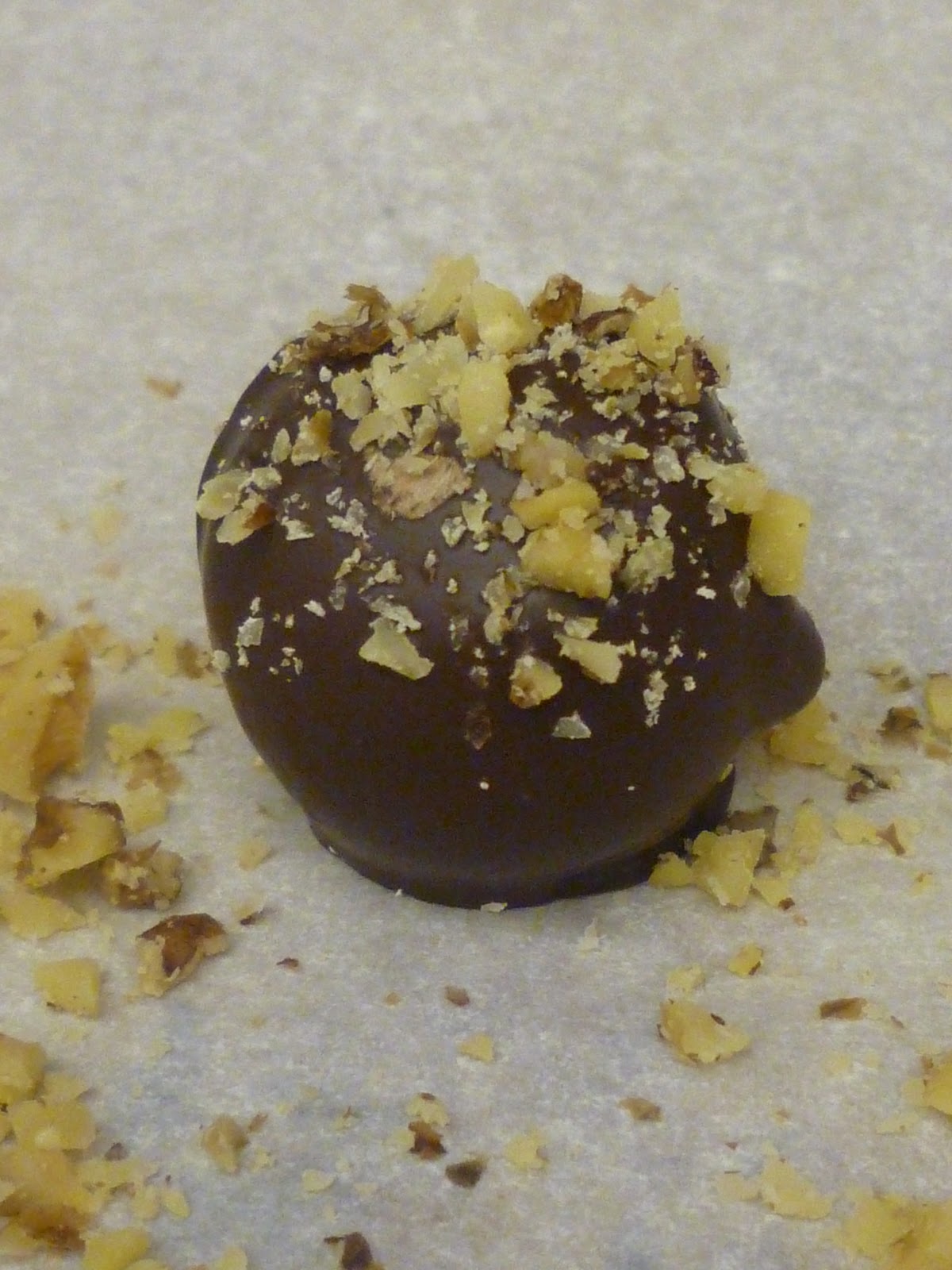
Marzipan-Walnut Truffles

Ingredients
Marzipan:
-3 oz. almond paste (I found it in the baking aisle at my local grocery store.)
-¾ cup powdered sugar
-2 oz. walnuts, chopped
-1-2 tbsp. brandy or other liquor (can use corn syrup for alcohol-free)

Coating:
-8 oz. dark chocolate, chopped
-2oz. walnuts, finely chopped

Method
-Cut the almond paste into small pieces and place in a mixing bowl.
-Sift the powdered sugar over the almond paste and knead into a cohesive ball, adding liquor or corn syrup as needed.
-Knead the chopped walnuts into the marzipan.
-Scoop teaspoon-size portions of the walnut marzipan and roll into balls to create the truffle centers.
-Prepare the coating by melting 6 oz. of the chocolate in a heat-safe bowl that fits snugly over a pot of barely simmering water (the bottom of the bowl should not touch the simmering water), stirring frequently until it reaches 120 degrees F. Remove from the heat, add the remaining 2 oz. chocolate and stir frequently until the chocolate is melted and reaches 85 degrees F.
-To maintain the temperature, place the bowl of melted chocolate on a heating pad set to medium. Alternatively, leave the small pot of water at a bare simmer on the stove and stir your chocolate over it if the temperature starts to drop.
-Use a fork to gently press each center in the melted chocolate and then turn once to coat evenly, -Scoop the truffle back onto the fork and tap the bottom of the fork on top of the melted chocolate a few times.
-Tap the fork on the edge of the bowl to remove the rest of the excess chocolate before gently setting the truffle on a baking sheet lined with parchment paper. Tapping the fork on top of the melted chocolate and then on the side of the bowl helps to keep a little chocolate puddle or “foot” from forming on the bottom of the truffle.
-Sprinkle the remaining chopped nuts over the truffles before the chocolate sets and then leave at room temperature until dry.

Makes about 20 truffles. Stored in an airtight container, they will keep at room temperature for several weeks.

Have a wonderful week. Happy Thanksgiving!

Ciao for now,

Neen