Press Your Luck: Farmhouse Cheddar

2 Mar

My dad is pretty handy. Proof? Take a look at what he built in my parents’ backyard last year:

When I decided that I really wanted to try making hard cheeses, I quickly realized that cheese presses weren’t exactly the most affordable pieces of equipment in the world. But the mechanism didn’t seem particularly complicated, and I was able to find simple plans on several websites (type “cheese press plans” into a search engine). Dad worked his magic and last weekend, I brought my press home to Arlington. (Thanks, dad!)

I decided to start with one of the simpler recipes in Ricki’s book, a farmhouse cheddar that would be ready to taste in about a month. The main reason I selected this recipe is that it offered the chance to practice many of the techniques involved in cheese making. Much like confectionery, the process is all about timing and chemistry. So, let’s cut to the cheese, err, chase:

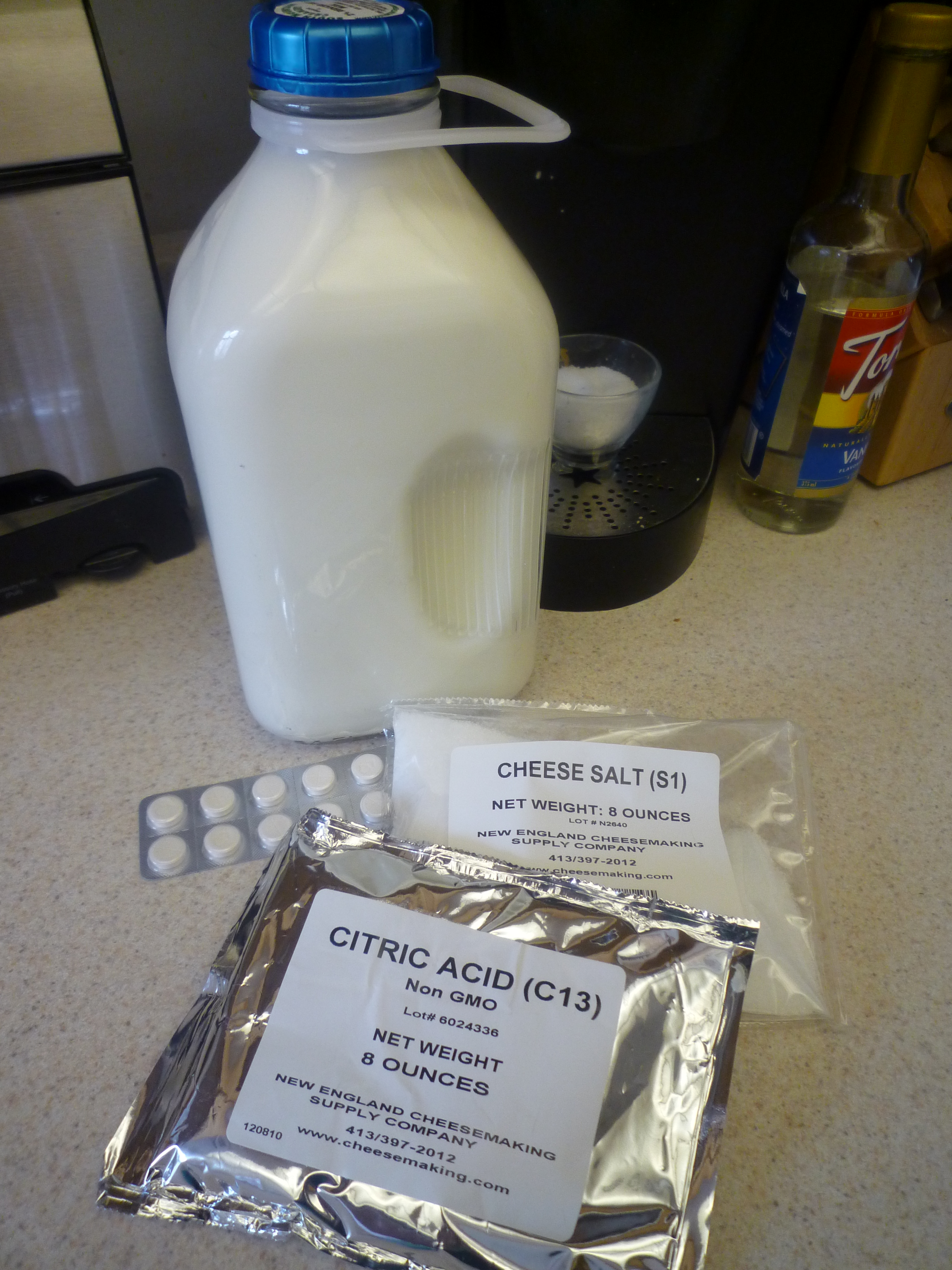
First a note about these ingredients. The original recipe calls for double what you see here. I realized upon filling my pot with milk that two gallons weren’t going to fit and cut the recipe in half.

Click on any of the pictures to see larger versions.

  • -1 gallon whole milk
  • -One package of direct set mesophilic starter
  • -½ tbsp. cheese salt (non-iodized salt)
  • -¼ tablet rennet or ¼ tsp. rennet, dissolved in ¼ cup water. (I used double-strength rennet and needed only 1/8 tsp.)
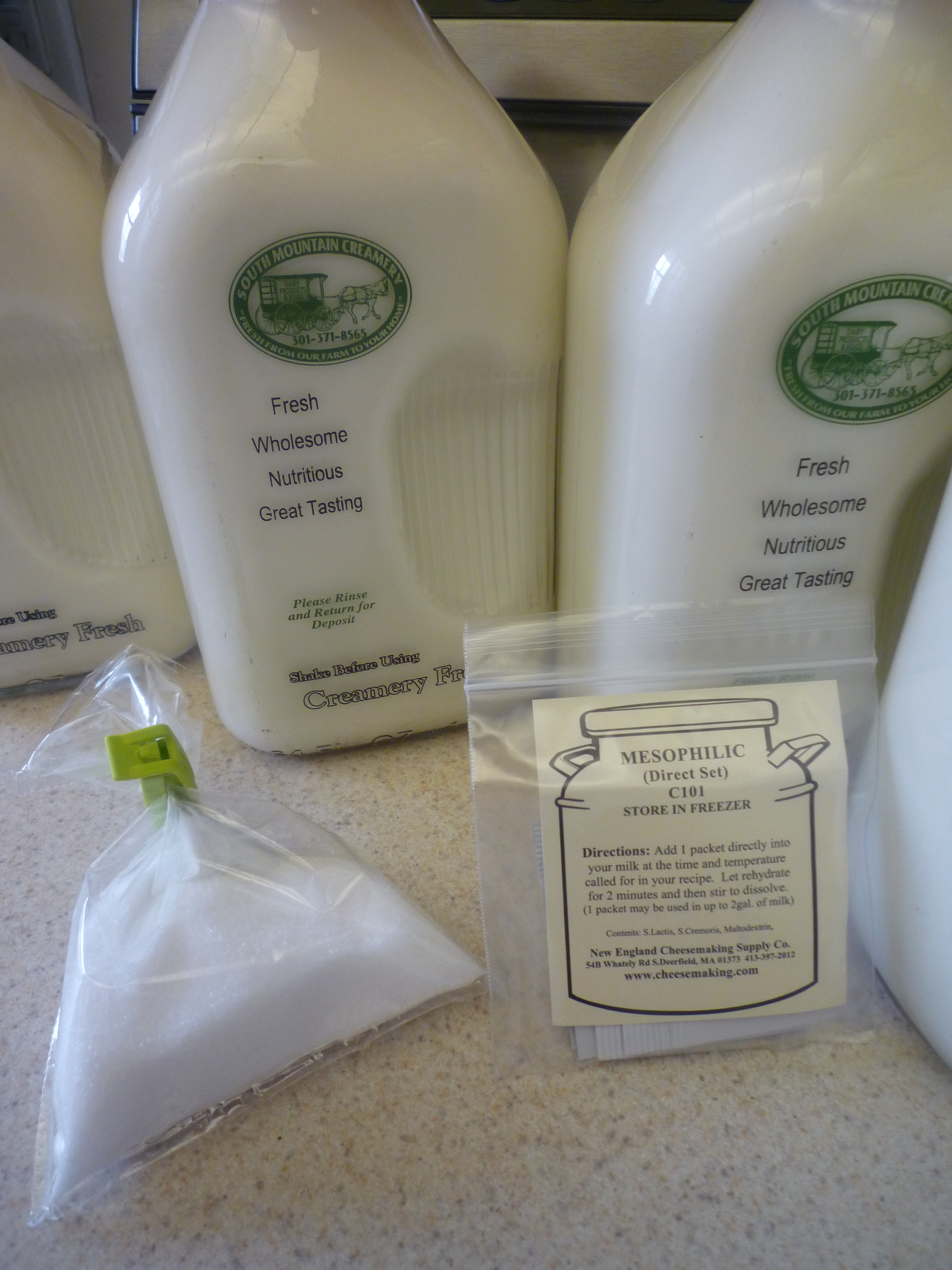
Pour the milk into a large pot and place it in a sink of warm water. Gradually increase the temperature of the water bath, either by running more hot water from the tap or adding small amounts of boiling water, until the milk reaches 90 degrees F. Add the mesophilic starter and mix well for about a minute. Cover the pot and allow the milk to ripen for 45 minutes. Check the temperature every so often, you want to keep it as close to 90 degrees as possible. I left my pot in the warm water bath and added small amounts of hot water every 10 minutes or so to do this.

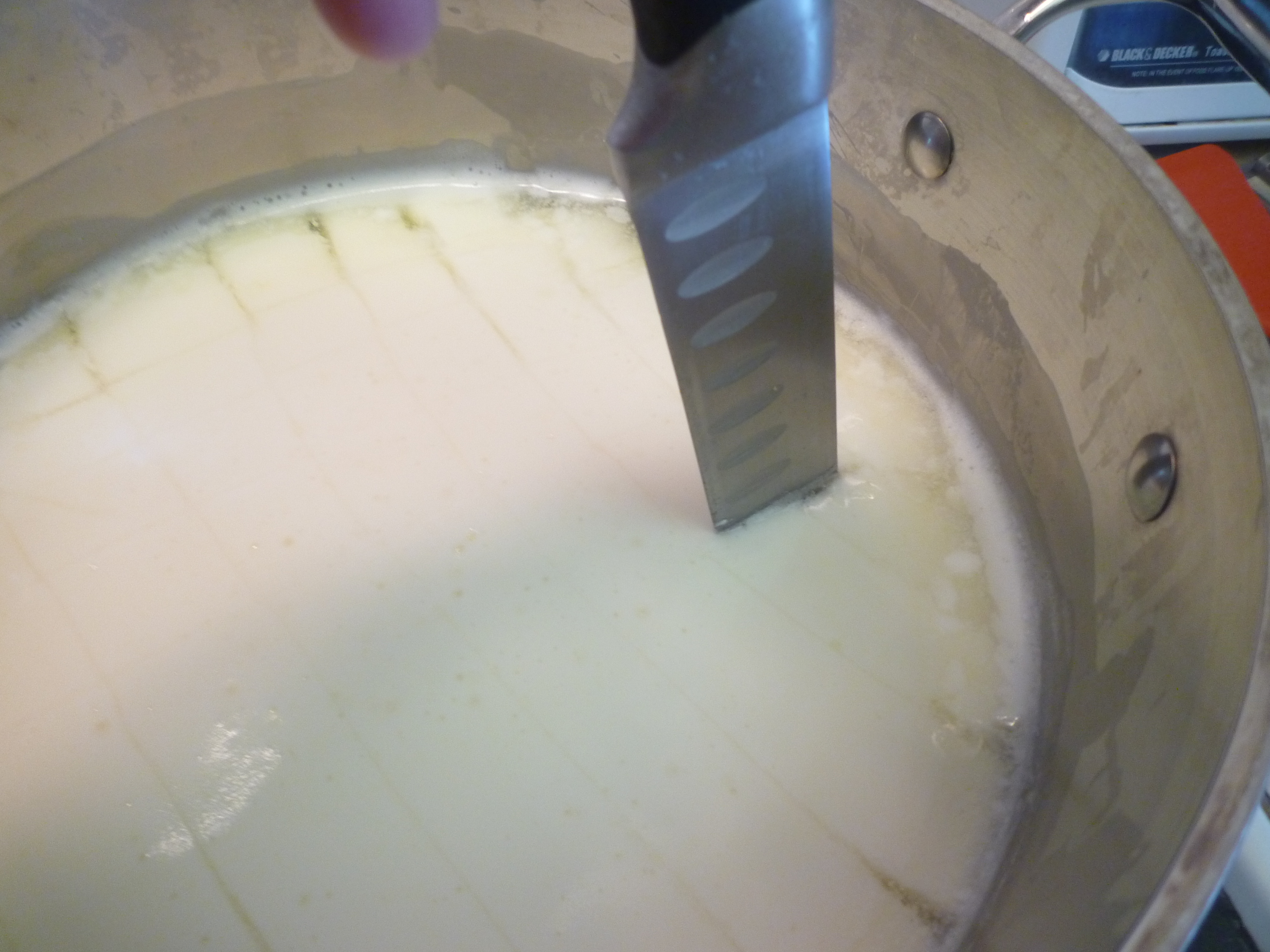
After 45 minutes, add the diluted rennet and stir, using a gentle up-and-down motion, for about a minute. Cover the pot and let it sit at 90 degrees F for 45 minutes or until the curd breaks cleanly. Cut the curd into a checkerboard pattern of ½ in. squares.

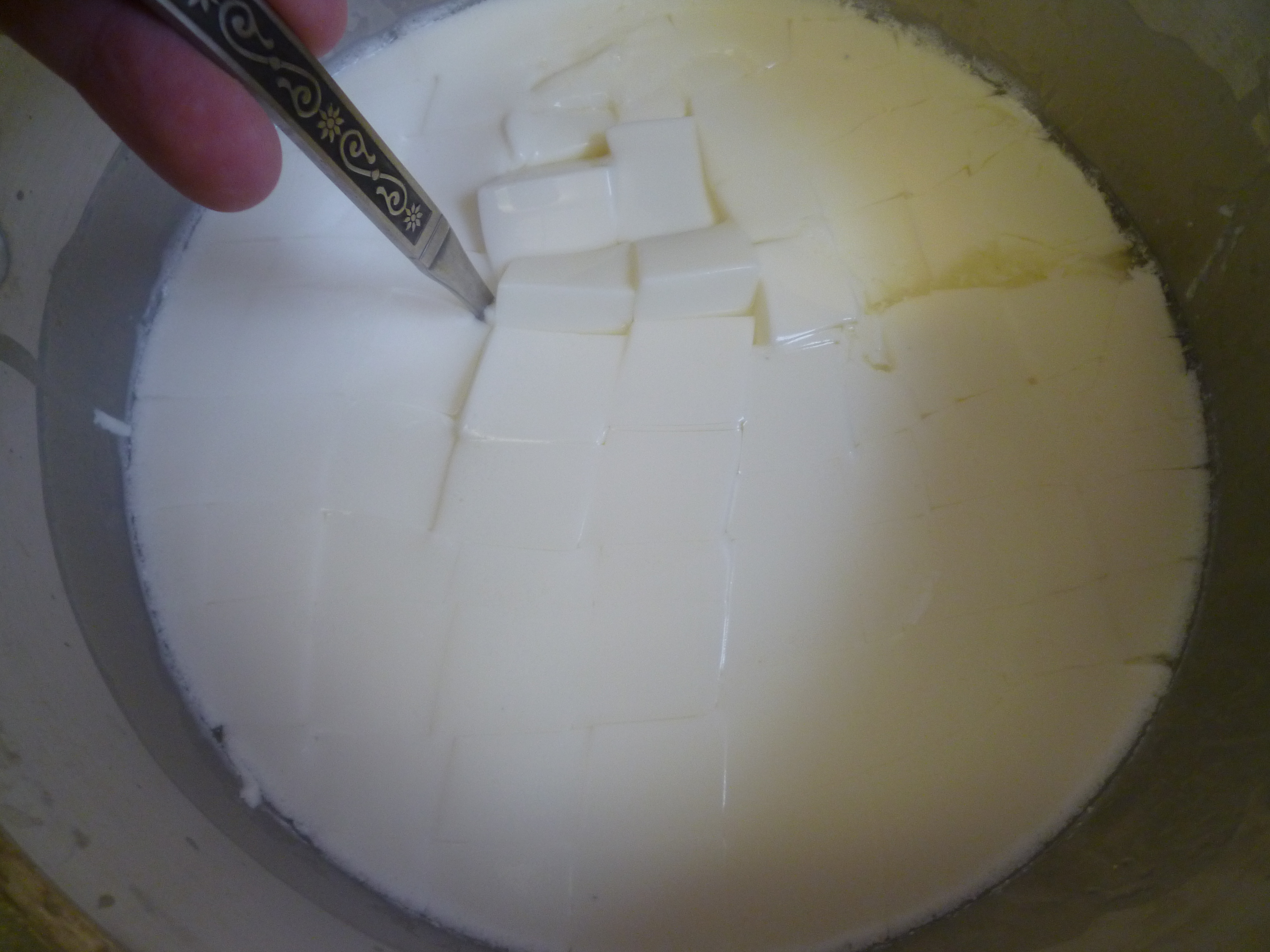
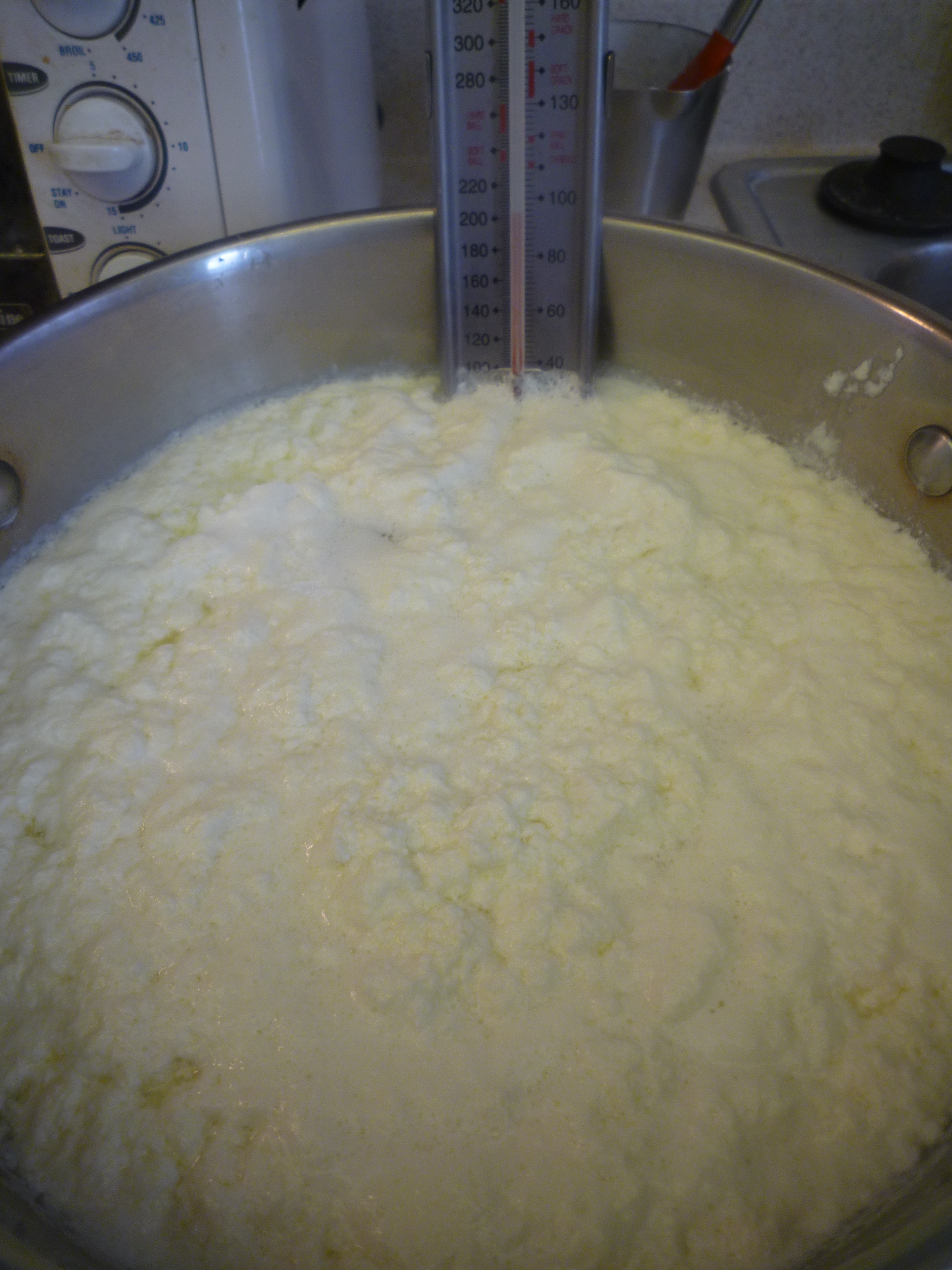
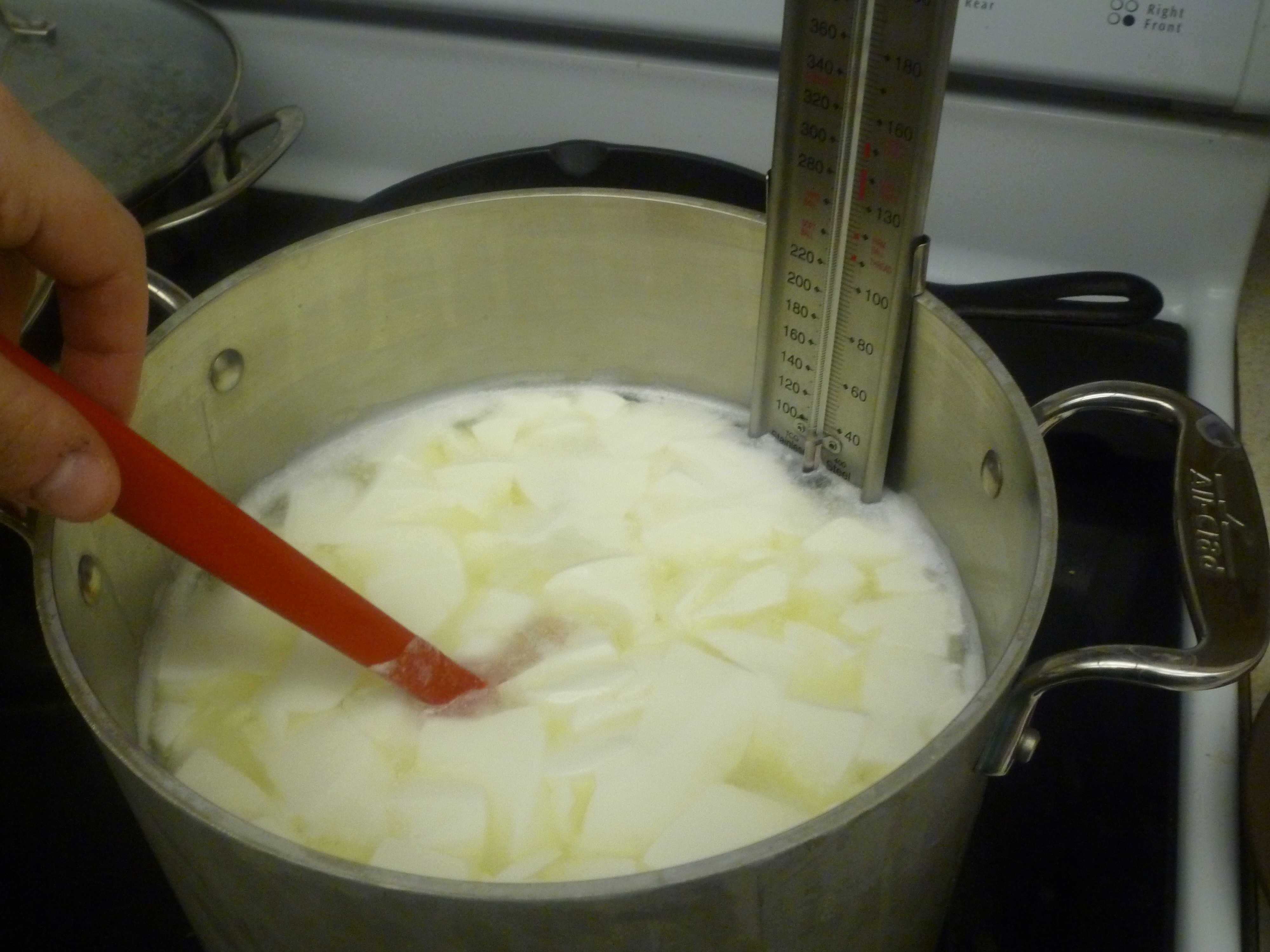
Again using the water bath method, slowly increase the temperature of the curd to 100 degrees. This can be a little tricky at first, since you don’t want to increase the temperature by more than 2 degrees every five minutes. Err on the slow side. Stir gently to keep the curds from matting together as they heat up. You’ll notice that they shrink a lot.

Once the curds reach 100 degrees, pour them into a colander lined with cheesecloth. Tie up the corners of the cheesecloth and hang the curds to drain in a non-drafty spot for an hour. You want to keep them fairly warm, so I hung them over the pot I used for heating.

After an hour, move the drained curd to a bowl and gently break into walnut sized pieces. Add the salt to the curds and toss lightly with your fingers to distribute evenly.

Firmly pack the curds into a mold (the teal pvc pipe pictured) lined with cheesecloth. Put the mold on top of an inverted plate over a pie pan. This allows the excess liquid to drain away from the cheese.
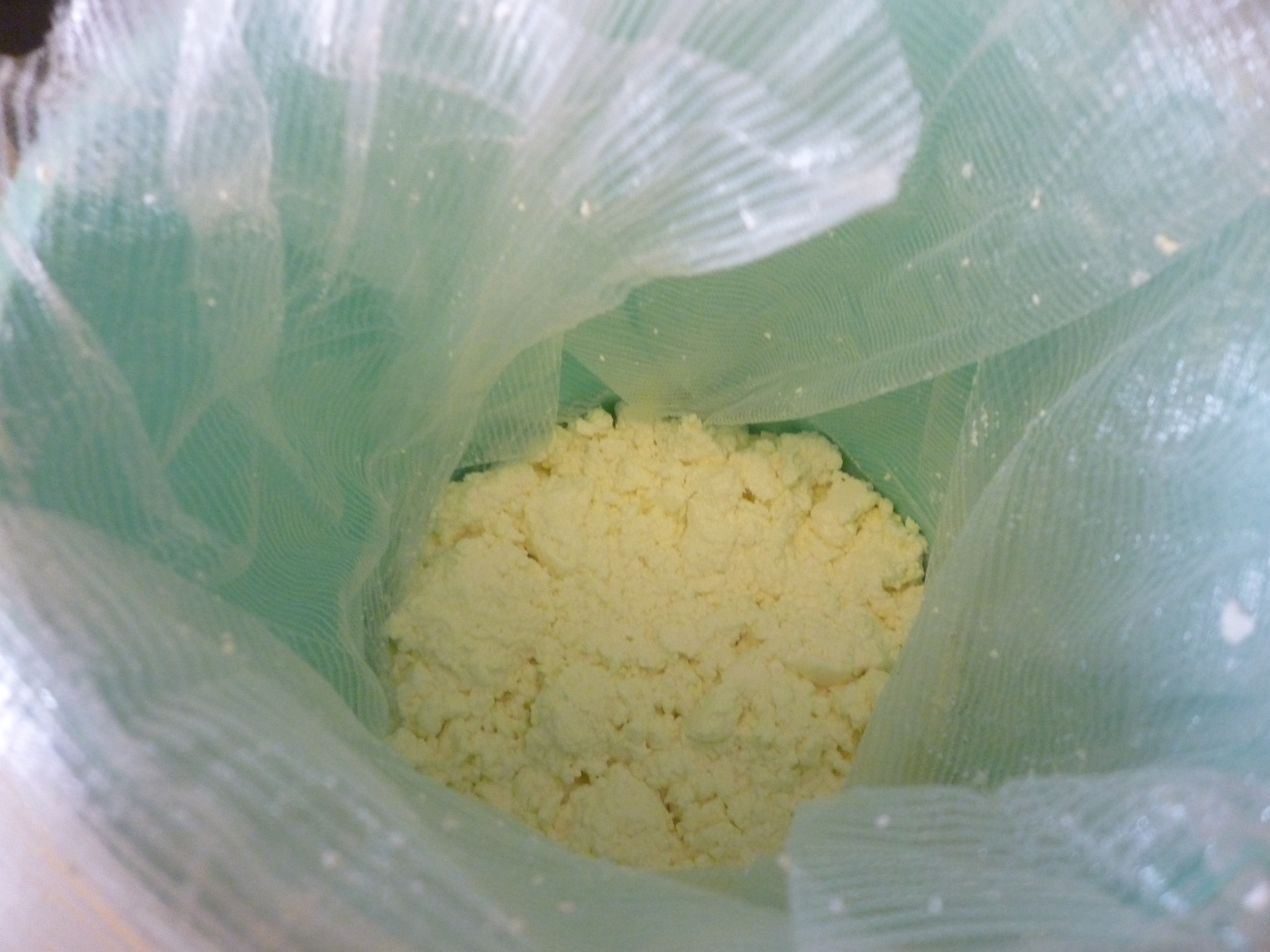
Fold the cheesecloth over the curds and place a snug fitting follower on top of them. Then add the pusher (the thinner, white piece of pvc pipe). Finally, place the board on top of the pusher and add weights as necessary.
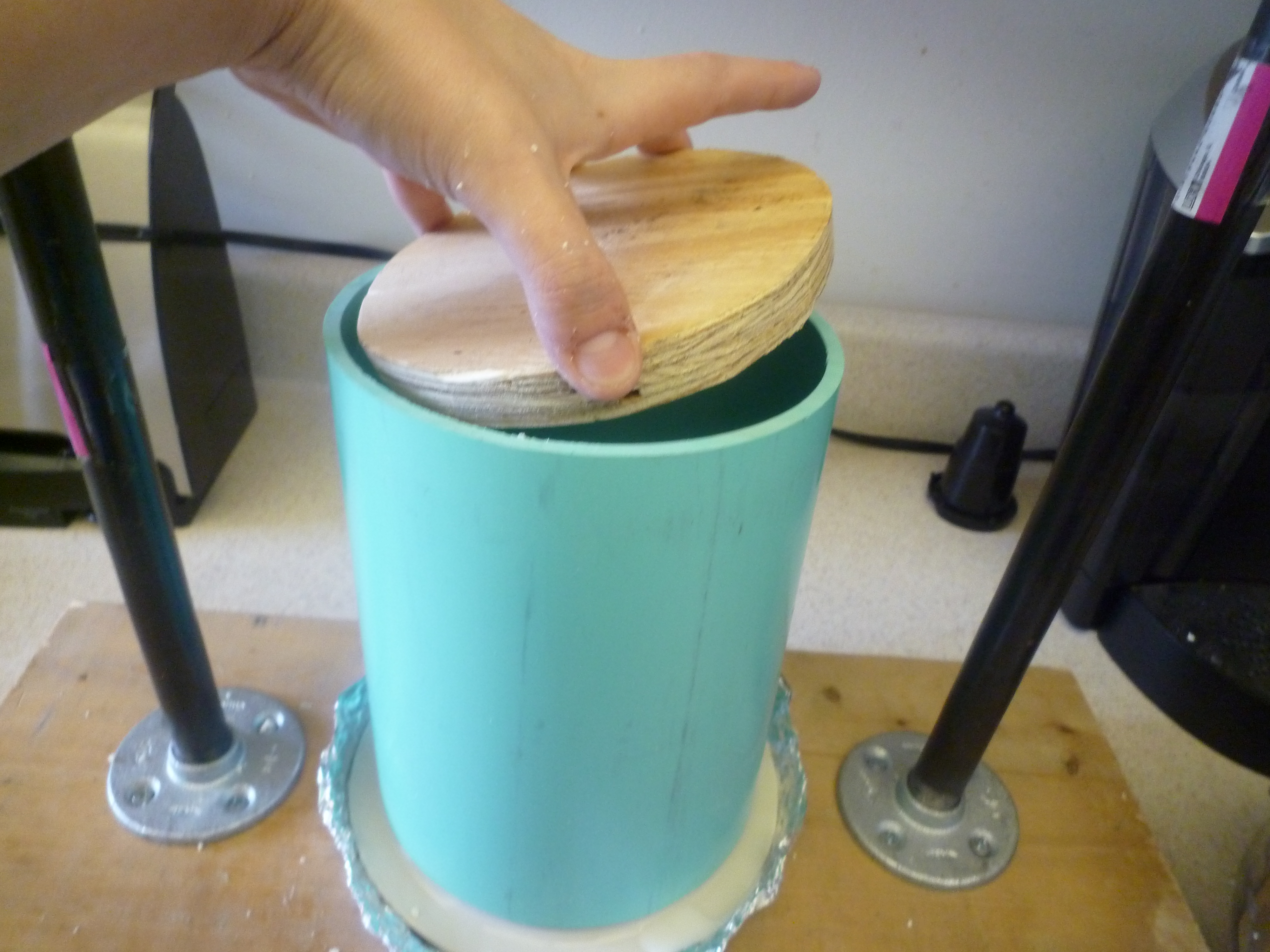
For farmhouse cheddar, press at 10lbs. of pressure for 10 minutes, then remove, flip the cheese over and redress it in the cheesecloth…
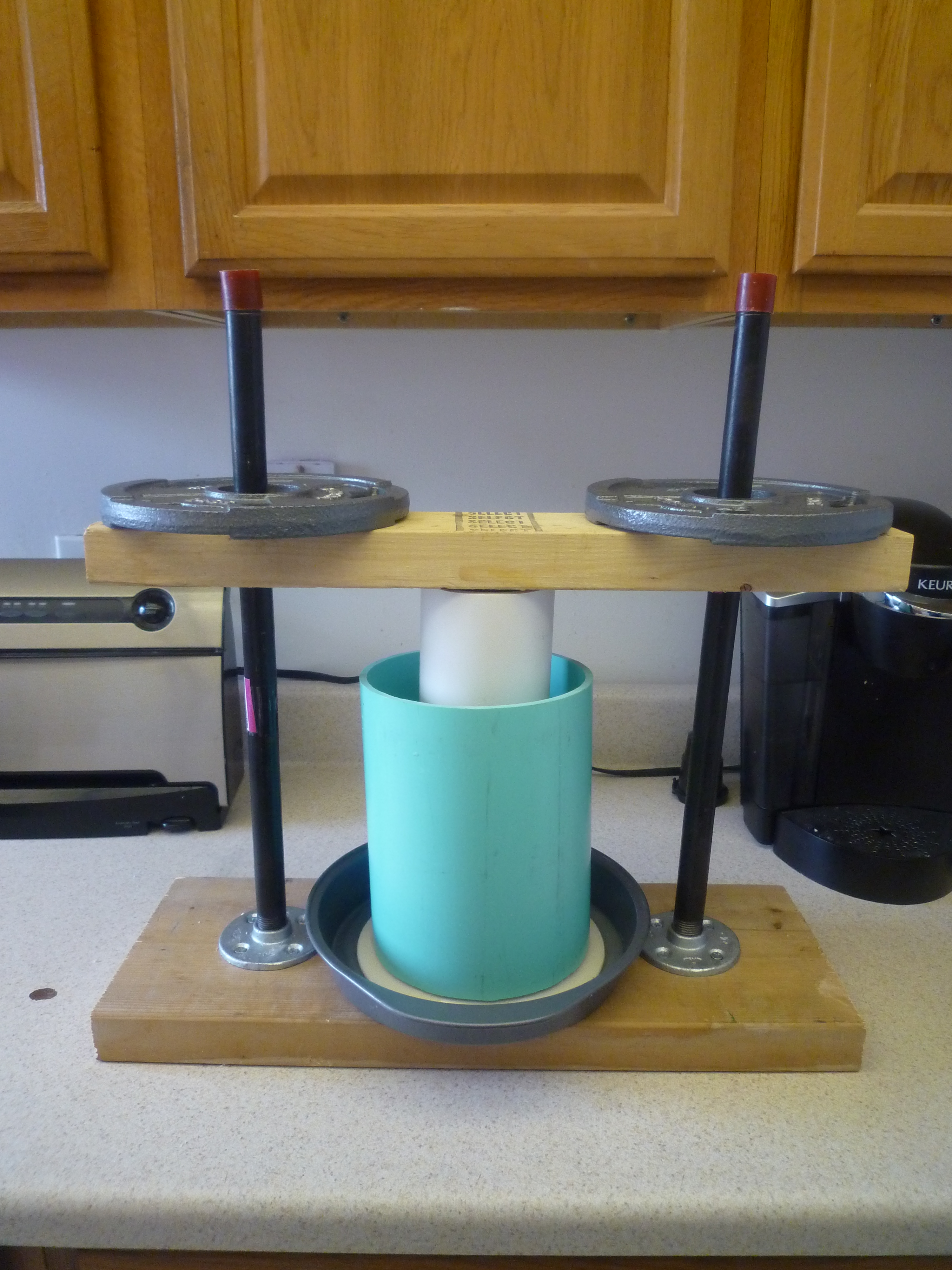
Then 20lbs. of pressure for 10 minutes, flip, and redress…

And finally at 50lbs. of pressure (Fact: The Joy of Cooking and On Cooking weigh 10lbs.) for 12 hours. Don’t do what I did and neglect to think about how this would time out; I had to get up at 3 a.m. to take the 50lb. weights off. D’oh.

After 12 hours, you should have something that looks like this. Personally, I like the rather attractive dent left on one side from the inverted plate:
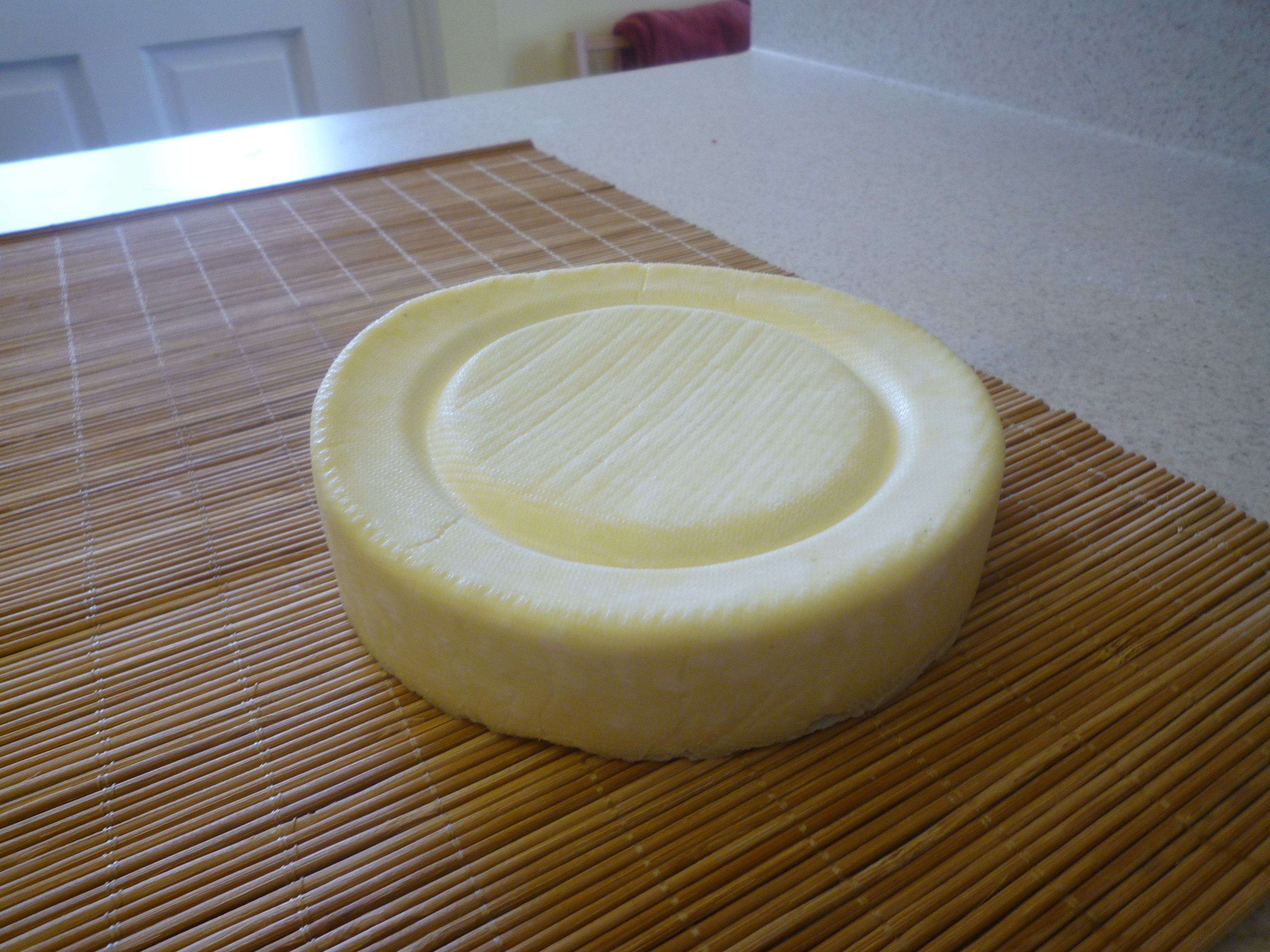
Put your cheese on a wooden board and allow it to air-dry at room temperature for 2-4 days. Turn it every so often to keep moisture from collecting on one side. Once the cheese has dulled in appearance and is no longer moist to the touch, you are ready to wax it.

Prior to waxing, refrigerate the cheese for several hours. You may also wipe it down with a paper towel dampened with vinegar to discourage mold growth.

Melt the cheese wax in a double-boiler until it reaches 210 degrees. Gently paint it on the cheese using a natural bristle or silicone brush, one side at a time.

Cover the wheel in two thin coats. My wax job was a little bit messy for a first rodeo, but I’m not really in a beauty contest here. You can always remove the wax and redo it (particularly useful if you decide to age it longer after cutting into it the first time), but we’ll see how things look in a month.

Age in a cool (below 68 degrees) environment for at least one month. Since the aging process began yesterday, I’ll be reporting back on 4-1-11 to let you know how it tastes. Hopefully it will not be a cruel April Fool’s joke.

Ciao for now,

Neen
Teen Dating Violence Awareness Month: “Grateful”

24 Feb

I am grateful.

Particularly on Saturday mornings. My four year old sheltie bounds immediately to the back door and barks excitedly, running joyfully around the patio, stopping to eat patches of snow as he goes. I boil a pot of water and grind enough beans to brew a French press full of rich, fragrant coffee. The dog comes back inside and immediately sits (his way of asking politely for a cookie). I smear a carrot stick with a little bit of peanut butter, put it down between his front paws, and he gleefully wanders off to devour his prize.

I assemble the ingredients to bake muffins to go with the morning coffee. Soon, the tantalizing smells will convince Joe to get up. In no time at all, my best friend and partner of six years will be chatting with me about the news and enjoying a lazy, work-free day while the dog snoozes between us. Maybe we’ll watch a movie, or take Dioji for a walk. In any case, I will be completely, utterly content and at ease.

And so, so grateful.

Almost a decade ago (in high school), I left an abusive relationship. As crazy as it sounds, it was one of the hardest things I’ve ever had to do. My partner at the time was manipulative and threatening to the point where I was afraid to go out with other friends. He told me that none of them could possibly love me as much as he did and that it was a waste of my time to maintain relationships with them. By the time I realized what was happening, what had begun as verbal put-downs spiraled into the ugly realm of physical and sexual abuse.

Following the break up, I tried for several months to endure his presence in the class and activities we shared at school. I thought that by doing this I was being strong and not causing trouble. But it couldn’t last. Every time I saw him, I relived the horrors over and over again. He wondered why I didn’t want to be friends. Finally, I filed for a protection from abuse order and won the motion. He was no longer allowed to be present at classes or events where I chose to be. What should have been liberating became a nightmare. My peers were afraid that I would do the same thing to other boys, and were aghast at the notion that my ex had done what I claimed. Most of those I considered friends turned away from me, insisting that it was just too hard to believe. Instead, degrading notes appeared in my locker, drinks were thrown on me at school sporting events, and classmates started petitions to have me removed from classes that my ex had been kicked out of, remarking that it was “only fair.” The school administration ignored those requests, but did nothing to correct the students’ misconceptions and assumptions.

To this day, I wish my acquaintances had believed me. Sometimes, albeit infrequently, there are days that feel compelled write to them and ask why they didn’t.

Why did you kick me while I was down? Why didn’t you love me?

My hope is that maturity has changed their attitudes toward victims of dating violence.

In my case, there is a positive epilogue. Over the last nine years, I’ve met people who’ve taught me what it really means to be a friend, and met a partner who has shown me that real love *is* respect. My friends, family, and partner gave me the strength and determination that has brought me to where I am now: I’ve graduated from university with honors, completed a master’s degree, lived in multiple cities both domestic and abroad, found a job that brings me happiness, and re-discovered that the world is full of wonderful people and experiences to soak in. I have a deep appreciation for the value of self-confidence and self-worth.

Nearly 1.5 million high school students nationwide experience physical abuse from a dating partner in a single year, and many have not been as lucky as myself. If someone comes forward to you and tells you that he or she is afraid in their relationship and needs help, it has already taken more courage than I can possibly describe to even come that far. Don’t stand for those who would blame the victim.

Don’t wait to be a true friend. I know that am forever grateful for each and every one that has been in my life.

Especially on Saturdays.

February is Teen Dating Violence Awareness Month. Please take the time to talk to the teens in your life about cultivating healthy relationships, and how to recognize the signs of abuse. To learn more, visit http://www.teendvmonth.org. If you think someone you know may be in an abusive relationship, don’t wait to speak up. Visit http://www.loveisrespect.org to learn how you can support victims and be a voice for real love. Love *is* respect…

www.teendvmonth.org

www.breakthecycle.org

www.loveisrespect.org

www.pcar.org

www.nsvrc.org

My Cheesy Valentine: Part Deux

15 Feb

Shortly after meeting my best friend in the world, I discovered his disdain for most things vegetable-related. I’ve since learned that while he doesn’t necessarily enjoy a veggie as the star of the show on a plate, he doesn’t mind their flavors in a dish. And to his credit, he’s become much more adventurous in our six-ish years together. Still, I was a little bit shocked the first time I made these little crostini that he found them just as delightful as I did. It’s a great appetizer for a crowd, or just for you and your sweetie.

Spinach, Artichoke and Caramelized Onion Crostini

  • 1/3 cup low-fat plain yogurt or Greek yogurt
  • 1/3 cup low-fat sour cream
  • 3 oz. Neufchatel cheese or cream cheese
  • 1 can of artichoke hearts, drained
  • 10 oz. fresh spinach
  • 1 onion, diced
  • 1 clove garlic, minced
  • 1 tsp. dried thyme
  • 1 tbsp. Dijon mustard
  • ½ tsp. dried cayenne pepper
  • Salt and pepper to taste
  • 1 french baguette

Cut the baguette into ½ in. slices on a diagonal and lightly brush them with olive oil. Toast until golden brown and set aside.

In a wide pan, sweat the diced onions in olive oil until soft, translucent and sweet. Add the garlic and cook for another minute. Add the spinach and cook just until it has wilted. Set the pan aside.

In the bowl of a food processor, combine the yogurt, cheese, sour cream, artichoke hearts, thyme, mustard, pepper, and a few pinches of salt. Pulse to combine. Add the spinach, onion and garlic to the food processor and pulse until it has a spreadable consistency.

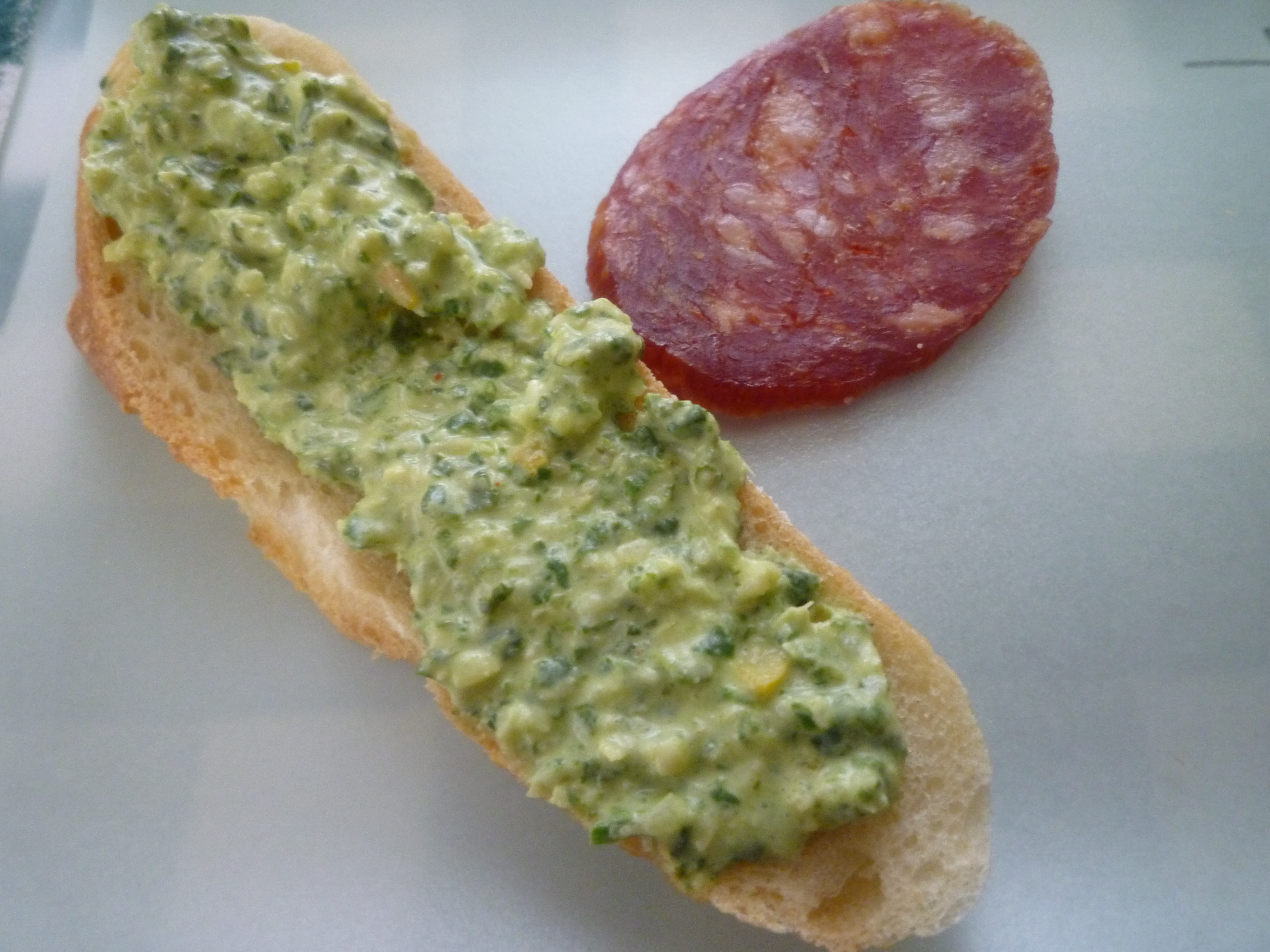
Top each toasted baguette slice with the spread and serve at room temperature. We had ours with some thin-sliced hot soppressata on the side. In the summer, I serve it as a chilled dip alongside raw carrot slices for a cool appetizer.

So that was our Valentine’s day appetizer, and you heard about the entrée in part 1, but I know what you’re really here for: Dessert.

I made this pound cake, which baked up beautifully. It’s an easy one-bowl recipe. It took a little bit longer to cook in my oven, but not by much. Maybe 1 hour and 30 minutes instead of the indicated 1 hour and 20 minutes.

The cream was whipped with some vanilla bean paste and a few teaspoons of sugar. I kept the it fairly neutral, because the cake was plenty sweet on its own.

The coulis was my favorite part (and apparently was Joe’s as well, because I caught him eating it out of the container with a spoon, haha). If your Valentine, like mine, does not love chocolate, try this!

Mash a pint of blueberries with a few teaspoons of sugar, a few drops of vanilla extract or vanilla bean paste, and the juice of one lime. You can also add a little bit of the zest for a stronger lime flavor. Simmer gently until thickened and a little bit syrupy, then let it cool to room temperature.

To put it all together, spoon a few generous swirls of the coulis on a plate, and then top with a cake slice and a dollop of whipped cream. The sauce has just enough tartness to balance out the cake’s sweetness and the cream brings the whole dish together. Oh, and the cake has the most wonderful, crackly crust. Delicious.

I hope that you are all having a lovely week! Enjoy the new goodies.

Ciao for now,

Neen
My Cheesy Valentine

14 Feb

A few weeks ago, I decided to try my hand at cheese making. It’s something I’ve always wanted to give a go, but wanted to do a little bit of research before trying. (With graduate school out of the way, I’m now working through the backlog of cookbooks and recipes I neglected.) For someone who loves cheese as much as I do, the prospect of making my own was very exciting. Since I’d planned to make Joe a special meal for Valentine’s day, I saw it as an opportunity to get something extra-special on our plates.

I started with ricotta, the easiest cheese to make. If you have milk (whole and 2% yield the best consistency), buttermilk, and some cheesecloth, you can make ricotta in under a half-hour. Line a colander with a few layers of cheesecloth and set aside. Combine a half-gallon of milk with 2 cups of buttermilk in a large pot over medium high heat. Stir every so often to keep the mixture from scorching, but once it is hot and steaming, stop stirring. When the mixture reaches about 175 degrees F, the curds will separate from the whey. Gently ladle the curds into the cheesecloth, tie up the corners, and hang the cheese to drain for about 20 minutes. Voila! You’ve made ricotta. Store in an airtight container in the refrigerator for up to a week.

Next up was another favorite: Mozzarella. This required a bit more special equipment, but I was able to order anything I needed from New England Cheese making Supply Co. I must recommend Ricki Carroll’s book, Home Cheese Making if you’re interested in learning all about the history and science behind cheese.

So here’s what you’ll need for mozzarella:

Ingredients

  • One gallon of milk*
  • 1 ½ tsp. citric acid dissolved in one cup of cold water
  • ¼ rennet tablet diluted in ¼ cup of cold water
  • 1/4 cup of cheese salt

*Note: Do not use milk that is labeled “ultra-pasteurized.” Pasteurized / homogenized milk will work just fine, but UP milk has been treated at such high temperatures that it is not suitable for most cheese making. (It will work for ricotta.)

Hardware

  • A large pot
  • A small colander that can fit inside the pot and a pair of tongs (or a spider if you have one)
  • A thermometer that will clip onto the pot
  • A board for kneading
  • Heat resistant gloves (I used these—I bought them for when I use my mandoline because the hand guard on it is flimsy.)

Okay, here we go!

Combine the milk and citric acid/water mixture in a pot over medium-high heat while stirring vigorously, then stir gently while the milk heats to 90 degrees F.

Take the pot off of the heat and add the rennet, mixing in a gentle up and down motion for 30 seconds. Put a lid on the pot and leave it undisturbed for 5 minutes. When you remove the lid, the curd should look like custard and should show a clear separation between the curd and whey. Test by putting two fingers between the curd and the side of the pot. If you see a clean break, the curd is ready to cut. If it is too soft, wait another five minutes and test again. It took a total of 15 minutes in my kitchen.

Cut the curds into a checkerboard pattern and put the pot back over medium-high heat. Cook, stirring the curds gently until they reach 110 degrees F. Take the pot off of the heat and continue stirring gently for 3-4 minutes.

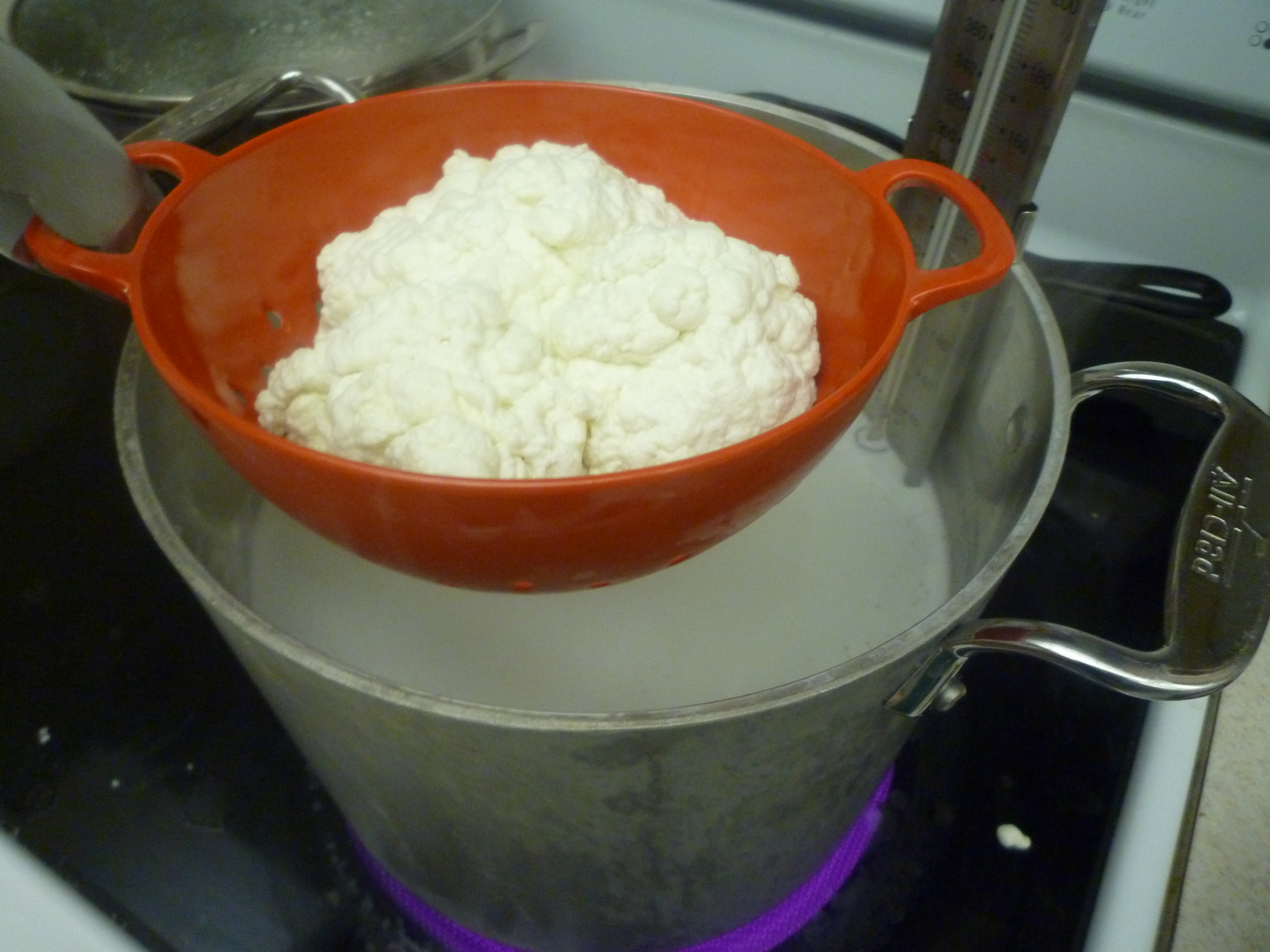
Gently ladle the curds into the colander over a bowl so that you can reserve the whey that drains off of them. Press them gently to remove as much whey as possible and so that they begin to form a cohesive unit.

Pour the whey that has collected in the bowl back into the pot, add the ¼ cup of salt, and allow it to heat to at least 175 degrees. (Put on your gloves!)

Dip the curds in the colander into the hot whey for several seconds.

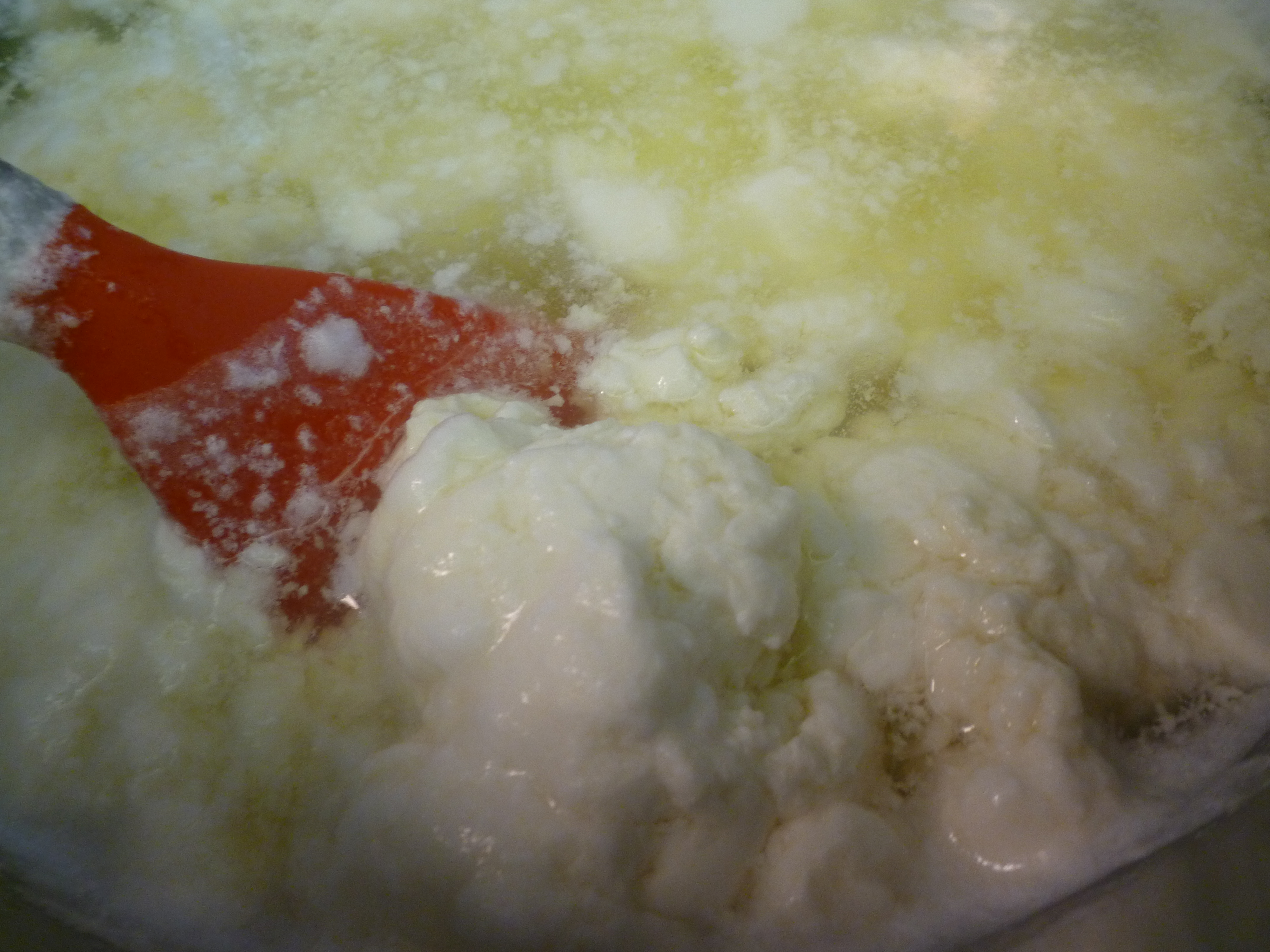
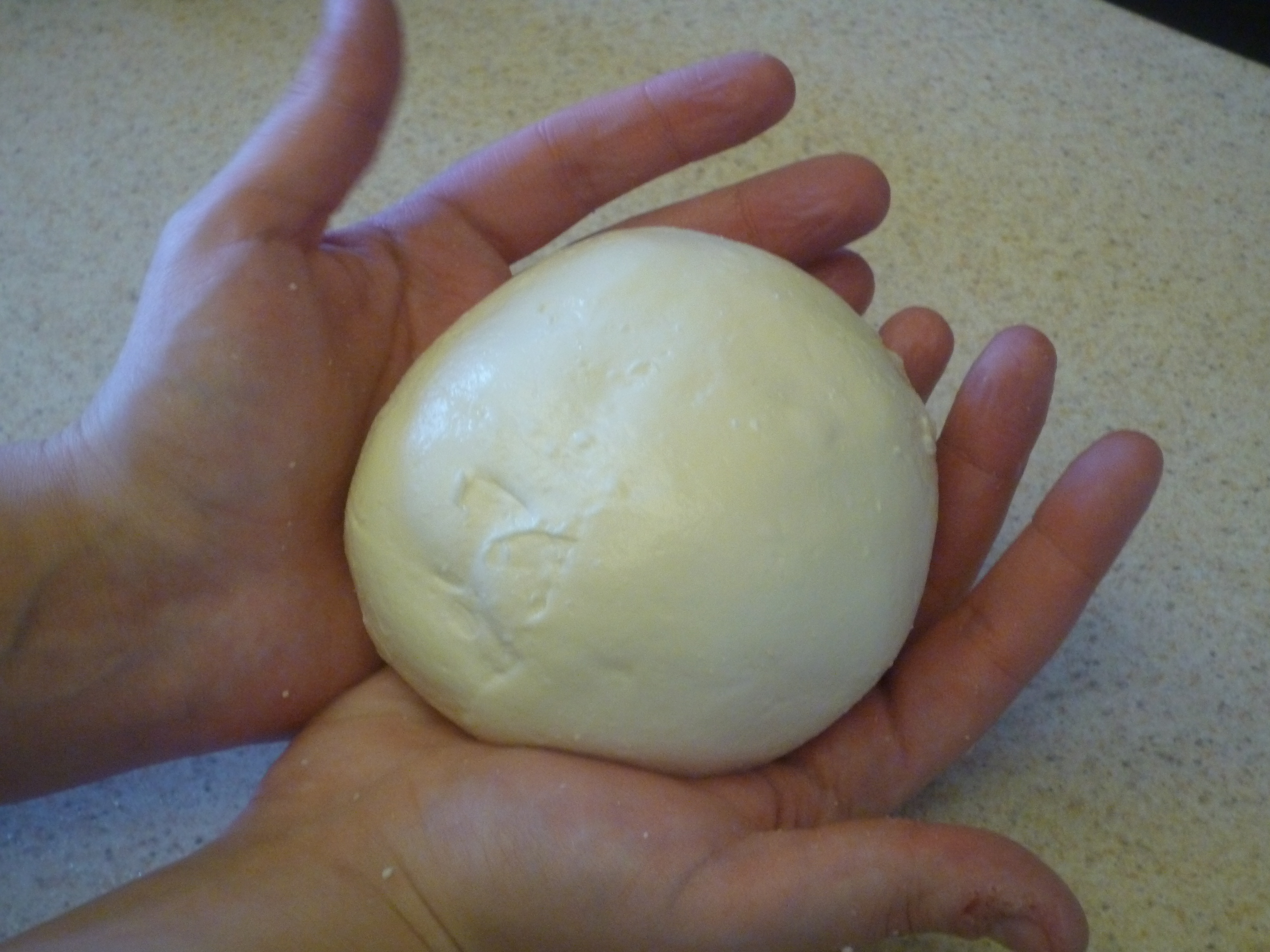
Remove, and then knead the curds like bread dough. Repeat this process several times until the cheese is cohesive and stretchable. The cheese is ready when it is shiny and has a consistency similar to pulled taffy. Roll into a ball and place immediately in a bowl of cold water for ½ hour. This will improve the texture of the cheese.

From there you can slice, grate, or melt it however you like.

So what did I make for my Valentine?

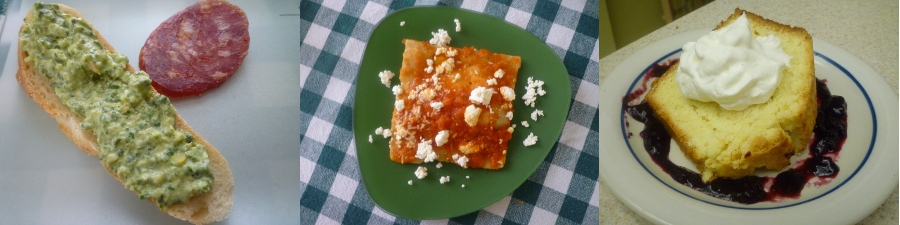
I made a batch of homemade pasta (hail Lidia Bastianich’s recipe) and filled ravioli full of fresh cheese and spices. Topped it all off with a touch of tomato & sweet pepper sauce and sprinkled on a little extra ricotta for good measure. Simple, but with ingredients so lovely I wanted to let them speak.

We also had some spinach, artichoke and caramelized onion crostini with hot sopressata, and finished the meal with a decadent little pound cake with vanilla bean whipped cream and blueberry-lime coulis for dessert. Don’t worry, recipes for the apps and dessert are forthcoming!

For now, have a happy (and cheesy) Valentine’s day. Share it with the ones you love and remind them just how special they are to you.

Ciao for now,

Neen

Black and Goldies: Super Blondies

1 Feb

Two entirely different things inspired this post. First, there was the February 2011 issue of Bon Appetit. If you haven’t seen the cover of said magazine, it was a siren calling, “Look at these delicious cocoa-walnut brownies, don’t you want them right now?” To use a Bourdain-ism: Total food porn.

Then there was January 23rd. It was the day that my beloved Pittsburgh Steelers valiantly defeated the New York Jets to secure their spot in Super Bowl XLV. I can’t wait for the big game this weekend vs. Green Bay. It has potential to be one of the best ever: Two teams so well-matched that it’s the lowest Super Bowl point spread in 27 years.

Having already made and devoured Bon Appetit’s dark and decadent goodies last week, I decided to switch it up this week and go for the gold. This one’s for you, Steelers.  Good luck in the big game!

Black and Gold Blondies

Black and Goldies

These are a one pot wonder, so make sure that your saucepan is big enough to accommodate all of the ingredients. I used a 4qt. to account for whisking space.

Ingredients
1 cup all-purpose flour
1 cup light or golden brown sugar, packed
8 tablespoons (4 oz.) unsalted butter
1 egg
½ tsp. vanilla extract
1 tsp. coconut flavoring (optional, but soooo good)
¼ tsp. salt
2 oz. dark chocolate, roughly chopped
1 cup pecans, toasted and chopped

Method
Pre-heat the oven to 350 degrees F.

Line an 8×8 in. pan with parchment or buttered foil.

To toast the pecans, spread them out on a sheet pan and bake for about 8-10 minutes or until lightly fragrant.

Cut the butter into 1 in. pieces and melt in a saucepan over medium heat. Stirring gently, allow it to cook for about 5 minutes or until the foaming subsides and the butter browns just lightly.

Take the pan off of the heat and beat in the brown sugar until the mixture is smooth and shiny.

Beat in the egg and extracts until thoroughly combined.

Slowly beat in the flour and salt until no dry spots remain and then add the pecans and dark chocolate pieces.

Spread the batter in the prepared pan and bake for 25 minutes or until a toothpick poked into the center comes out mostly clean (a crumb or two is fine). The top of the blondies should look shiny and set. This may take up to ten minutes longer depending on your oven, but start checking for doneness at 25 minutes.

Here’s the hard part: Wait. Let them cool in the pan on a wire rack for an hour and a half and then gently lift the whole slab out of the pan (this is where your foil/parchment is so handy). Let them cool out of the pan for an hour more and then cut into squares. Yield: 16 blondies.

Cook’s note: There is no leavening agent in this recipe, so these will be more fudgy and less cakey than some brownie/blondie recipes. The edges (especially if you use buttered foil) are lightly crispy. Personally, I love a gooey cookie so I have no complaints.

Enjoy the treats and GO STEELERS!

Troy Polamalu and Ryan Clark after the AFC Championship

Ciao for now,

Neen

Back to Basics: Béchamel

21 Jan

In The Making of a Chef , Michael Ruhlman recalls that nearly everyone in his Skills One class at the Culinary Institute of America scorched the first béchamel sauce that they attempted. He vividly describes the mountain of pots lined with scorched flour/butter/milk piled in the sink. Upon reading this, I smiled to myself:

“Oh, I remember that.”

I cannot count the number of times during college that I stood (highly annoyed) scrubbing stuck-on roux off of the bottom of my only saucepan. Irritated, I’d grab On Cooking off of my bookshelf and wonder, “What did I do wrong this time?” The number of things that could go wrong with such a simple sauce astounded me: Wrong pan. Pan too hot. Milk too cold. Milk too hot. Flour and butter not cooked enough. Gritty consistency. Raw floury taste. Burnt taste.

I hope to help my dear readers avoid that angst. This is how I make my white sauce and, inspired by the passage from Ruhlman’s book, I thought it was worth sharing.

Carl Sagan once wrote that “if you want to make an apple pie from scratch, you must first create the universe.” I say that if you want to make the perfect macaroni and cheese, you must first create the béchamel.

Unlike other mother sauces that begin with long-cooking stock, the beauty of béchamel is in its simplicity and relatively short cooking time. It is a post-work weeknight sauce.

Begin by pouring one cup of milk—in my opinion, 2% yields the best consistency and mouth feel—into a small saucepan. Add a bay leaf, bring the milk to a boil and then remove the pan from the heat and cover it.

In a medium saucepan, combine 1 oz. of butter and 1 oz. of flour over very low heat to make a roux. The roux will act as the thickener in this sauce. Using a pan with sloped sides is very important. You don’t want your roux getting stuck in the corners of a straight-sided pan and scorching. Not only will that undoubtedly ruin the flavor of your sauce, but lost roux means a watery, runny consistency.

As the butter melts, mix it with the flour to form a paste. There are various stages of cooking a roux. For béchamel sauce, cook on low heat only until it is just golden. The more a roux is cooked, the more flavor it develops, but the trade-off is that it loses its thickening ability. Darker roux are frequently used for brown sauces, gumbos and stews.

Now it is time to add the milk to the roux. Patience is the key here. Think about making an emulsion. If you’ve ever made mayonnaise you know that if you add the oil to the egg yolks too fast, the mixture will break and you will be left with a messy oil slick instead of a creamy mayonnaise. In this case, if you add the milk too quickly (or use cold milk) the sauce will be lumpy and/or grainy. How sad. So begin whisking the roux before any milk even touches the pan and add the scalded milk in a thin, steady stream.

Whisk, whisk, whisk. Turn the heat up to medium and do not stop whisking. Within a few minutes, the sauce will thicken and begin to bubble. At this point, add a few pinches of salt and taste the sauce. It will probably still have a little bit of raw, starchy taste. Cook, stirring continuously for 5-6 more minutes until the sauce is velvety and coats the back of a spoon. Add a few pinches of freshly grated nutmeg, stir, and taste again. If you like how it tastes, stop there.

Think, I mean really think, about how your sauce tastes. Yes, béchamel is often just a base, but it’s like building house: If you don’t have a good foundation, the rest is just going to crumble. So take time to make your base well and the final product will reward your taste buds. Taste, season, and taste again. Remove the bay leaf before serving.

Now you have your béchamel, or white sauce, and you can get creative. Add a handful of your favorite cheese and stir until it melts—that goes great over pasta and vegetables (I LOVE it on broccoli), use it unadulterated as lasagna or moussaka filling, or add a small onion that has been very finely diced and sweated in butter to make sauce soubise—which is excellent with grilled meat.

So there you have it: Delicious white sauce that takes less than 20 minutes to make. Experiment and enjoy.

Ciao for now,
Neen