Don’t Ask, Don’t Tell? Don’t Discriminate!

9 Jun

Generally, I like riding the Metro. I enjoy having the time to think about whatever I want to think about. At work and home there are usually little tasks waiting to be finished, but on the train there are no computers and barely even a cell phone signal. Free-thinking time.

Usually, this is a good thing. For instance, it gave me a chance to read up on the candidates for today’s primary elections before I go off to vote after work. Yes Virginians, there is a primary today. GO VOTE. Polls are open until 7.

Some days, this thinking time is not such a good thing. Those days are usually the ones where something has gone awry and I’m brooding over it because I cannot think of any action to take. Yesterday was such a day. I was reading the news and came across this:

WASHINGTON (AP) — The Supreme Court refused on Monday to hear a legal challenge to the Pentagon’s “don’t ask, don’t tell” policy, a decision that allows the Obama administration to continue its slow, back-burner response to liberal activists who want gays to serve openly in the military.

During last year’s campaign, President Barack Obama indicated that he supported eventually repealing the law, but he has made no specific move to do so since taking office in January. The White House has said it won’t stop the military from dismissing gays and lesbians who admit their sexuality.

Democrats who control Congress also are not in a hurry to end the policy, which was made law in 1993. Easing the outright ban on gays in the military caused political trouble for President Bill Clinton and Democratic lawmakers that year, and Obama and his congressional allies want to avoid an issue that would roil the public just as they are seeking support for health care and other initiatives.

A Democratic aide to the Senate Armed Services Committee called a review of the law “not a high priority” and said the panel will look at the issue sometime before the end of Obama’s term — but would not specify when. The aide spoke on condition of anonymity to speak freely about the committee’s plans.

It shouldn’t surprise me, but it does. It sickens, disgusts, and enrages me beyond belief to see our government support such a shameful policy. And it made me wonder, “What if Clinton had stood his ground?” By compromising rather than demanding equality at the very start, it’s made it far too easy for the homophobic portion of the population to consider “Don’t ask, don’t tell” a fair and just policy.

At it’s heart, the policy is nothing more than basic discrimination. The fact that reviewing it is “not a high priority” is outrageous when those in power claim the U.S. as a nation to be a celebration of diversity. Using the excuse that repealing it now would distract us from our “objectives” in the middle East, or make it more difficult to pass health care reform, is ludicrous. By requesting that the Supreme Court not hear this case, the Obama administration has effectively slapped the faces of many of its most fervent supporters. I knew there would be decisions I did not agree with, but this was a no-brainer.

It doesn’t take rights away from anyone, it doesn’t take money away from anyone, and it’s a Puritanical policy that was put in place to soothe a group of people who use this logic: It’s okay for you to go and get your head blown off in a foreign country by some grenade wielding maniac, but don’t you dare tell us that you love someone of the same gender! In other words, you’re good enough to be a tool of our military, but not a human being with a full set of civil rights.

Support the troops? Then put your money where your mouth is and support all of them.

Don’t Ask, Don’t Tell? Don’t Discriminate!

9 Jun

Generally, I like riding the Metro. I enjoy having the time to think about whatever I want to think about. At work and home there are usually little tasks waiting to be finished, but on the train there are no computers and barely even a cell phone signal. Free-thinking time.

Usually, this is a good thing. For instance, it gave me a chance to read up on the candidates for today’s primary elections before I go off to vote after work. Yes Virginians, there is a primary today. GO VOTE. Polls are open until 7.

Some days, this thinking time is not such a good thing. Those days are usually the ones where something has gone awry and I’m brooding over it because I cannot think of any action to take. Yesterday was such a day. I was reading the news and came across this:

WASHINGTON (AP) — The Supreme Court refused on Monday to hear a legal challenge to the Pentagon’s “don’t ask, don’t tell” policy, a decision that allows the Obama administration to continue its slow, back-burner response to liberal activists who want gays to serve openly in the military.

During last year’s campaign, President Barack Obama indicated that he supported eventually repealing the law, but he has made no specific move to do so since taking office in January. The White House has said it won’t stop the military from dismissing gays and lesbians who admit their sexuality.

Democrats who control Congress also are not in a hurry to end the policy, which was made law in 1993. Easing the outright ban on gays in the military caused political trouble for President Bill Clinton and Democratic lawmakers that year, and Obama and his congressional allies want to avoid an issue that would roil the public just as they are seeking support for health care and other initiatives.

A Democratic aide to the Senate Armed Services Committee called a review of the law “not a high priority” and said the panel will look at the issue sometime before the end of Obama’s term — but would not specify when. The aide spoke on condition of anonymity to speak freely about the committee’s plans.

It shouldn’t surprise me, but it does. It sickens, disgusts, and enrages me beyond belief to see our government support such a shameful policy. And it made me wonder, “What if Clinton had stood his ground?” By compromising rather than demanding equality at the very start, it’s made it far too easy for the homophobic portion of the population to consider “Don’t ask, don’t tell” a fair and just policy.

At it’s heart, the policy is nothing more than basic discrimination. The fact that reviewing it is “not a high priority” is outrageous when those in power claim the U.S. as a nation to be a celebration of diversity. Using the excuse that repealing it now would distract us from our “objectives” in the middle East, or make it more difficult to pass health care reform, is ludicrous. By requesting that the Supreme Court not hear this case, the Obama administration has effectively slapped the faces of many of its most fervent supporters. I knew there would be decisions I did not agree with, but this was a no-brainer.

It doesn’t take rights away from anyone, it doesn’t take money away from anyone, and it’s a Puritanical policy that was put in place to soothe a group of people who use this logic: It’s okay for you to go and get your head blown off in a foreign country by some grenade wielding maniac, but don’t you dare tell us that you love someone of the same gender! In other words, you’re good enough to be a tool of our military, but not a human being with a full set of civil rights.

Support the troops? Then put your money where your mouth is and support all of them.
In Praise of the Pasture

5 Jun

Note: The following post contains information about commercial beef production that readers may find disturbing. While I encourage you to read on, I ask that you do so at your own discretion and with an open mind. Thank you.

Before the corn industry took America by storm following World War II, cattle and other herbivorous, pastured animals were raised in fields using rotational grazing. This grazing practice divides a pasture into several sections and moves the herd between sections regularly throughout the year to prevent over-grazing. In return, the cattle provided their rich manure to help replenish the pasture year after year. This manure was also used to fertilize the crops grown on the farm. In fact, the working farm was very nearly a perfect cycle with no waste.

However, once World War II ended, the U.S. found itself left with an overabundance of synthetic nitrogen which had been used to make bombs. In an attempt to use it, it was given to farmers to use on their fields. With synthetic nitrogen now replenishing the fields, there was no longer any need to pasture animals. That same land could be used for growing more corn. Thus, the animals moved from the farm to the feedlot, where nature’s balanced cycle was indelibly broken. Farmers were no longer forced to rotate crops in order to keep nitrogen in the soil and corn became the golden child of the commercial agriculture industry. It has since made its way into over 2/3rds of consumer products.

And as for those big steer in the feedlots?

A typical commercial steer is given access to “feed” fairly frequently while being contained in a pen with hundreds of others like it. I put the above word in quotes because I’m not sure that this diet can necessarily be considered food to an animal that is, by nature, an herbivorous creature. Here is what the average steer gets:

Flaked corn, liquefied fat which is often in the form of beef tallow, molasses and urea (a protein supplement made from the same synthetic nitrogen fertilizing the fields), alfalfa hay and silage, Rumensin and Tylosin (antibiotics), and synthetic estrogen.

What’s important to remember is that steer evolved eating grass. Their stomachs contain a unique fermentation-like chamber where they can actually convert grasses into a form of protein. They’re not biologically equipped to digest corn and force-feeding it has created the host of problems (like bloat, acidosis, and infection) that cause the antibiotics to be necessary. In fact, cattle are so ill-equipped to digest this food that it can only be given to them for 150 days at most before they must be taken off of it. According to Dr. Mel Metzin, a staff veterinarian at a feedlot in Kansas, 15-30 percent of feedlot cattle are found to have abcessed livers at slaughter, and in some places the figure is as high as 70 percent. The antibiotics are also needed because the cows sleep in the very same pen where they eat, which often means sleeping in their own manure for extended periods of time. While not a pleasant thought at the start, it becomes even more reprehensible when you consider all of the hormones and antibiotics the average steer is laying in on a regular basis.

These antibiotics make their way into our meat and unfortunately have caused antibiotic-resistant strains of bacteria like e-coli to evolve. All of this doesn’t even take into account the fact that the corn being fed to these non-corn eating animals is littered with chemical fertilizers and has been genetically modified to produce maximum yield (some new strains even have built in pesticides! Eee…).

If this sounds overwhelming to you, breathe a sigh of relief as I tell you that you absolutely do not have to support this even if you are an omnivorous human like myself. Below are the URLs of the two local farms that I choose to get my bison, pork, and poultry products from. I provide their websites to use as a reference for what you should look for if you want to find a sustainable farm in your area. Notice how open these farmers are about guests visiting and how freely they describe their agricultural practices. Farms like these can provide you with quality meat/poultry products from animals that are raised on the foods their biology programmed them to eat, without any added antibiotics, hormones, or genetically modified food.

www.smithmeadows.com

www.cibolafarms.com

Please note that I choose bison over beef purely for the health reasons (higher protein content/lower fat) and because it is more readily available at my local market. I have nothing against sustainably raised cattle. If you’re really interested in finding a sustainable source of quality meat and are having trouble, please leave a comment and I will be more than happy to help you in your search. After all, I’m in library school…I can always use practice on those reference questions!

-Neen

References

Kessler, David. The End of Overeating: Taking Control of the Insatiable American Appetite (Rodale, 2009).

Pollan, Michael. In Defense of Food: An Eater’s Manifesto (Penguin, 2009) and The Omnivore’s Dilemma: A Natural History of Four Meals (Penguin, 2007).


Why Should I?

1 Jun

Over the weekend, I took some time to consider the question, “Why do this?”

It was tough when I began to think about writing this particular blog post because there is a whole host of reasons why I’ve chosen to eat clean and as local as possible. Much of my reading as of late has been devoted to this topic and has inundated me with a great many statistics. While these are certainly important, what I am trying to do and the motivation behind it can be explained in much simpler terms by someone who has done far more research:

“Depending on how we spend them, our food dollars can either go to support a food industry devoted to quantity and convenience and “value” or they can nourish a food chain organized around values–values like quality and health. Yes, shopping this way takes more money and effort, but as soon as you begin to treat that expenditure as a kind of vote–a vote for health in the largest sense–food no longer seems like the smartest place to compromise.”
-Michael Pollan

For tens of thousands of years, our ancestors ate the food provided by their local habitats. Even in (relatively) recent history, items transported from other places were rare commodities, saved for special occasions and relegated to things which simply could not be produced in the local climate.

With the advent of modern technology, we’ve learned to do it all quickly and efficiently. But is this really the best way to do things? Consider that most commercially grown products are bred for quantity (thus those watery, mealy tomatoes that pop up in the store in January) and visual appeal (but they looked so nice on the shelf!), and it becomes clear that what is being provided in the grocery store is nothing more than a mirage. Sure, the produce section looks full even in the middle of winter, but at what price? By the time those tomatoes reach the store, they’ve been shipped hundreds (if not thousands) of miles and their nutrition has degraded significantly. And since it’s the middle of winter, you guessed it, you’re going to pay more for them anyway. Paying more for an inferior product doesn’t make sense, does it?

So, as Pollan puts it, you have to put forth the effort. This means buying tomatoes from a local farm when they are in season and preserving them as best you can. While canning, dehydrating, and freezing all cause nutrient loss, products grown using sustainable agriculture practices contain significantly more vitamins, nutrients, and antioxidants than their commerically grown counterparts. So, while you’ll still lose some in the “saving” process, you’re left with more than what you’d get from the grocery.

Even much of that can be avoided by eating what is in season at any given time. Googling farms in your area can give you an idea of when certain products peak and what time of year you can expect to have certain vegetables and fruits. It’s really forced me to try some new veggies, which is never bad! Plus, many farms are open for “pick-your-own” fruits and vegetables, which is a great way to get kids involved in healthy cooking as children are more likely to eat something which they’ve had a hand in choosing and preparing.

And yet, while all of these are fine arguments for local food, none capture what it is that drives me: I feel better. I am very curious to see how my blood work comes up this week after finishing iron treatment and really devoting myself to better eating habits. But it’s not just a physical feeling of well-being either. It’s embracing my place as a citizen of the world. It is accepting that food, in its most basic form comes from a complex web of relationships between living beings. It is understanding that while the lifestyle comes with its sacrifices, it embraces the harmony between those living things that provide us with sustenance and a sense of community.

While I’m not a member of a religious faith, this connection to what fuels us has brought me a profound sense of peace and has reminded me that nature is, in the truest sense of the word, awesome.

Clean BBQ? It’s True…

28 May

When Joe and I decided to have folks over for Memorial Day this year, I decided that I wasn’t going to prepare a bunch of food that I couldn’t eat. For one thing, I knew that there would be leftovers and I wasn’t tossing away my grocery money on food that wasn’t in my plan. Furthermore, I thought my guests deserved food and not “food-like products.”

Here I am hanging out with Mr. Stripey ready to grill, so what was on the (mostly) clean menu?

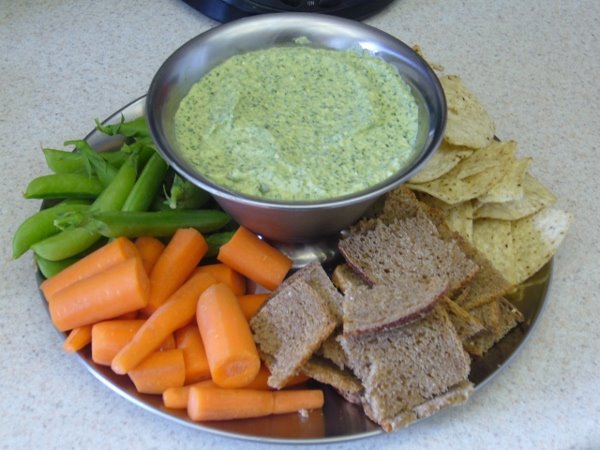
Clean Eating Magazine’s Caramelized Onion, Spinach, and Artichoke Dip served with Trader Joe’s natural corn tortilla chips, chopped carrots, toasted whole grain bread, and sugar snap peas (from Westmoreland Berry Farm—so delicious!).

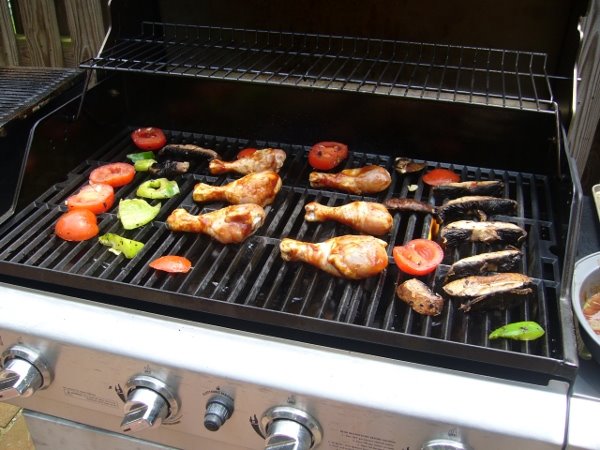
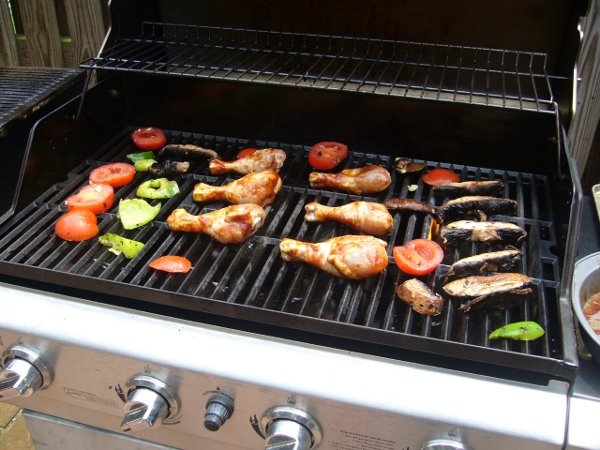
Dry rubbed chicken legs grilled to perfection and then glazed with a natural BBQ sauce.

Grilled portabella mushrooms, green peppers, and tomatoes tossed with olive oil, red wine vinegar, kosher salt, lemon-thyme, pepper, and garlic.

Not pictured: Dry rubbed smoked spare ribs that I had hanging out in our freezer for awhile. I was saving them for a special occasion. I warmed them over low heat in the crock pot for a few hours with a bit of cider vinegar and sucanat in the bottom. It made its own sauce and tasted absolutely fantastic!

Chocolate sour cream cupcakes, modified from Clean Eating’s recipe. I replaced the skim milk with unsweetened chocolate almond milk the second time I made these and never looked back. Best chocolate dessert ever.

I also made classic and in no way clean vanilla ice cream using the base for Cliff’s ice cream recipe from the Top Chef cookbook. It was some really great stuff. I used heavy cream and milk that was practically fresh from the dairy and the rest of the eggs that I gathered from the farm. Joe is still savoring the final container of it.

Sunday evening I realized that my berries from Westmoreland were on the verge of over ripening. Not wanting to let them go to waste and having cold/sweet stuff on the brain, I made some frozen yogurt. That vanilla ice cream might be decadent, but this stuff is sweet, tangy, cool, and 94 calories a serving.

Fresh Strawberry Frozen Yogurt

2 cups good quality low-fat plain yogurt (I buy mine from Blue Ridge Dairy Co.)

1 cup pureed fresh strawberries

1/3 cup raw, natural honey

Pinch salt

Combine all ingredients in a blender and then chill in a lidded container in the refrigerator for at least 2 hours. This really improves the texture and flavor quality of the final product, so don’t skip the rest period!

Churn for approximately 25 minutes in a countertop electric ice cream maker and then transfer to a lidded container and freeze for at least 3 hours before serving. On his show Good Eats, Alton Brown often says, “Your patience will be rewarded.” Listen to these wise words.

(Makes 6 servings)

I really would have taken a picture of it’s awesome pink color, but it didn’t last long enough! I guess I’ll just have to make it again soon…

Stay local!

-Neen

Clean BBQ? It’s True…

28 May

When Joe and I decided to have folks over for Memorial Day this year, I decided that I wasn’t going to prepare a bunch of food that I couldn’t eat. For one thing, I knew that there would be leftovers and I wasn’t tossing away my grocery money on food that wasn’t in my plan. Furthermore, I thought my guests deserved food and not “food-like products.”

Here I am hanging out with Mr. Stripey ready to grill, so what was on the (mostly) clean menu?

Clean Eating Magazine’s Caramelized Onion, Spinach, and Artichoke Dip served with Trader Joe’s natural corn tortilla chips, chopped carrots, toasted whole grain bread, and sugar snap peas (from Westmoreland Berry Farm—so delicious!).

Dry rubbed chicken legs grilled to perfection and then glazed with a natural BBQ sauce.

Grilled portabella mushrooms, green peppers, and tomatoes tossed with olive oil, red wine vinegar, kosher salt, lemon-thyme, pepper, and garlic.

Not pictured: Dry rubbed smoked spare ribs that I had hanging out in our freezer for awhile. I was saving them for a special occasion. I warmed them over low heat in the crock pot for a few hours with a bit of cider vinegar and sucanat in the bottom. It made its own sauce and tasted absolutely fantastic!

Chocolate sour cream cupcakes, modified from Clean Eating’s recipe. I replaced the skim milk with unsweetened chocolate almond milk the second time I made these and never looked back. Best chocolate dessert ever.

I also made classic and in no way clean vanilla ice cream using the base for Cliff’s ice cream recipe from the Top Chef cookbook. It was some really great stuff. I used heavy cream and milk that was practically fresh from the dairy and the rest of the eggs that I gathered from the farm. Joe is still savoring the final container of it.

Sunday evening I realized that my berries from Westmoreland were on the verge of over ripening. Not wanting to let them go to waste and having cold/sweet stuff on the brain, I made some frozen yogurt. That vanilla ice cream might be decadent, but this stuff is sweet, tangy, cool, and 94 calories a serving.

Fresh Strawberry Frozen Yogurt

2 cups good quality low-fat plain yogurt (I buy mine from Blue Ridge Dairy Co.)

1 cup pureed fresh strawberries

1/3 cup raw, natural honey

Pinch salt

Combine all ingredients in a blender and then chill in a lidded container in the refrigerator for at least 2 hours. This really improves the texture and flavor quality of the final product, so don’t skip the rest period!

Churn for approximately 25 minutes in a countertop electric ice cream maker and then transfer to a lidded container and freeze for at least 3 hours before serving. On his show Good Eats, Alton Brown often says, “Your patience will be rewarded.” Listen to these wise words.

(Makes 6 servings)

I really would have taken a picture of it’s awesome pink color, but it didn’t last long enough! I guess I’ll just have to make it again soon…

Stay local!

-Neen