Archive | Health RSS feed for this section

Two down, six to go! (Boca loaf inside)

11 Aug

What a weekend! Saturday night, we watched as Michael Phelps claimed his first gold medal in the men’s 400 IM. It was the event he said would be his toughest. Well, he blew past his own world record by 2 seconds and made it look easy. Then, last night Jason Lezak pulled of the comeback of all comebacks to bring the men victory in the 4X100 freestyle relay. It was unbelievable. Coming out of the final turn, he was still nearly a full body-length behind the Frenchman Alain Bernard. Suddenly, it just seemed like something changed inside of Lezak. Barnard hadn’t slowed down. If anything, he was exploding during the last 50 meters. Lezak just wanted it a little more, and his determination paid off when he touched the wall first.

So, thanks to Jason Lezak, Phelps’ quest for 8 gold medals continues. Here’s the list of events with their televised times (ET)

400m IM- August 9 @ 10pm- GOLD
4X100m freestyle relay- August 10 @ 11:01pm- GOLD
200m freestyle- August 11 @ 10:13pm
200m butterfly- August 12 @ 10:18pm
4X200m freestyle relay- August 12 @ 11:16pm
4X50m IM- August 14 @ 1o:45pm
100m butterfly- August 15 @ 10:07pm
4X100 medley relay- August 16 @ 10:55pm

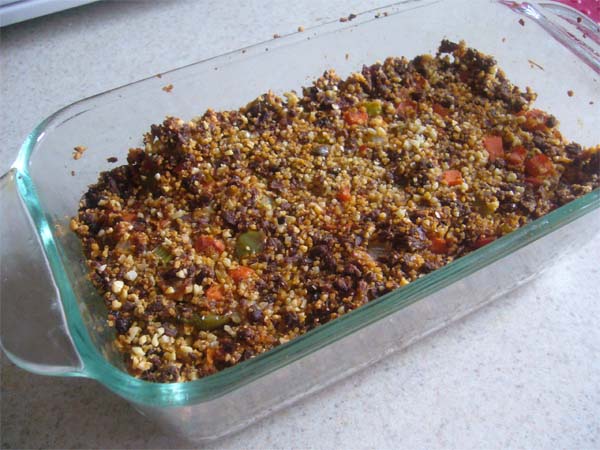
In comparison to the feats of athletics I saw this weekend, my accomplishments were rather small. In my own way, I had some good success. Here’s another vegan loaf recipe that’s a bit more “meaty” tasting.

Cast of Characters:

½ cup almonds (ground to a coarse meal)
2 TB olive oil One onion, diced
One large garlic clove, minced
One large carrot, peeled and grated
Two celery ribs, diced
One red or green pepper, diced
One cup baby bella mushrooms, coarsely chopped
2 cups Boca Ground “meat”
1 cup cooked whole wheat cous cous
1/4 – 1/2 cup vegetable broth
1 teaspoon mixed seasonings (whatever herbs and spices you like)
Freshly ground black pepper, to taste
1 tsp. salt

Use the same method as the lentil-veggie loaf and add only as much vegetable broth as is needed to bring the loaf together. This loaf only takes about 40 minutes to cook, although you can leave it in the oven for 5 extra minutes if you want the top to be very crispy. Divided into 8 slices, it comes out to about 116 calories and 10 grams of protein per slice. It is low in fat and carbohydrates too, but I don’t have the numbers with me right now. I’ll post them in the comments later if anyone shows interest.
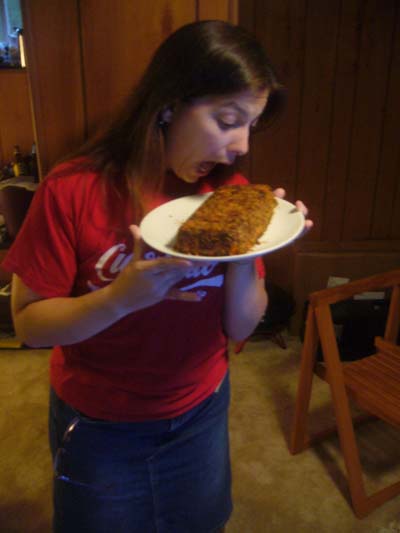
Here’s me deciding that a fork won’t be necessary…
In other news, I decided on a chocolate protein powder to experiment with. It’s by BSN and it’s called Lean Dessert (in chocolate fudge pudding flavor). It made really good ice cream—yum! I really like it, but I’m still trying out more samples because as powders go, it comes in a little bit low at 20g protein per scoop. I got a sample of Jay Robb’s whey powder at Vitamin Shoppe. That comes in at 25g protein per scoop and they only use milk from cows that have not been given hormones. To me that seems like a good thing. I have enough hormones of my own, thanks.

Also, looks like it’s back to the drawing board on the iron front. Remember that I mentioned I was due for blood work in August? Well, everything came back looking great with the exception of my ferritin (1), iron (9), iron saturation (2), and hematocrit (25%). It’s really hard not to get discouraged. Pushing more red meat into my diet doesn’t exactly thrill me because of the cholesterol factor, so fixing this issue will be about making good choices and creating new ways to sneak iron into recipes.

Safeway sells giant bags of frozen shrimp and scallops. I can toss those into my stir-fries along with vegetables like broccoli and red peppers that aid in iron absorption. I also plan to buy some bran flakes and molasses to make iron muffins. Another thought that crossed my mind was finding some young, mild calves or chicken livers, chopping them finely, and adding that to one of my protein loaves. Like I said, I’m going to have to get creative. It’ll probably mean giving up my beloved protein bars as snacks in exchange for something that is high protein AND high iron, like some tuna fish or a molasses-bran muffin. At any rate, I spent most of last evening researching high-iron recipes and I will most certainly post anything successful.

Even though I’m discouraged about my iron level, I have to remember that I’ve successfully raised my vitamin D and B vitamins, have normal liver functions, and have maintained proper levels of everything else. My goal now is to keep eating healthy and to raise my hematocrit as much as I can. I’ve said it before, but I truly believe writing down a goal is all the motivation we need sometimes, and this situation is no exception. I will fine tune my eating habits to focus on protein and high iron. Since I’m not a medical expert, I’ve also consulted a hematologist to help me monitor everything.

I hope everyone is having a wonderful start to their week and that the sun is shining wherever you are. Stay motivated and stay positive!

Ciao for now, friends.

Eat Your Veggies: Lentil-Veggie Loaf

3 Aug

Comfort food is a wonderful thing, and in my opinion, there’s nothing better than a good meatloaf. It’s tasty, high in protein, and makes enough for days of leftovers. However, some RNY post-ops have difficulty digesting meat and that can make it hard for them to meet their daily protein requirement. I’m fortunate enough not to have that problem, but here’s a recipe for my meat-intolerant friends. Bonus: It’s vegan friendly, too!

Lentil-Veggie Loaf

Cast of Characters:

½ cup almonds (ground to a coarse meal)
2 TB olive oil
One onion, diced
One large garlic clove, minced
One large carrot, peeled and grated
Two celery ribs, diced
One cup baby bella mushrooms, coarsely chopped
**2 cups cooked lentils
1 cup uncooked oat bran
1 teaspoon mixed seasonings (whatever herbs and spices you like)
Freshly ground black pepper, to taste
1 tsp. salt

Method:

Pre-heat an oven to 350 degrees Fahrenheit.

**To cook the lentils, place one cup of thoroughly rinsed red lentils into a pot with two cups of water. Let it come to a boil and then reduce to a simmer for about 45 minutes.

Begin by dicing all of the vegetables. Sauté the onions and garlic for a minute, and then add the rest of the vegetables, and sauté until they are slightly softened.


In a large bowl, combine the oat bran, flaxseed meal, almonds, herbs, and seasonings.
Add the lentils and sautéed vegetables, (don’t wash the sauté pan if you want to make gravy) and then mix/mash until the mixture is moist, soft, and can keep a shape. It should not be runny, but if it is, add a little extra oat bran to thicken it.
Thoroughly grease a loaf pan and press the mixture into it.
Bake for approximately 45 minutes to an hour (in my oven it took 50 minutes). The outside will be crisp, but the inside should remain somewhat moist. Yum!
Oh, and remember that sauté pan you left out for gravy? (I didn’t have any tonight, but I promise it’s good!) You can make a tasty pan gravy while the loaf is cooling a bit. If there’s any excess oil remaining in the sauté pan, drain it off, and then return the pan to the stove. Let it get warm over medium heat, and then remove just long enough to add ¼ cup of dry white wine before returning it to the stove. Scrape the browned bits off the bottom of the pan using a spatula, and then add ¾ cup of vegetable stock or broth. To thicken the gravy, bring the liquid to a boil and then add a slurry (1 tbsp. of cornstarch mixed with 2 tbsp. COLD water) while stirring vigorously. Reduce the heat to a simmer, and allow the gravy took cook for 5-10 minutes. Season with herbs and spices similar to those you added to the lentil-veggie loaf. Spoon the gravy over a slice and enjoy!

Enjoy the leftovers as a sandwich filling, try topping cold slices with different sauces (mustard, ketchup, salsa, marinara sauce…etc.) or even topping them with other sautéed vegetables. A combination of sweet and hot peppers sounds great to me. Be creative!

The recipe yields 8 generous slices with 153 calories, 5 grams of fat, 18 grams of carbohydrates, and 10 grams of protein each. It might be a low calorie meal, but it certainly sticks with you (I had a slice an hour ago and still feel quite full).

Tomorrow, I hope to make some new protein bars. Joe and I went out to dinner at Moe’s Southwest Grill (home of my new favorite 200 calorie taco!) last night and there happened to be a Trader Joe’s next door. Needless to say, I returned home with a bunch of new ingredients to try out.

We have some friends coming over to watch the Redskins/Colts game tomorrow night, so I’m also pondering what healthy snacks I could serve. I got some mushroom-asiago chicken sausages at TJ’s and I’m thinking they could come in handy. We shall see.

I hope everyone is having a lovely weekend. Mine has already been full of fun and pleasant surprises, including these:

Irises! My favorite flower. What can I say? I snagged a great guy.
Ciao for now, friends!

A Little Bit of Everything

1 Aug

There was a really excellent article on ESPN the other day by Eric Adelson discussing the magnitude of the challenge that Michael Phelps will face during the Olympics. Including preliminary races, semi-finals, and finals, he will swim 17 races in the span of nine days.

Here’s a link to the article: http://sports.espn.go.com/espnmag/story?id=3508530

This is the part I really wanted to quote though, because I’ve never quite been able to describe to anyone what swimming the individual medley is like. For those who don’t know, the IM is an event in which swimmers swim equal distances of all four strokes (butterfly, backstroke, breastroke, and freestyle). The longest race of that type I’ve ever competed in was the 200m version and I distinctly recall seeing black spots afterward—although it was one of the greatest adrenaline rushes I’ve ever felt. At any rate, here’s a paragraph from the article that explains what the 400m event feels like:

“Phelps begins with the most difficult event: swimming’s decathlon, the 400 individual medley. The race begins with 100 meters of butterfly, in which he must propel his body out of the pool, over and over, until he feels as if he’s doing squat jumps with two kids on his back. The fly requires an edge, almost an anger. ‘You have to be tougher, meaner,’ says 1992 gold medalist Mel Stewart. ‘If you don’t have a base of strength and stamina, you fade. You die.’

Next, the backstroke. Lie on your back, put ankle weights on and kick for a full minute. That’s what the backstroke feels like. By the end of these 100 meters, a swimmer’s quads and abs are shot. The race is half over.

Switch to breaststroke, Phelps’ weakest. He will struggle to hold form: back straight, elbows tight, head up, wrists snapping just so. His arms will whine and the field will close in and someone might even pass him, as Ryan Lochte did in the trials.

The freestyle leg will take anything Phelps has left. During breaststroke, muscles lock up. Still, he must sprint for 50 more seconds. Many swimmers drive the final 25 meters without lifting their head to breathe, to wring the final tenths out of the clock. At trials, Matt Grevers saw spots and felt his consciousness start to slip away. Phelps broke the world record to barely win the event at trials, and he called it ‘one of the most painful races of my life.’ He has 15 left.”

…And yet, some people commenting on ESPN continue to claim that swimming isn’t “a sport in the true sense.” What does that even mean? In order to find “the true sense” that this person was talking about I turned to the American Heritage Dictionary. I figured that if I found the definition of the word, I could then determine whether or not swimming fit the criteria. The first listing for “sport” came up as follows: “Physical activity that is governed by a set of rules or customs and often engaged in competitively.”

Well, I certainly came out of the pool breathing hard and feeling tired when I raced, so there’s the physical activity component. As for the next part, swimming most assuredly has rules, (i.e. touching the wall with two hands on certain strokes, no flutter kicking during butterfly or breastroke..etc). Lastly, judging from the endless number of swim meets I went to from ages 6-18, I’d say that it is “often engaged in competitively.”

Ladies and gentlemen, we have a sport! And now that I think of it, those very same principals apply to another sport that some people roll their eyes at even more:

Synchronized Swimming!

I think that synchronized swimming (and figure skating) often get put down as sports simply because when done properly, they look so beautiful and effortless. That’s how these people are trained. Team USA synchronized swimmer Kate Hooven said of the lack of respect, “It gets frustrating at times. Maybe we make it look too easy.”

Here’s an idea of what’s happening under the water for those swimmers. First of all, it’s an immediate disqualification if the bottom of the pool is touched. That means suspending the body in water while performing maneuvers which require breath control, balance, muscle control, and a big smile on your face. Part of the training regimen used to achieve this involves using 10 lb. weight belts and 2 1/2 lb. ankle weights during practice. Like most elite athletes, they devote 6-8 hours a day to their sport. While much of that time is spent in the water, they also do a lot of biking, running, yoga, and pilates to maintain flexibility and strength.

In other words, try treading water for 4 minutes, hold your breath during most of it, and add a host of underwater somersaults (in both directions) and then tell me if you can still determine which way is up. That’s nothing compared to what you’ll see done at the Olympics this year. I’d encourage everyone to try and catch the finals, because it’s bound to be an impressive display of athleticism and artistry.

All of this drama and fun starts a week from today. If there’s a specific event you don’t want to miss, here is the schedule of televised events.

I hope everyone had a wonderful week and that you’re looking forward to a relaxing weekend. Joe and I tried out the Wii Fit last night and I have to say, I’m just amazed at the technology that went into creating the game. The idea that the balance board wirelessly synchronizes with the system and can feel every little movement you make is just crazy to me. The game itself is truly a great step in the right direction. By being so active and interactive, it succeeds in encouraging exercise via fun games and tests. I particularly like the yoga, step aerobics, and the strength training. Joe is much better at the balance games than I am (haha, I know I’m a little clutzy). In any event, I’m really exciting to start tracking my progress with it and finding out if I do in fact get a little more “Fit.” My weekend will probably involve a lot of playing with my new toy (thanks Mom and Dad!).

This weekend also kicks off preseason football with the Hall of Fame Game. Indianapolis plays Washington, but the real focus here is the induction of this year’s Hall of Fame Class: Congratulations to Fred Dean, Darrell Green, Art Monk, Emmitt Thomas, Andre Tippett, and Gary Zimmerman. You can read more about their successful careers at www.profootballhof.com.

That’s all from me today. Again, have a wonderful weekend and remember to think positive! Ciao!

Learning a lesson the hard way

31 Jul

Warning: Long post ahoy!

I’ve talked a lot about learning valuable life lessons lately, and recently an interesting discussion came up on the ObesityHelp forums that got me thinking. My blog focuses on the positive because that attitude is what motivates me to continue living this lifestyle. That said, there are some lessons I’ve had to learn in a very hard and negative way.

The discussion on OH I am referring to comes up quite frequently and usually begins with someone asking, “Why do we need to take all of these vitamin supplements after surgery?” or, “Do we have to do it for the rest of our lives?” The short answers are “Because you don’t absorb all the nutrients from your food anymore,” and “Yes.”

This is why:

I was not always committed to this lifestyle the way that I am now. Last year, at almost 3 years post-op, I’d stopped losing weight and assumed that my body was settled at 175 lbs. I looked pretty good and felt alright for the most part. I was a little bit tired some days, but chalked it up to being a college student who was stressed. I’d become complacent about taking my vitamins and since my labs had been alright at my last check-up, I thought I didn’t need them. I’d slacked on my eating habits too. I wasn’t gaining any weight either, so I didn’t focus so much on eating protein and vegetables first at meals.

One day in early March I went over to my university’s health center for an annual exam, and oddly enough the woman who did it happened to specialize in gastroenterology. After hearing about my surgery and successful weight loss, she noted that I was looking a little pale. She thought it would be best to get a check up on my labs, so she took some blood and I went on my merry way.

Within hours, she called me back and demanded that I come see her the next day. It wasn’t just one thing, either. Everything was shot. I had no thiamin, B-12, folic acid, zinc, or vitamin D. Worst of all was my iron. My hematocrit (the percentage of blood volume occupied by red blood cells) was 23% (a normal female’s is between 37-48%), and my iron level was 2 (normal is between 60-160, usually higher in males). She impressed upon me that low levels of B vitamins could do neurological damage, that I was suffering from malnutrition, and I needed treatment immediately.

It hit me all at once. No wonder I’d stopped losing weight, my body was holding on to anything it could get. Suddenly my exhaustion and difficulty concentrating all made sense. The next day, she wrote me prescriptions for some high-intensity supplements, started a course of B-12 injections, and referred me to a hematologist for the iron problem. I’d tried several different iron supplements in the past, but they’d all made me so ill I couldn’t eat.

The hematologist she referred me to was one of the kindest people I’ve ever met. He listened patiently while I told him my history with iron supplements and then suggested I try a course of iron infusions along with an iron rich diet. He explained that the infusions would take several hours because they first give a Benadryl drip to subdue any allergic reactions, a Zantac drip to help with the nausea, a small test-dose of the iron to be sure that the body won’t reject it, and then finish with the actual infusion. All in all, it would take 2-3 hours.

After my second infusion, I was picking up my purse and trying to shake off the drowsy feeling from the Benadryl when I realized that something wasn’t right. My lips felt funny. I looked at the nurse and said, “I think something’s wrong.” After that, the room started spinning and everything turned blurry. Within a minute, there were about 8 people in the room. One kept telling me to keep looking at him. I was going into anaphylactic shock, and I just kept mouthing “please help me.” My blood pressure bottomed and everything went black for a minute before one nurse injected epinephrine into my right arm while another injected an antihistamine into my left. When I could finally breathe again, I just kept thanking everyone. My whole body hurt, but at least I was alive. My hematologist appeared, apologizing for what I’d gone through, but said we’d work on another plan after I felt better. They kept me at the hospital overnight in case I relapsed, which thankfully, didn’t happen.

The infusions did get my hematocrit up to 30%, but with iron supplementing out of the question after such a severe allergic reaction, all I could depend on was me being responsible enough to commit to an extremely iron rich diet. I also had to learn to give myself B-12 injections once a month because the doctors noticed that it helped my iron level go up. I remembered the promise I’d made to myself after having the RNY, to never live an unhealthy lifestyle again. I’d screwed up, but I vowed to get back on track.

It took months for my blood work to start coming back with average levels of most things. My iron was always a little bit low, but not dangerously so. I was also able to lose weight again, since I wasn’t starved for nutrients. Unfortunately, what I did to my body did have some lingering effects. I have a little bit of trouble remembering things that I’ve said and it can be hard to concentrate sometimes. I am fortunate that I came out mostly unscathed, because from what I’ve seen vitamin deficiencies do to some dear friends on OH, what happened to me was mild.

The point of that story is not to make anyone afraid. It is to spread awareness and remind patients that it doesn’t matter if you’re 5, 10, or 20 years out—it’s always important to supplement properly and have regular blood work check-ups (I’m due for one in August).

A tool I have found that helps to give me an idea of my nutrient intake is a program from www.fitday.com. Fitday itself is a food diary website, but in their downloadable program, it is possible to create reports that show how much of certain nutrients and vitamins you’re getting from food. Of course, I remain aware that I’m not absorbing all of that, but it does give me an idea of where I might need to add an extra supplement.

Four years ago, I promised that I would never live an unhealthy lifestyle again. It shouldn’t have taken a bad scare to remind me of that, but it did. Sometimes we have to learn things the hard way.

I learned that 3-4 chewable vitamins, B-100 complex, and vitamin D, along with a (delicious) iron rich diet and a B-12 shot once a month makes me feel fantastic. I wouldn’t have it any other way.

Flowers and Chocolate

29 Jul

What better way to begin a day than with some pretty flowers?

I hope you all had a lovely weekend. This past weekend, I was on a mission. It was a noble mission, and one that I undertook after careful consideration of the dangers and pitfalls. I had to rescue:

Yes, chocolate. An innocent victim thrust all too often into the grasp of high-fructose corn syrup and gobs of fat. Let me let you in on a little secret: Chocolate is so awesome that it doesn’t need either of those things to be good.

Determined to prove this, I was delighted when my package from http://www.greatprotein.com/ arrived last week. In it were samples of Ultimate Protein in chocolate, vanilla, and strawberry. Using the base directions from Shelly’s protein ice creams, I whisked together the following ingredients:

1 scoop chocolate protein powder
2 tbsp. sugar-free fat-free chocolate fudge pudding powder
1 cup 2% milk

My normal skepticism regarding protein powder was hanging around, but the bowl smelled so good I couldn’t help but try a taste. It was reminiscent of the chocolate milk from Turner’s dairy that my grade school cafeteria served. I began to think this one might even be tolerable as a drink! I flipped on the ice cream maker and wandered off to play video games with Joe.

25 minutes later, I could hear the churn slowing down and I knew that the mixture had firmed up. I got a plastic tub out and looked into the ice cream maker. But this was no ice cream! Shiny, dense, and rich in chocolate flavor, I had full blown gelato on my hands. I divided the batch into three small containers, but only two made it to the freezer to firm up (I wanted some soft serve).

Had I succeeded in rescuing chocolate? Here’s the verdict: Each serving contained 84 calories, 2 grams of fat, 4 grams of carbohydrates, and 10 grams of protein. A solid victory was achieved, and I think a large canister of Ultimate Protein is in my future…

But what if (unlike me), you don’t have protein powder hanging around? I know it’s not on most people’s shopping list, so I sought to make a healthy chocolate ice cream using readily available ingredients. Granted, it didn’t end up packed with protein, but it did make a larger volume (better for crowds) and still tasted great.

In a blender (you can use a bowl and a whisk if you’re feeling macho), combine:

1.5 packages sugar-free fat-free chocolate fudge pudding powder
1 cup 2% milk
1 tbsp. cocoa powder
1 twelve ounce can non-fat evaporated milk
2 eggs
1 tbsp. vanilla extract

Blend until the mixture is smooth and lump free. Pour the whole batch into an ice cream maker and churn for 25-30 minutes. Remove to a large plastic storage container and set in the freezer to harden (or eat it if you’re impatient like me).

The recipe makes about a half-gallon (8 cups). Here are the nutrition facts based on serving size:

1 cup serving: 98 calories, 2 grams of fat, 14 grams of carbohydrates, 6 grams of protein, and 7 grams of sugar.
1/2 cup serving: 49 calories, 1 gram of fat, 7 grams of carbohydrates, 3 grams of protein, and 4 grams of sugar.

So, have your ice cream and eat it, too! Chocolate doesn’t need so many helpers around. It can most definitely stand on its own without adding a whole lot of extra sweeteners or fats.

NOTE: The above ice creams become very hard when frozen. This is completely normal. Allow them to stand for 5-10 minutes before serving and they will return to a scoop-able state. Enjoy!

My agenda for the week mostly depends on what packages arrive. I’ve ordered some other protein powder samples that should arrive this week, and I’ve also FINALLY managed to find my birthday present: A Wii-Fit! It took awhile, but sniping on Ebay paid off in the end. Other than that, it’ll be a mish-mash of what ever pops into my head, so stay tuned. Ciao for now!

The Planning Principle (plus bonus cake!)

24 Jul

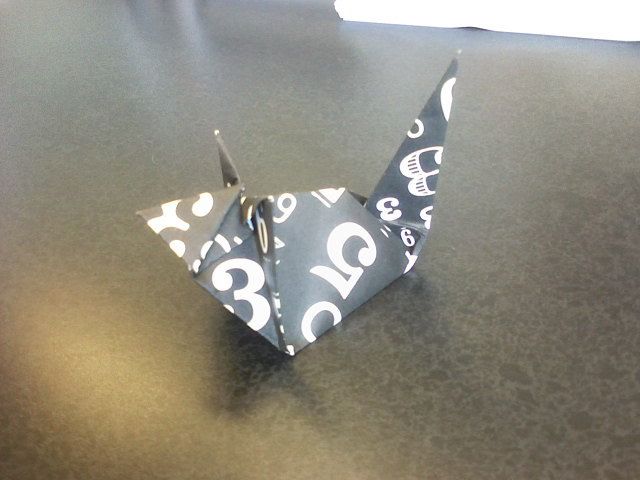
I call him the mouse that ran up the clock. He says good morning to all!

Yesterday, as I threw the last of my apple butter bars into my work bag it occurred to me that the evening ahead would call for copious amounts of baking in order to replenish my protein meal/snack supply.

After a fruitful trip to Harris Teeter, I was armed with the necessary ingredients and a few new things to experiment with. Dinner was first on the chopping block, and because I had plans for baking later I decided to keep it simple. Let me tell you, this is the best tortilla pizza yet. I’m calling it “Summer Pizza” because I honestly believe it’s at its prime when made with herbs and tomatoes picked straight from the garden.

I began by dicing up the first roma tomato from my vine and added fresh basil, fresh parsley, one diced baby bella mushroom, a teaspoon of olive oil, pinch of kosher salt, a grind of black pepper, dash of onion powder, and about a tablespoon and a half of my homemade marinara sauce. After mixing it all together, I let it sit on the counter for about 20 minutes to let all of the flavors come together. It smelled heavenly as I spooned it onto a multi-grain tortilla which I then topped with 1/4 cup of shredded part-skim mozzarella and a few small dollops of fat free ricotta. After ten minutes in a 425 degree oven, I was treated to one very delicious 200 calorie pizza. Yum!

Close-up for texture!


My plan for the evening was to make a batch of banana-nut protein muffins and a protein apple cake that I would cut into bars. While considering this, it reminded me of another important lesson that’s been drilled into me at this point: Plan Ahead.

When Joe and I had to stop in Breezewood for a bite to eat on our way to Pittsburgh (after being stuck in traffic all afternoon), we had a myriad of fast food options. While I don’t eat fast food very often, there is the occasional stop while traveling or night when I don’t feel like cooking or actively going out to dinner. I prepare myself by researching nutrition information on restaurant’s websites and making a list of the best options available. For instance, Wendy’s chili, or half of an oven roasted Twister wrap with no pepper-mayo from KFC. It’s surprising how well you can eat at most places if you simply plan ahead. If I’m invited to dinner somewhere that I can’t find something that fits my diet, I generally resolve to choose the healthiest option and eat only half of it. But I decide that in advance, because if I don’t then I continue eating because “it tastes good” and not because I’m hungry.

I apply the same planning principle to my everyday meals. I know how many calories I want to have during the workday and plan 2 meals and 2 snacks accordingly. My evening consists of another meal and snack with a total daily calorie count somewhere between 1,000-1,200 and a daily protein intake of 65-80 grams.

After doing some calculations, I knew that the banana-nut muffins would yield 8 decent sized muffins at 151 calories, 6 grams of fat, 12 grams of carbohydrates, and 8 grams of protein. They would be good for a filling snack. The apple cake would yield 6 bars at170 calories, 10 grams of fat, 15 grams of carbohydrates, and 10 grams of protein. Those would make a good breakfast or dessert treat with some protein ice cream.

The banana nut protein muffins were a delicious success (I just had one for a snack). You can find the original recipe at Shelly’s blog. The changes I made were to use a regular muffin tin, two tablespoons of SF caramel syrup and 1 tablespoon of SF vanilla syrup, replace one of the tablespoons of almond butter with a tablespoon of apple butter, and make a batch of 8 larger muffins (instead of 24 small ones). Because the muffins are larger, I also extended the cooking time to 18 minutes, or until the tops spring back when poked with a finger.

Then it was onto the apple cake. During my Harris Teeter excursion, I came across an apple type I hadn’t seen before, labeled as “Sweet Jazzy Apples.” Yes, yes it’s probably a marketing term for some apple I’ve already had, but I decided to give them a taste test anyway so I’d know if they’d make good applesauce for canning season in the fall. Anyway, you came here for apple cake, so here’s the recipe and method:

Neen’s Apple Cake Bars

1/4 cup almond flour
1/2 cup rolled oats
1/4 cup soy flour
1 scoop Nitro vanilla protein
pinch of salt
cinnamon
1/2 tsp baking soda
2 tbsp spiced apple preserves (I use homemade—if you buy, try to find all fruit preserves)
1 tbsp SF caramel syrup
1/2 apple, sliced
2 tbsp almond butter
1 egg
2 tbsp no sugar added apple butter
1/2 graham cracker’s worth of crumbs

Set your oven to 350 degrees.

Whisk almond flour, half of the rolled oats, soy flour, half of the protein powder, baking soda, cinnamon and salt. Add the syrup and preserves and mix until combined. Set aside.

In a separate bowl, beat the almond butter with the egg until smooth.

Combine the two mixtures and then add the other half of the protein powder and the other half of the oats. The batter will be very sticky, so oil whatever you’ll be using to spread it in the pan. I just spray my hands with non-stick spray.

Line a loaf pan with aluminum foil or parchment paper. If using aluminum foil, be sure to spray it with non-stick cooking spray. Spread the batter evenly in the pan and then top with apple slices. Spread the apple butter over the apple slices, creating an even glaze.

Bake the cake for 20 minutes and then sprinkle the graham cracker crumbs over the top. Bake 5 more minutes and then remove from the oven.

After the cake cools, remove it from the pan (this is where the parchment/foil really comes in handy) and cut into 6 bars.

Wrapped in plastic, they’ll keep on the counter for 4-5 days. For longer storage, keep them in the fridge for up to two weeks.

In light of what I’ve shared about planning ahead, here is my food plan for the day:

Breakfast: 3/4 Luna Chocolate Pecan Pie protein bar (it was very good—a bit sweet for my taste)
Morning snack: Banana nut protein muffin
Lunch: Deli turkey, fresh tomato, and a sprinkle of cheddar cheese wrapped in a large lettuce leaf.
Afternoon snack: Apple protein cake bar
Dinner: Thin cut loin pork chops, lightly breaded and sautéed hot and fast in olive oil.
Evening snack: NSA fudgesicle or a protein bar

I also plan to buy my books for school and beginning my research for the fantasy football draft (I’ve been slacking big-time).

If you have a plan or goal for anything today, (work, food, school, exercise…etc.) share it in the comments section! It’s worth giving some thought to, because sometimes a plan is the only motivation needed to get things done. Ciao for now, friends!